Can You Sleep With Your Eyes Open?
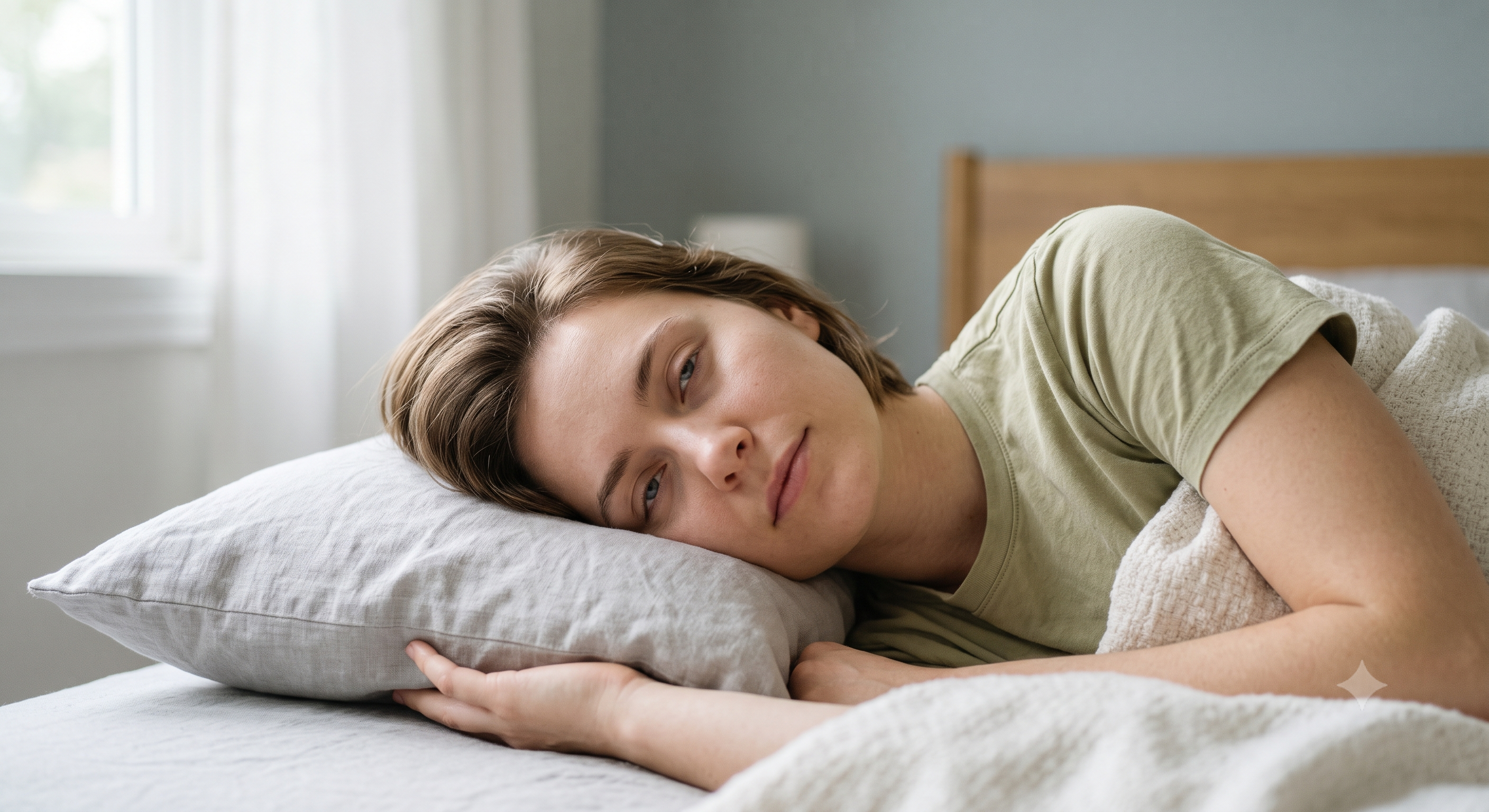
Yes, some people sleep with their eyes partly or fully open, a condition often called nocturnal lagophthalmos. The brain can still move through normal sleep stages while the eyelids fail to seal, so real sleep and open eyes are not mutually exclusive — though dry, irritated eyes are the main downside.
The clearest way to think about sleeping with your eyes open is the Seal-vs-Stage framework: whether your eyelids physically seal shut is a separate question from what sleep stage your brain is in. A person can be deep in a normal sleep cycle while the eyelid muscles simply fail to close the gap completely, leaving a sliver — or the whole eye — visibly open. It looks alarming to a partner watching from across the bed, but it does not necessarily mean the sleeper is any less asleep.
This condition is known clinically as nocturnal lagophthalmos, from the Greek for "hare eye" (hares were historically believed to sleep with their eyes open). It reflects an incomplete eyelid seal during sleep rather than a distinct sleep disorder of the brain itself. It is often noticed by a bed partner long before the sleeper is aware of it, since a sleeping person typically has no sensation that their eyes are still partly exposed.
Normal sleep is organized into repeating cycles of non-REM and REM stages, and the eyes behave very differently across them. During REM sleep, the body enters a state of near-total muscle atonia — the muscles go slack so the body does not physically act out dreams — while the eyes themselves move rapidly beneath closed lids. When the eyelid's own closing mechanism doesn't fully engage, that same drop in muscle engagement can keep the lids from sealing shut rather than easing them closed.
For most sleepers the eyelids close and stay closed without any conscious effort, because the muscle and nerve signals that control the eyelid work together automatically. When that coordination is incomplete, a gap can persist through the night regardless of which sleep stage the brain is cycling through. This is a mechanical eyelid issue layered on top of otherwise ordinary sleep architecture, not evidence that the sleep itself is shallower or lower quality.
The phrase "sleeping with one eye open" is older and more figurative than nocturnal lagophthalmos. It is commonly used to describe staying lightly vigilant or on guard while resting — the sense that part of you never fully lets go. The expression borrows from certain animals and marine mammals that rest one half of the brain at a time so that one eye can remain open and watchful for predators, a strategy unrelated to human sleep biology.
In humans, "one eye open" is not a recognized separate sleep stage or a literal split-brain state. It is generally shorthand for an unsettled, easily-interrupted kind of rest — the sort of light, watchful sleep a new parent or someone in an unfamiliar or unsafe environment might describe. If someone is describing a literal, physical gap in one eyelid during sleep rather than a feeling of vigilance, that points back to nocturnal lagophthalmos rather than a true "one eye open" state.
Covering the eyes when sleeping — with a sleep mask, blackout curtains, or simply a hand or blanket — mainly addresses light exposure rather than the eyelid-seal issue itself, though a soft eye mask can also help keep the eyelid surface protected and slightly more moist overnight. Light is the primary cue the brain's internal clock uses to time sleep: light-sensitive cells in the retina detect brightness, particularly blue light around 480 nm, and relay that signal to the brain's master body clock.
Artificial light at night can suppress the release of melatonin, the hormone tied to that internal clock, and shift the timing of sleep. Reducing light reaching the eyes — by covering them or dimming the bedroom — can support the body's natural nighttime melatonin rhythm. For someone whose eyelids don't fully close, a well-fitted mask can also act as a light-blocking, moisture-preserving barrier over the exposed part of the eye through the night.
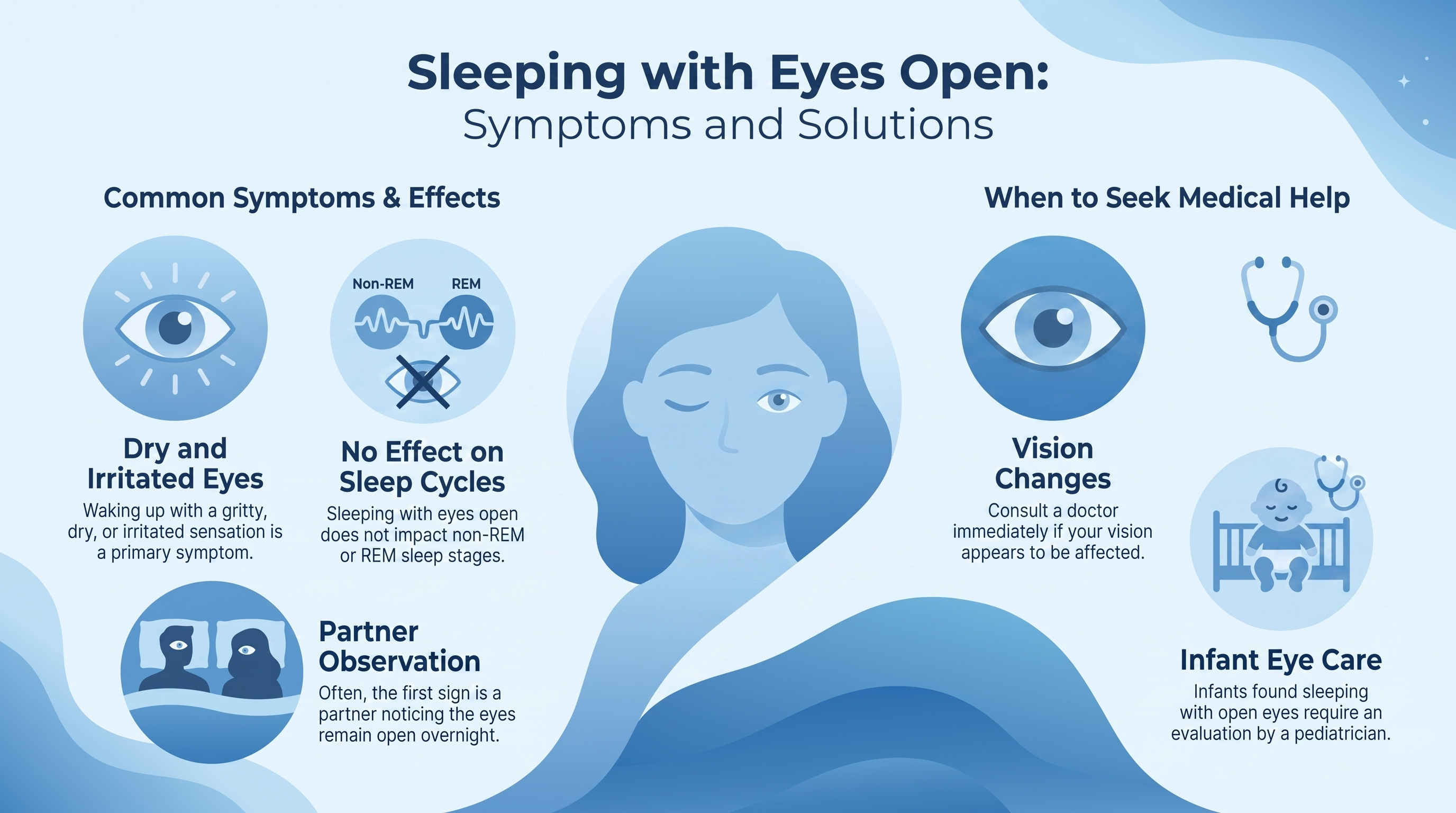
The main risk is to the eye's surface rather than to sleep quality. An eye that isn't fully covered overnight is exposed to open air for hours, which can leave it feeling dry, gritty, or irritated upon waking. Over time, repeated overnight exposure can be uncomfortable enough that people seek an eye specialist's advice, particularly if a partner has confirmed the eyes are staying open regularly.
There is no indication in the current research base that an open-eyelid gap by itself changes how the brain cycles through non-REM and REM stages. The concern is localized to the eye surface, not the underlying architecture of sleep.
Consider an eye doctor visit if any of the following apply:
An eye specialist can assess how completely the eyelids close and suggest protective options; this article is not a substitute for that evaluation.