Baby Sleep Schedule by Age (Newborn to Toddler)

Newborns need about 14-17 hours of sleep a day, infants 4-12 months need about 12-16 hours, and toddlers 1-2 years need about 11-14 hours (CDC). Naps gradually shrink from several a day to one, while nighttime stretches lengthen. Always place a baby on their back on a firm, flat surface to sleep.
A baby sleep schedule is not one fixed timetable — it is a rhythm that shifts every few months as a baby's nervous system matures. The clearest anchor point is the CDC's 24-hour sleep range by age: newborns (0-3 months) need about 14-17 hours, infants (4-12 months) need about 12-16 hours, and toddlers (1-2 years) need about 11-14 hours, counting naps and nighttime sleep together. Treat any specific nap count or clock time as a general guide, not a rule, since individual babies vary. For the sound environment around naps and bedtime, see best noise machines for sleep and baby sleep music.
By around 4 months, a baby is in the infant range (4-12 months), where the CDC-cited 24-hour sleep need is about 12-16 hours. This age is often when parents notice sleep becoming less predictable for a stretch, as the sleep-wake system continues developing. Naps are still frequent and shorter than they will be later, and nighttime sleep is typically broken into multiple stretches rather than one long block.
A consistent pre-nap and pre-bedtime routine — the same order of calm steps each time, in a dim, quiet room — helps cue the body that sleep is coming, even before a baby can tell time. Because this age still falls under the CDC's safe sleep guidance, always place the baby on their back on a firm, flat mattress with no loose bedding, pillows, or soft objects in the sleep space.
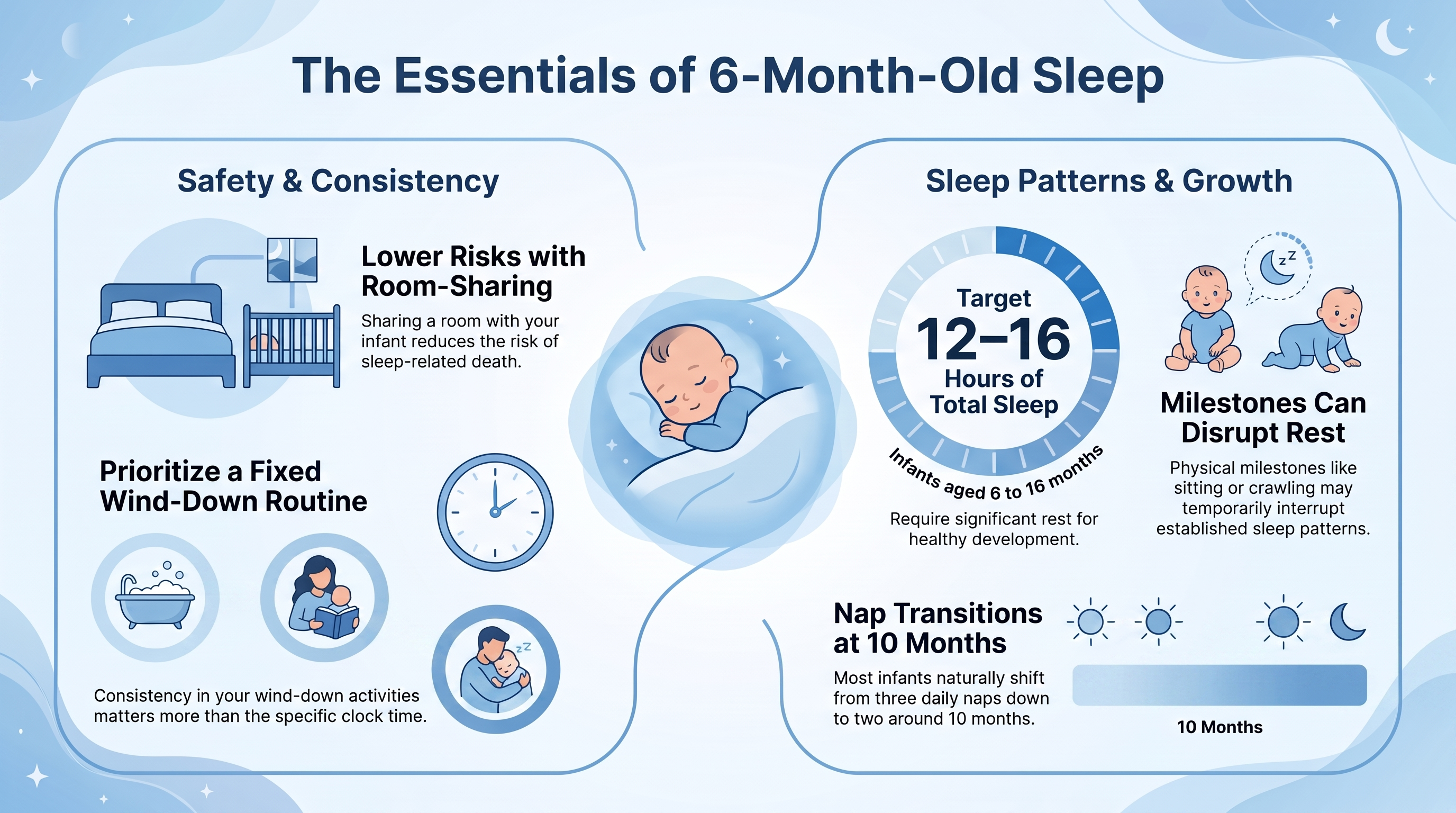
At 6 months, a baby remains in the 4-12 month infant range, so the 24-hour target is still roughly 12-16 hours of combined nap and nighttime sleep. Many families find that naps start consolidating into a more predictable pattern around this stage, with longer stretches at night becoming more common, though the exact timing varies widely from baby to baby.
A 6 month old sleep routine benefits from consistency more than precision — a fixed sequence before sleep (dim lights, a calm activity, the same short routine) matters more than hitting an exact clock time. Room-sharing without bed-sharing is recommended safe-sleep practice at this age and can lower the risk of sleep-related infant death.
An 8 month old is still within the 4-12 month infant sleep range (about 12-16 hours across 24 hours). Many babies this age are working through developmental milestones like sitting or crawling, which can temporarily disrupt an otherwise settling routine. Keeping the same wind-down sequence for naps and bedtime helps sleep stay anchored even through these temporary disruptions.
A 10 month old sleep schedule still falls in the 4-12 month infant category, with a 24-hour need of roughly 12-16 hours. By this point, many babies have moved toward two naps a day rather than three or more, though the shift happens gradually and on its own timeline for each child. Consistency in the pre-sleep routine remains the most reliable lever a caregiver has, since exact nap timing will keep shifting for a few more months.
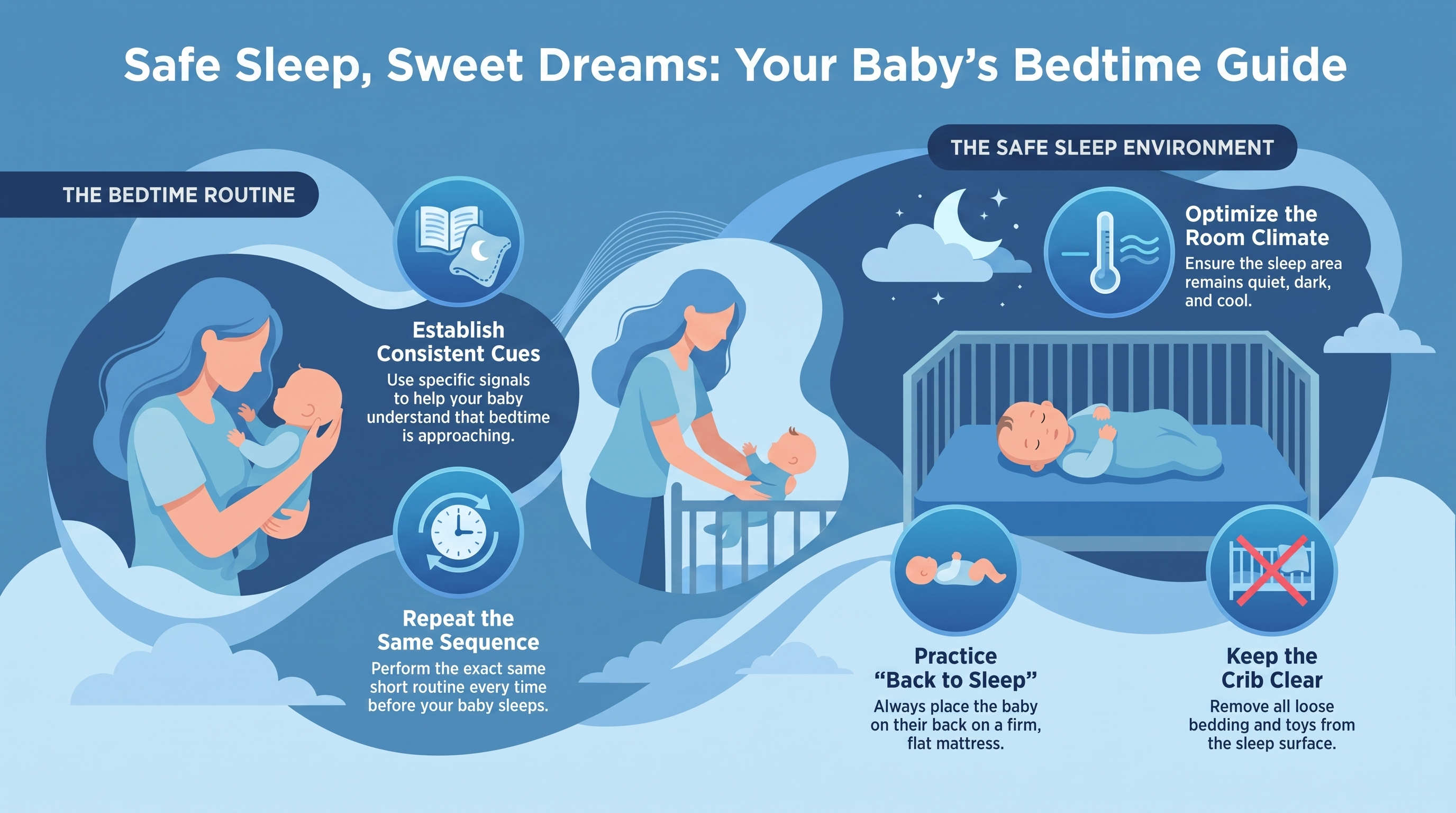
Across the whole 4-12 month infant window, the CDC-cited total is about 12-16 hours in a 24-hour day, and the general trend is fewer, longer naps as the months pass along with gradually longer nighttime stretches. Rather than memorizing a specific schedule for every week of a baby's first year, it helps to think in terms of a repeatable framework.
Call it the Cue-Routine-Environment approach: a consistent cue (like dimming lights or a specific phrase) signals that sleep is coming, a short repeatable routine (feeding, a calm activity, settling into the crib) follows the same order every time, and the sleep environment stays quiet, dark, and appropriately cool. This structure can flex as nap counts and durations shift with age, without needing to be rebuilt from scratch every few weeks.
Safe sleep practices apply throughout the entire infant period: always place the baby on their back, use a firm flat mattress with a fitted sheet only, and avoid loose blankets, pillows, bumpers, or soft toys in the crib. The CDC notes that room-sharing without bed-sharing can lower the risk of sleep-related infant death by up to 50%, and the "Safe to Sleep" campaign has been associated with more than a 50% drop in SIDS incidence since it began in 1994.
A 1 month old is a newborn (0-3 months), with a CDC-cited 24-hour sleep need of about 14-17 hours. At this stage, sleep is largely driven by feeding needs rather than a clock-based routine, and waking every couple of hours around the clock is typical. A structured schedule is less useful here than simply following the baby's cues while keeping every sleep surface consistent with safe sleep guidance.
Dressing a baby for sleep is about layering for room temperature rather than adding extra bedding. Because loose blankets are a safe-sleep hazard in the crib, many caregivers use a wearable blanket or sleep sack instead of a loose blanket, paired with a breathable base layer appropriate for the room. The crib itself should stay minimal — a firm, flat mattress and a fitted sheet, with no pillows, bumpers, or soft toys — regardless of how the baby is dressed. If a room runs warm or cool, adjusting the layer under the sleep sack is generally easier to manage than adjusting bedding in the crib.
Bring safe-sleep questions and ongoing concerns about a baby's breathing or sleep to a pediatrician. Reach out if:
The American Academy of Pediatrics publishes safe sleep guidance that a pediatrician can walk through with you in detail.
A 12 month old sits right at the edge of the infant and toddler ranges. Just under a year, the CDC's infant total of about 12-16 hours still applies; just past the first birthday, a child moves into the toddler range of about 11-14 hours across 24 hours. In practice, this is often a transition period where two naps a day are still common but a single longer nap is beginning to take shape for some children.
A sleep routine for a 12 month old benefits from keeping the same Cue-Routine-Environment structure used earlier in infancy, adjusted for a slightly later bedtime and fewer, longer naps as the toddler pattern emerges. There is no single correct nap count at this age — the right number is whichever supports full nighttime sleep without the child becoming overtired before bed.
An 18 month old is in the toddler range, with a 24-hour sleep need of roughly 11-14 hours. Many toddlers at this age are still napping once or twice a day, and the transition toward a single afternoon nap is common territory during this stretch, though timing varies by child. A predictable bedtime routine remains one of the most consistent tools for supporting nighttime sleep through this transition.
Toddlers aged 1-2 years need about 11-14 hours of sleep in a 24-hour period, per the CDC. By this stage, most children have settled into one nap a day rather than two, paired with a longer, more consolidated stretch of nighttime sleep. A consistent bedtime and wake time — even on weekends — helps anchor this rhythm, since toddlers' internal sleep-wake systems respond well to predictable timing.
Toddlerhood is also when sleep resistance often becomes more noticeable, since toddlers are more aware of separation and more capable of protesting bedtime. A calm, unhurried wind-down routine and a dark, quiet, appropriately cool room continue to be the most reliable supports, the same core environment principles used throughout infancy.
Sleep patterns for 2 year olds typically include one afternoon nap plus a full night's sleep, together totaling the toddler range of about 11-14 hours. Night waking becomes less frequent for most toddlers by this age, though occasional disruptions from teething, developmental changes, or schedule shifts (like travel or illness) are common and not usually a sign of a lasting problem. If a 2 year old's sleep pattern shifts and stays disrupted for an extended period, especially alongside other symptoms, it's worth mentioning to a pediatrician.