Baby Sleep Problems: Bassinet, Teething and Won't Sleep

Most baby sleep problems — resisting the bassinet, only sleeping when held, fighting sleep, or waking more during teething — trace back to a small set of causes: startle reflex, a strong preference for contact, overstimulation, or gum discomfort. A consistent routine and safe sleep basics (back sleeping, firm flat surface, room-sharing) address most of them.
Sorting out baby sleep problems is easier with one simple framework: the Comfort-Gap check. Every common problem below — the bassinet refusal, the baby who only sleeps in arms, the overtired baby fighting sleep, the teething night-waker — comes down to a gap between the comfort a baby had a moment ago (being held, moving, feeding) and the comfort of the sleep space they are moved into. Closing that gap, without compromising on safe sleep basics, is the throughline for every section below. If your baby's schedule itself feels off, pair this with baby sleep schedule by age.
Whatever the specific problem, the sleep space itself should always follow the same safety basics: babies should be placed on their back to sleep, on a firm, flat mattress with no soft bedding, and room-sharing (not bed-sharing) is associated with a sleep-related-death risk reduction of up to 50%. Since the "Safe to Sleep" campaign launched in 1994, sudden infant death syndrome (SIDS) incidence has fallen more than 50%.
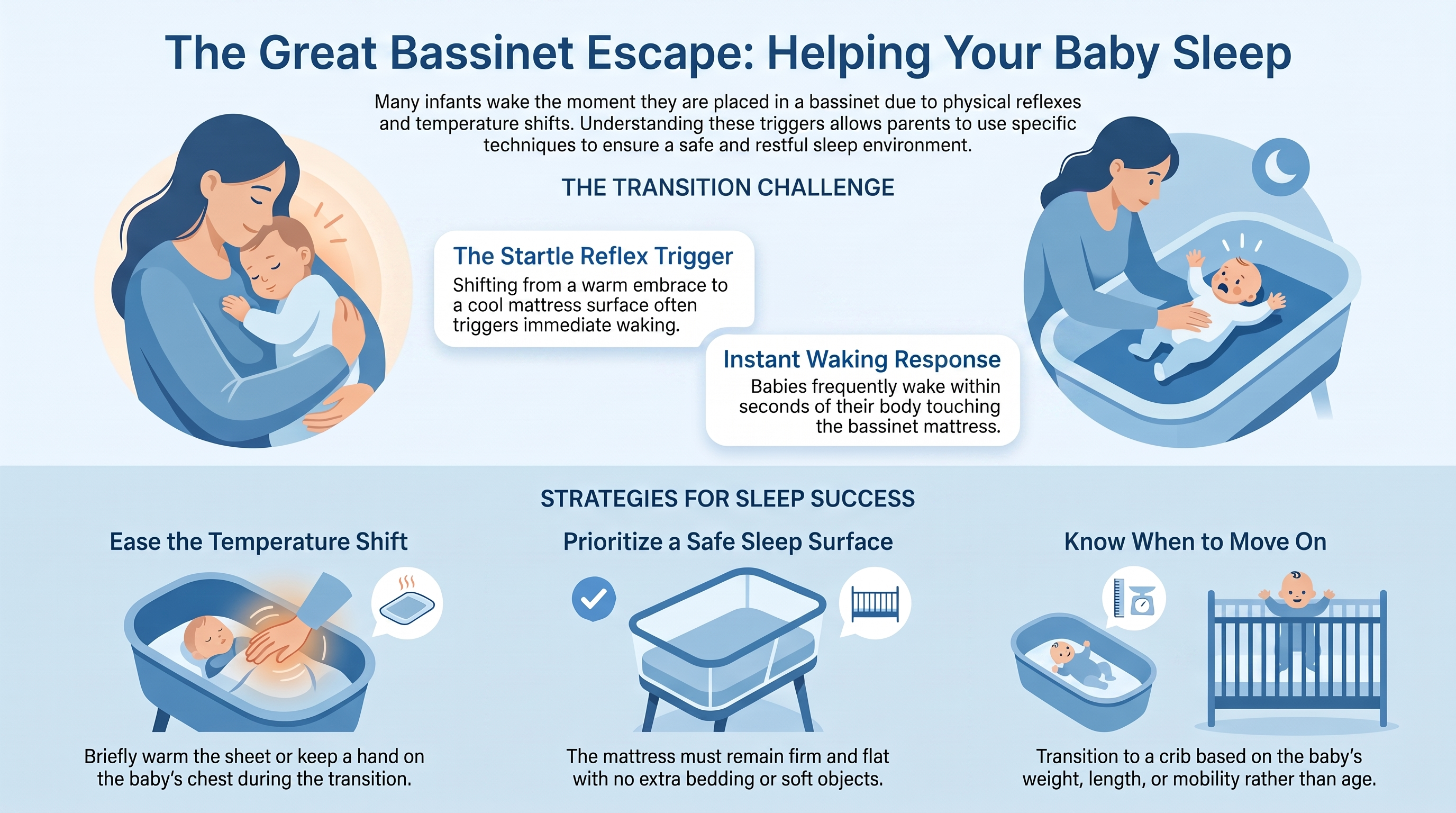
A baby who sleeps soundly in arms but wakes within seconds of touching the bassinet mattress is one of the most common frustrations new parents describe. Part of the reason is physical: the sudden change from a warm body to a flat, cool, firm surface, combined with the loss of contact, can trigger a startle reflex that jolts a lightly sleeping baby awake. The bassinet mattress itself must stay firm and flat, without soft bedding, bumpers, or inclined surfaces, as part of safe sleep guidance — so the fix has to work with that constraint, not around it.
Common approaches parents use include warming the sheet briefly before placing baby down, keeping a hand on baby's chest for a few extra seconds after the transfer, and building a short, predictable wind-down routine so the bassinet becomes associated with the calm state that follows, not a sudden change. None of these guarantee an instant fix — bassinet resistance is often a phase tied to a baby's developing startle reflex and nervous system, and it typically eases with time and consistency rather than any single trick.
There is no single fixed age at which every baby must switch from bassinet to crib. In practice, families move on once the baby approaches the bassinet's stated weight or length limit — these limits vary by manufacturer and product — or once the baby starts pushing up on hands and knees or shows signs of rolling, since a bassinet's smaller, stationary design is intended for a baby who is not yet mobile. Whichever sleep space is used next, the same safe sleep basics apply: firm, flat mattress, no soft bedding, and always placing baby on their back. See co-sleeping for guidance if you are considering a bedside sleeper as a bassinet alternative.
Moving from bassinet to crib is its own transition, and many of the same Comfort-Gap ideas apply: a consistent pre-sleep routine, a room that feels familiar (same room-sharing setup, similar sound environment), and giving the change a few nights to settle rather than expecting an immediate switch. A steady white-noise style background, discussed further in best noise machines for sleep, is one way some families keep the sound environment consistent across the bassinet-to-crib move. As with any sleep surface, the crib mattress should be firm and flat with no soft bedding, and baby should be placed on their back.
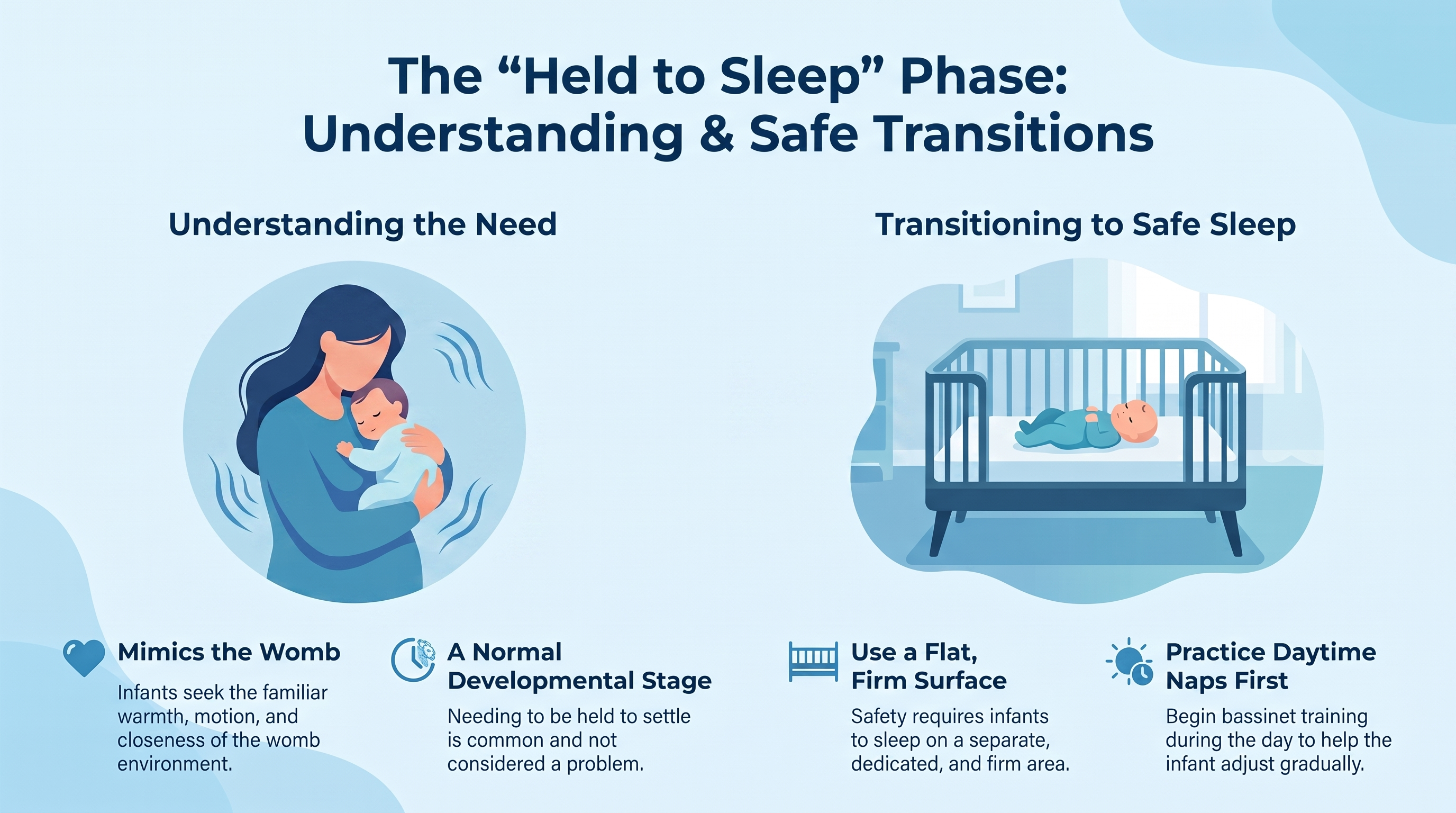
It is genuinely common, especially in the newborn stretch, for a baby to settle only while being held. The motion, warmth, heartbeat sound, and closeness resemble the environment baby just spent months in, so it is not surprising that an unfamiliar, still, flat surface feels like a downgrade by comparison. For many families this is a normal developmental stage rather than a sign that something is wrong — but it is also genuinely exhausting, and safe sleep guidance is clear that any sleep a caregiver is not actively and safely supervising should happen on a separate, flat, firm surface, not in arms, on a couch, or on a sitting device.
Practical ways families narrow the Comfort-Gap here include practicing daytime naps in the bassinet first (when stakes and fatigue are lower), using the same calming steps every time right up to the moment of the transfer, and accepting that this stage, while draining, is often temporary and tends to ease as babies grow and their startle reflex matures.
Most sleep resistance is developmental, not medical. Talk with your baby's pediatrician if you notice:
Bring these questions to a well-baby visit or call the office directly if a symptom seems urgent.
A baby fighting sleep — rubbing eyes, crying, arching, or getting more wound up the more tired they get — is often overtired or overstimulated rather than simply "not tired." Past a certain point of tiredness, a baby's body can produce stress hormones that work against settling, which is part of why an overtired baby can seem to have more energy at bedtime, not less. Being in a new or highly stimulating environment right before sleep, or being kept awake past the body's natural readiness window, can make it noticeably harder for a tired baby to wind down.
A predictable, low-stimulation lead-up to sleep — dim light, quiet or gentle consistent sound, the same handful of steps in the same order — gives a baby's nervous system a clear signal that sleep is coming, which tends to reduce the fight even when it cannot eliminate it entirely. Consistent background sound is one piece some families use here; see baby sleep music and colored noise for sleep for more on that option.
When bedtime resistance, short naps, or frequent night waking persist despite a consistent routine, some families work with a baby sleep consultant. A sleep consultant typically helps build an age-appropriate schedule and routine and troubleshoots specific sticking points like fighting sleep or bassinet refusal. A consultant is not a medical provider, so any concern that could be medical — breathing changes, illness, unusual patterns — should go to your baby's pediatrician first, with a consultant used for the routine and habit side of things.
Many parents notice more night waking and fussier bedtimes around the time a new tooth is coming in, and gum discomfort is the commonly cited reason. Because this is usually a temporary stretch tied to a specific tooth breaking through, the most reliable approach tends to be keeping the existing bedtime routine as consistent as possible rather than introducing new sleep habits during a rough patch, since new habits introduced during teething can be harder to undo once the discomfort passes.
Sticking to safe sleep basics matters just as much during teething as any other time: back sleeping, a firm flat mattress, and no soft items, teethers, or objects left in the sleep space. If a teething night is particularly hard, a brief return to more hands-on comfort followed by placing baby back down awake, rather than a full departure from the routine, is a common middle ground families use.
Parent reports vary here, and that variation is itself the honest answer: some babies sleep more than usual while teething, as if their body is coping with the discomfort by resting more, while others sleep noticeably less and wake more often both during naps and overnight. Neither pattern signals a problem on its own — both are commonly described, and sleep typically settles back into the baby's usual pattern once the tooth has come through.
Because the day-to-day pattern can shift during teething, it can help to keep expectations flexible for that stretch rather than assuming a single rough night means a lasting regression. If disrupted nights continue well past when a tooth has emerged, it is reasonable to revisit the routine using the same Comfort-Gap ideas covered above, or to check whether the base schedule in baby sleep schedule by age still fits your baby's current age and needs.