Baby & Infant Sleep Music and Lullabies
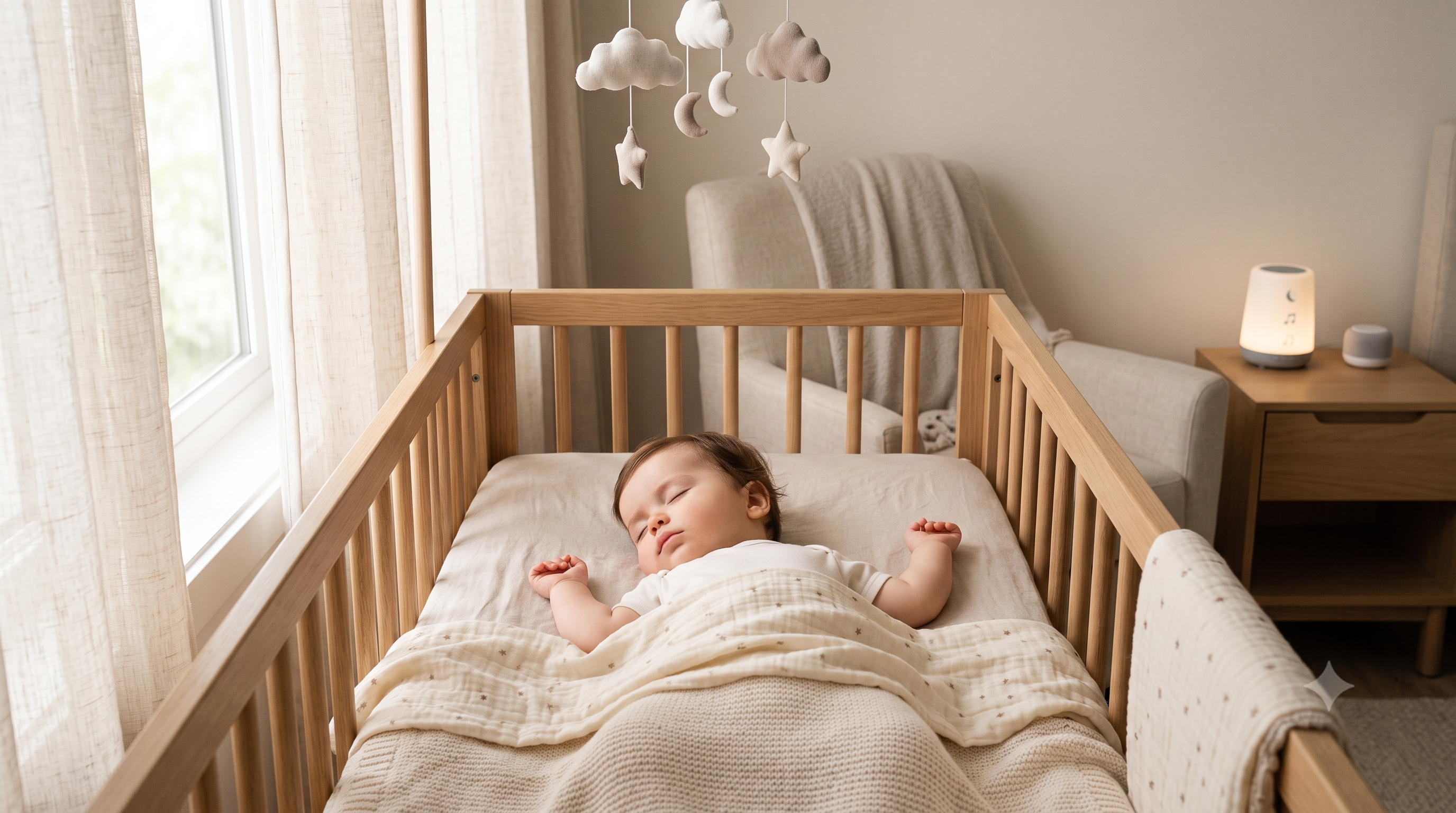
Infant sleep music and lullabies work best as one steady, low-volume cue inside a consistent bedtime routine. White noise mainly masks disruptive sounds; pink noise shows early, limited evidence of deepening slow-wave sleep. Whatever sound is used, safe-sleep basics — back sleeping, an empty crib, a device placed away from the baby — still come first.
Choosing infant sleep music is easiest with one simple framework: Mask vs. Enhance. Most sleep sounds parents reach for, from a fan to a lullaby playlist, work by masking — covering sudden noises so they are less likely to wake a sleeping baby. A smaller category of sound, weighted toward lower frequencies and known as pink noise, has been studied for a different, still-emerging role: potentially enhancing slow-wave sleep itself rather than just covering up disruptions. Knowing which job a given sound is actually doing helps set realistic expectations, and it matters more than the specific song or playlist a family picks. For the sleep stage pink noise research is most associated with, see deep sleep, and for baseline sleep-duration targets by age, see how much sleep do I need.
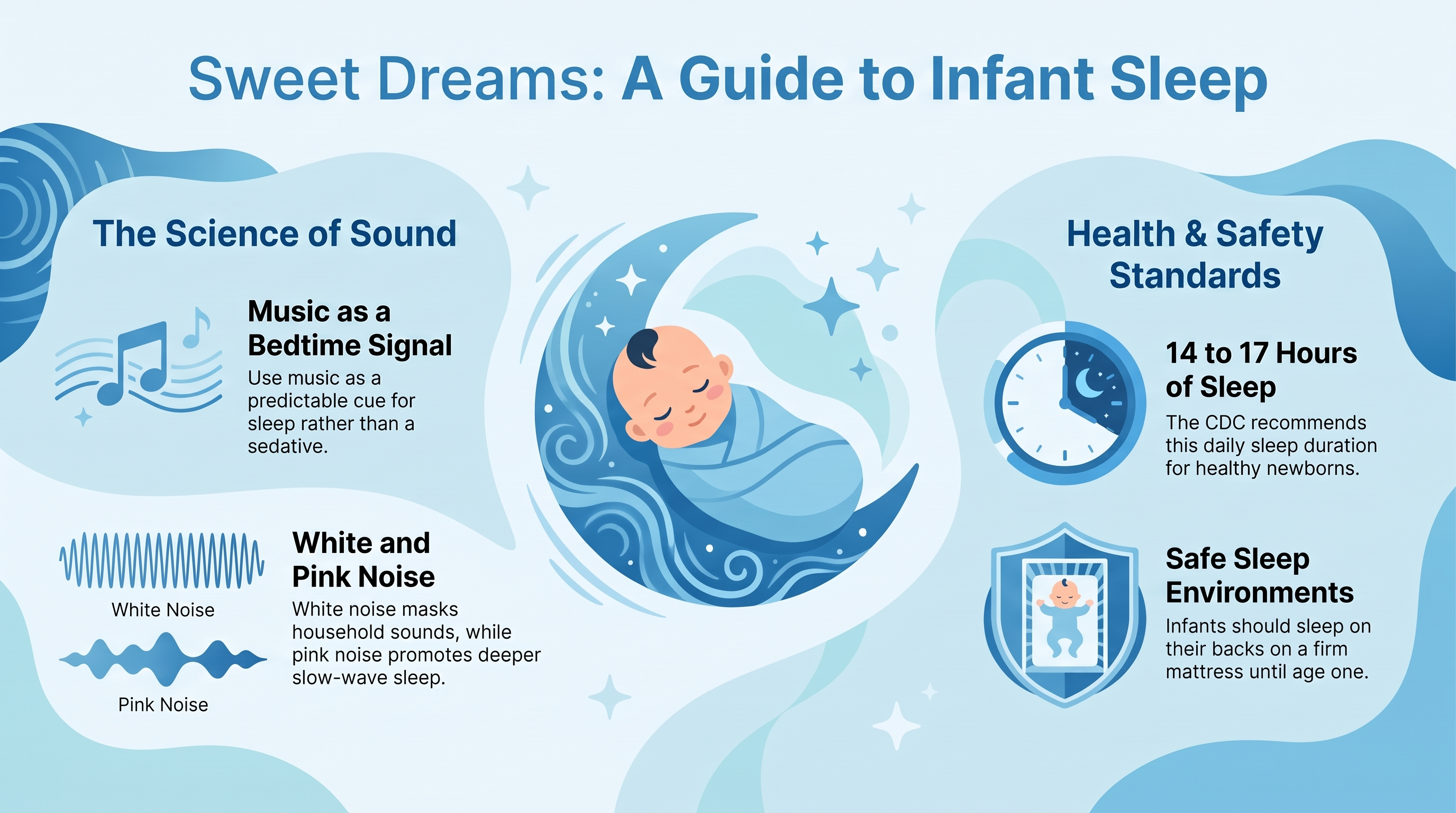
Infant sleep music is most useful as a predictable signal, not a sedative. A baby's total sleep need does not change based on what is playing in the background: the CDC recommends 14–17 hours a day for newborns (0–3 months) and 12–16 hours for infants (4–12 months), including naps. Music or a lullaby is one piece of the wind-down that helps a baby recognize bedtime is starting, alongside dimmer lights and a calmer pace.
The sound science behind why this can help is limited but consistent. White noise, such as a fan or a steady hum, works mainly through masking — it covers sudden household noises like a door closing or a sibling talking, which can otherwise startle a baby out of sleep, though it has not been shown to improve sleep quality on its own. Pink noise, which weights lower frequencies more heavily, has shown a different pattern in small, preliminary studies: when timed with the brain's own rhythms, it has been linked to more slow-wave sleep and better memory consolidation. That research is still early and was not conducted specifically in infants, so it is worth treating as a promising direction rather than a settled answer.
Whatever sound is used, it should sit alongside — not replace — basic safe-sleep practice. Babies should be placed on their back to sleep until age one, on a firm, flat mattress with no soft bedding, and never on a sofa or sitting device. Room-sharing without bed-sharing has been associated with up to a 50% reduction in SIDS risk, and any sound machine or playback device should be kept out of the crib and away from cords or loose attachments. Since the "Safe to Sleep" campaign began in 1994, SIDS incidence has fallen by more than 50%, underscoring how much these basic placement and environment choices matter alongside any bedtime routine.
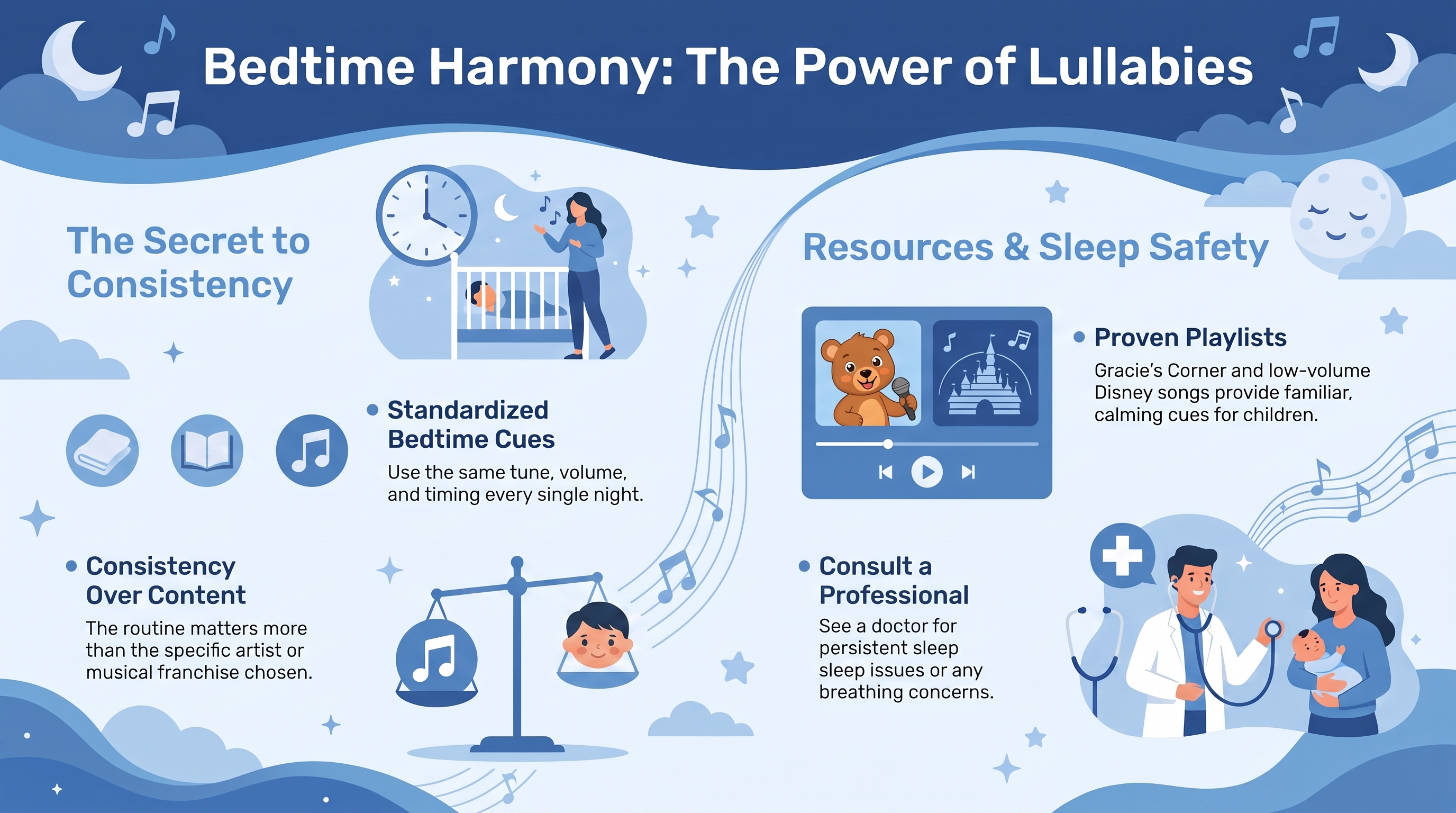
A lullaby is the oldest version of infant sleep music: a simple, repeated melody, traditionally sung live by a caregiver, meant to soothe a baby toward sleep. Modern recorded lullabies and children's sleep playlists serve the same function but add consistency — a baby hears the same tune, at the same volume, at the same point in the routine, every night. That repetition is the part doing the work, more than any particular song choice.
Gracie's Corner is a children's music and animation brand whose catalog includes bedtime-themed songs that have become a popular choice for toddlers and preschoolers as part of an evening wind-down. As with any children's sleep song, it functions best as one predictable, calming piece of a broader routine rather than a stand-alone fix for sleep problems — keep the volume low and the device placed safely away from the crib.
Disney-branded lullaby and sleep-music playlists are used the same way as other calming children's music: a low-volume, familiar cue that bedtime has arrived. Nothing about the Disney branding changes infant sleep safety — the same basics apply regardless of what is playing, including back sleeping, an empty crib, and a playback device kept outside the crib itself.
Children's sleep music is the broader modern category that lullabies, Gracie's Corner songs, and Disney playlists all fall under: recorded, repeatable audio built around a calm bedtime mood rather than the fast tempos of daytime kids' content. For a toddler or older infant, the specific artist or franchise matters far less than whether the same track or playlist is used consistently, at a steady low volume, as part of the same nightly sequence.
Sleep music and lullabies are not a medical intervention, and safe-sleep questions are best discussed with a pediatrician. Talk to a doctor if:
The American Academy of Pediatrics recommends discussing any safe-sleep question, and any persistent breathing or sleep concern, directly with your child's pediatrician rather than relying on general guidance alone.