Sleep: Synonyms, Meaning and Words That Rhyme
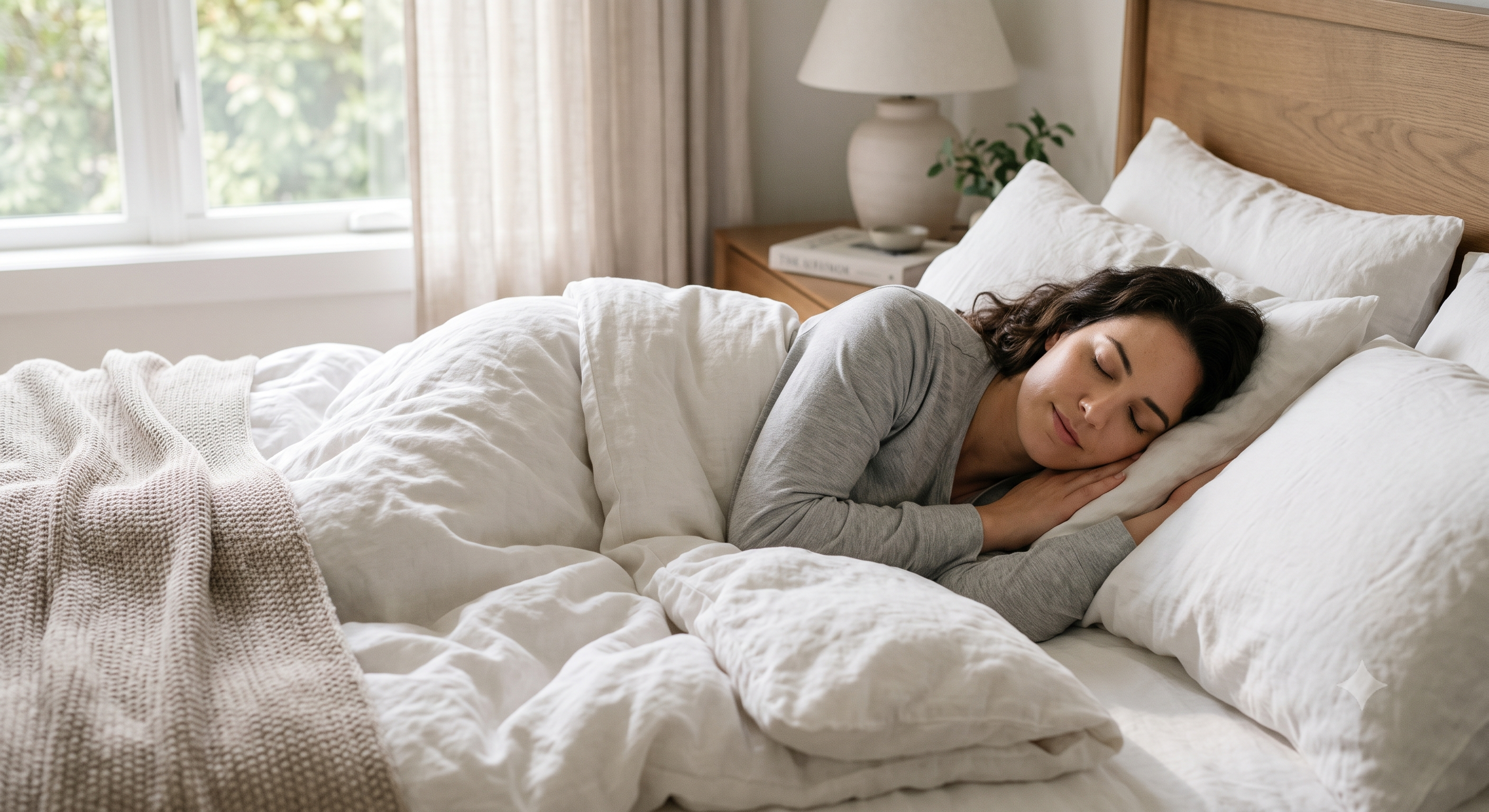
Sleep means the natural state of rest for the body and mind. Synonyms include slumber, rest, doze, and shut-eye; rhyming words include deep, keep, and sheep. The past tense is slept, "sleep tight" means to rest well, and in Spanish sleep is dormir (verb) or sueño (noun).
The word "sleep" carries more territory than it first appears: it is a noun, a verb, a bedtime phrase, and a word with equivalents in nearly every language. This guide walks through the most common ways people search for it — as a synonym, a rhyme, a dictionary definition, and a translation — so you have one place to check meaning, wording, and usage.
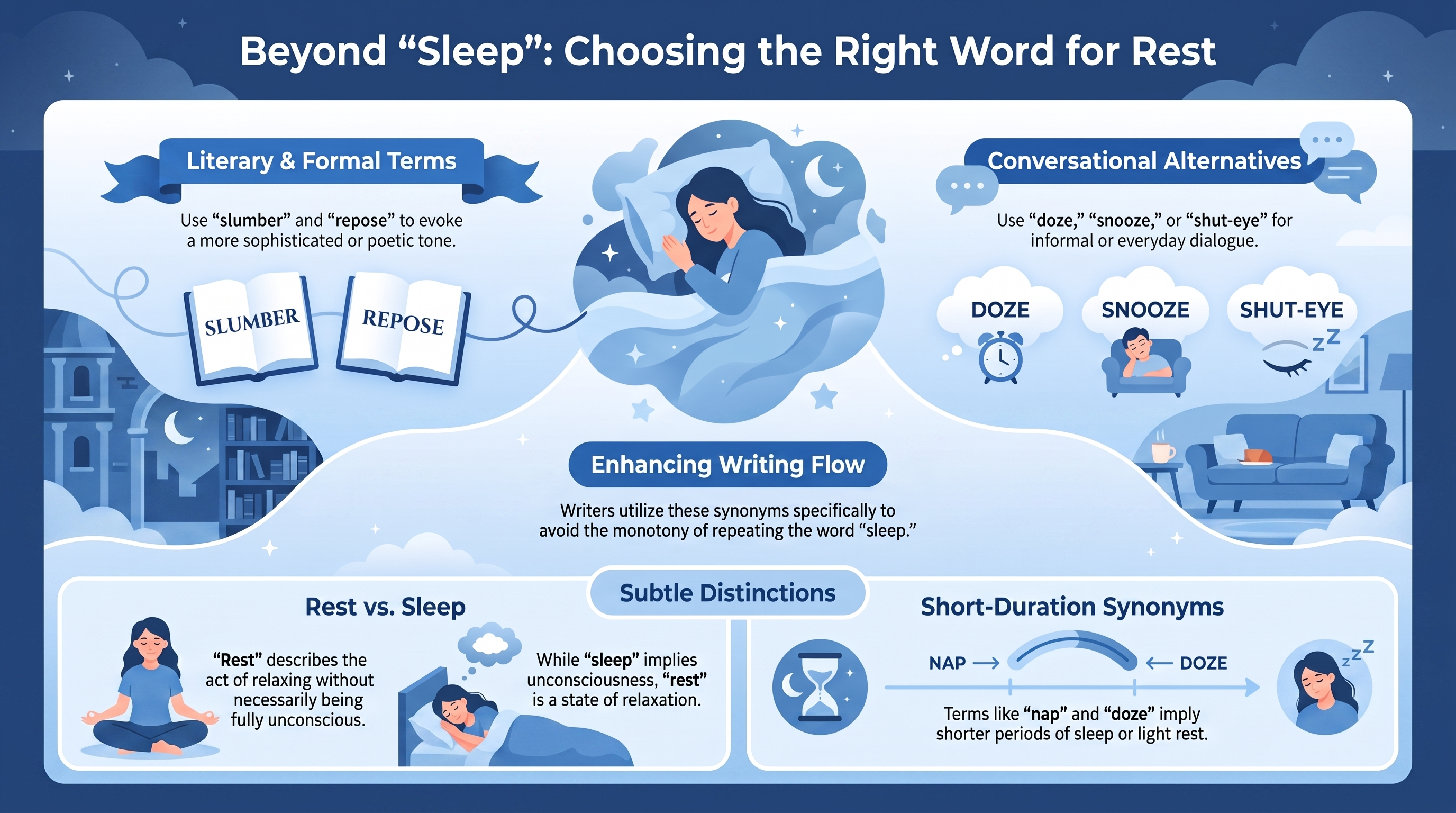
The most common synonyms for sleep are slumber, rest, doze, nap, snooze, shut-eye, and repose. Each carries a slightly different tone: "slumber" and "repose" sound more formal or literary, while "doze," "snooze," and "shut-eye" are casual, conversational words for the same state. "Rest" is broader and can describe simply relaxing without being fully asleep, whereas the others specifically mean the sleeping state itself.
Writers reach for these alternatives to avoid repeating "sleep" in the same paragraph, and each swap slightly shifts the mood of a sentence — "slumber" for a fairy-tale tone, "shut-eye" for a breezy, informal one.
Sleep is a one-syllable word ending in a long "ee" sound, which gives it plenty of perfect rhymes: deep, keep, weep, sheep, creep, sweep, steep, leap, peep, and reap. These words show up constantly in lullabies, nursery rhymes, and poetry built around bedtime, since "sheep" and "deep" pair naturally with the imagery of counting sheep and drifting into deep sleep.
Sleep is a naturally recurring, active state of rest for the body and mind in which awareness of and responsiveness to the outside world are greatly reduced. It is not simply the brain "switching off" — it is a highly regulated neurophysiological process essential for cellular repair, metabolic regulation, and cognitive maintenance.
Two internal systems govern when sleep happens: a homeostatic drive that builds the longer a person stays awake, and a circadian rhythm, driven by the brain's internal clock, that sets the timing of sleep and wakefulness across the day. How much sleep a person needs changes with age — the CDC recommends about 14-17 hours a day for newborns, gradually decreasing to 7 or more hours for adults 18 and older. Parents comparing needs across ages may also find baby sleep schedule guidance useful.
As a noun, "sleep" refers to the state of rest itself, as in "I didn't get enough sleep." As a verb, "to sleep" means to be in that state, as in "I sleep eight hours a night." The word also shows up in common idioms: "sleep on it" means to think something over before deciding, "put to sleep" can mean either helping someone fall asleep or, in a different context, euthanizing an animal, and "sleep around" is slang unrelated to rest at all. Context almost always makes the intended meaning clear.
In Spanish, the verb "to sleep" is dormir, as in "voy a dormir" (I am going to sleep) or "duermo bien" (I sleep well). The noun form is sueño, a word that can mean either "sleep" or "dream" depending on context — Spanish uses the same word for both concepts. To describe feeling sleepy, Spanish uses the phrase "tener sueño," literally "to have sleep."
The past tense of "sleep" is slept, an irregular verb form used for both the simple past and the past participle: "I slept well last night" and "I have slept for eight hours." Unlike regular English verbs, "sleep" does not take an "-ed" ending in the past tense — the vowel changes instead, a pattern shared with other irregular verbs like "keep" (kept) and "sweep" (swept).
"Sleep tight" is an affectionate phrase meaning to sleep well and soundly. It is most often said as a goodnight wish to someone heading to bed, especially children, frequently paired with similar phrases like "good night" and "sweet dreams." Word historians offer a few different theories for where "tight" comes from in this context, but the meaning in modern use is settled: it simply wishes someone a solid, restful night's sleep. Parents saying it at bedtime may also want ideas for the room itself, such as baby sleep music or baby sleep gear that supports a calm wind-down routine.
Knowing the words for sleep is one thing — getting enough of it is another. Consider talking to a doctor if:
A doctor can help identify whether a sleep problem needs further evaluation rather than just a change in routine.
Beyond the handful of everyday alternatives, "sleep" has a much longer list of stand-ins once you widen the net to literary, dialect, and slang terms. Grouping them by tone makes them easier to use correctly.
A thesaurus grouping like this is useful for writing, since it helps match the register of a sentence — "catch some Z's" fits a text message, while "repose" fits a poem.
To actually use "sleep" in a Spanish sentence, the two words to know are dormir (the verb, to sleep) and sueño (the noun, sleep or dream). A few practical phrases: "que duermas bien" (sleep well), "hora de dormir" (bedtime), and "me voy a dormir" (I'm going to sleep). "Buenas noches" is the standard way to say "good night" when someone is heading to bed.
In French, the verb "to sleep" is dormir (the same spelling as Spanish, though pronounced differently), and the noun for sleep is sommeil. "Bonne nuit" means "good night," and "dors bien" means "sleep well" — a common phrase said to children at bedtime, much like sounds parents might pair with a calm noise machine for sleep during a wind-down routine.
In American Sign Language, the common sign for "sleep" is made by bringing one open hand slowly down over the face while closing the fingers and the eyes, mimicking the motion of drifting off to rest. It is a widely recognized, easy-to-learn gesture that visually represents the concept of sleeping rather than spelling out the letters of the word. Families dealing with early wake-ups or irregular naps may also find it useful to review common baby sleep problems alongside learning simple bedtime signs.