Drooling in Your Sleep: Why It Happens & How to Stop
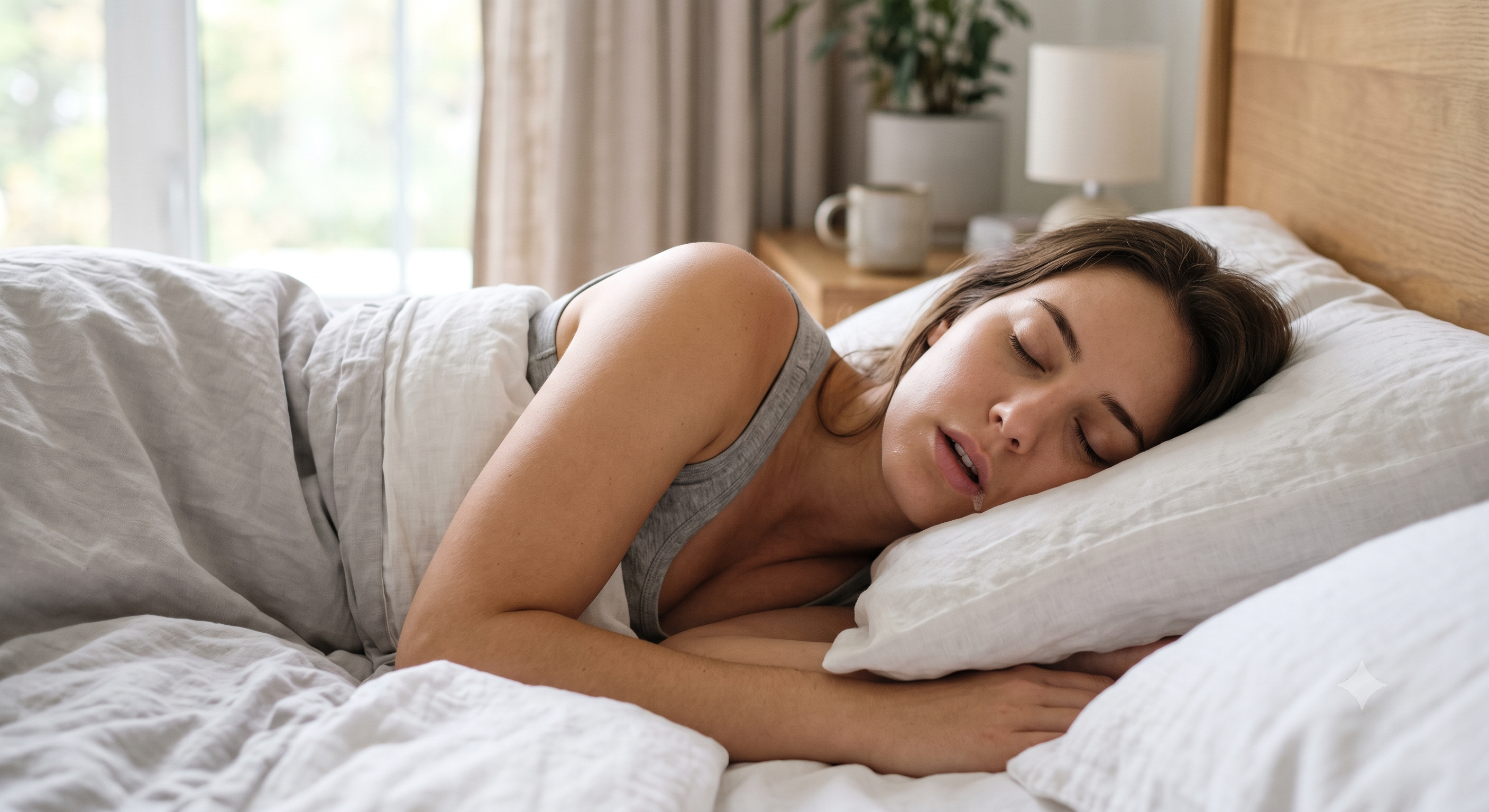
Drooling in your sleep is usually caused by sleep position, mouth breathing from nasal congestion, or the natural muscle relaxation of deep and REM sleep. It's normal in most cases. Sleeping on your back, treating congestion, and getting checked for sleep apnea if loud snoring or breathing pauses are present can all help reduce it.
Waking up to a damp pillow is one of the most common — and most harmless — nighttime habits. Understanding drooling is easiest with a simple Position–Airway–Tone framework: three overlapping drivers that decide whether saliva stays where it belongs or ends up on your pillowcase. Position is where gravity sends the saliva, airway is why your mouth is open in the first place, and tone is how relaxed your jaw and mouth muscles are during a given stage of sleep. Almost every case of nighttime drooling traces back to one or more of these three factors.
Saliva production doesn't stop while you sleep, but the swallowing reflex that normally clears it during the day slows down. If your mouth is closed and you're lying on your back, that saliva simply collects and gets swallowed as usual. Change any part of that setup — your head position, your airway, or how relaxed your mouth muscles are — and saliva has an easier path out rather than down.
Position matters most for side and stomach sleepers, since gravity pulls pooled saliva toward the lower corner of the mouth instead of the back of the throat. Airway comes into play when nasal congestion, allergies, or a blocked nose force you to breathe through an open mouth instead of your nose, which gives saliva a direct route out. Sleep apnea is a common airway-related driver of overnight mouth breathing — obstructive sleep apnea is estimated to affect roughly 24–33% of U.S. adults, and as many as 80% of cases go undiagnosed, so loud snoring or gasping alongside drooling is worth paying attention to.
Tone refers to how relaxed the muscles around your jaw and mouth are during a given sleep stage. REM sleep in particular involves a marked drop in muscle tone throughout the body, and the deeper stages of the night's sleep cycle bring a general loosening of muscle activity as well. That extra relaxation can make it easier for the jaw to drift open, which is one reason drooling often shows up more in the later, more restorative parts of the night.
Waking up to a wet pillow is sometimes taken as proof of a great night's sleep, and there's a kernel of truth to it: the muscle relaxation that lets saliva escape is more pronounced during deep NREM sleep and REM sleep, the same stages associated with physical recovery and memory processing. But drooling isn't a reliable measurement on its own. Plenty of people reach deep, restorative sleep every night without ever drooling, and drooling can just as easily be explained by something unrelated to sleep quality — a stuffy nose, a particular sleep position, or a pillow that tips the head forward. Treat a wet pillow as a normal, relaxed-body sign at most, not a scorecard for how well you slept.
Because drooling usually comes down to position, airway, or muscle tone, the most effective fixes target those same three areas rather than the saliva itself. Start with the simplest change: sleeping on your back keeps saliva away from the corner of the mouth in the first place. A supportive pillow that keeps your head and neck aligned — rather than tipping your chin down and your mouth open — reinforces that position through the night.
If congestion is the culprit, treating it before bed (a saline rinse, addressing allergies, or seeing an ENT about a deviated septum if it's a recurring problem) can reduce the mouth breathing that drives saliva out. Staying hydrated during the day can also help keep saliva at a normal consistency rather than thick and hard to manage. If you take any medication and notice increased drooling, it's worth mentioning to the prescribing doctor rather than adjusting anything on your own.
Occasional drooling is normal, but see a doctor if you notice:
These situations call for a professional evaluation rather than home remedies.
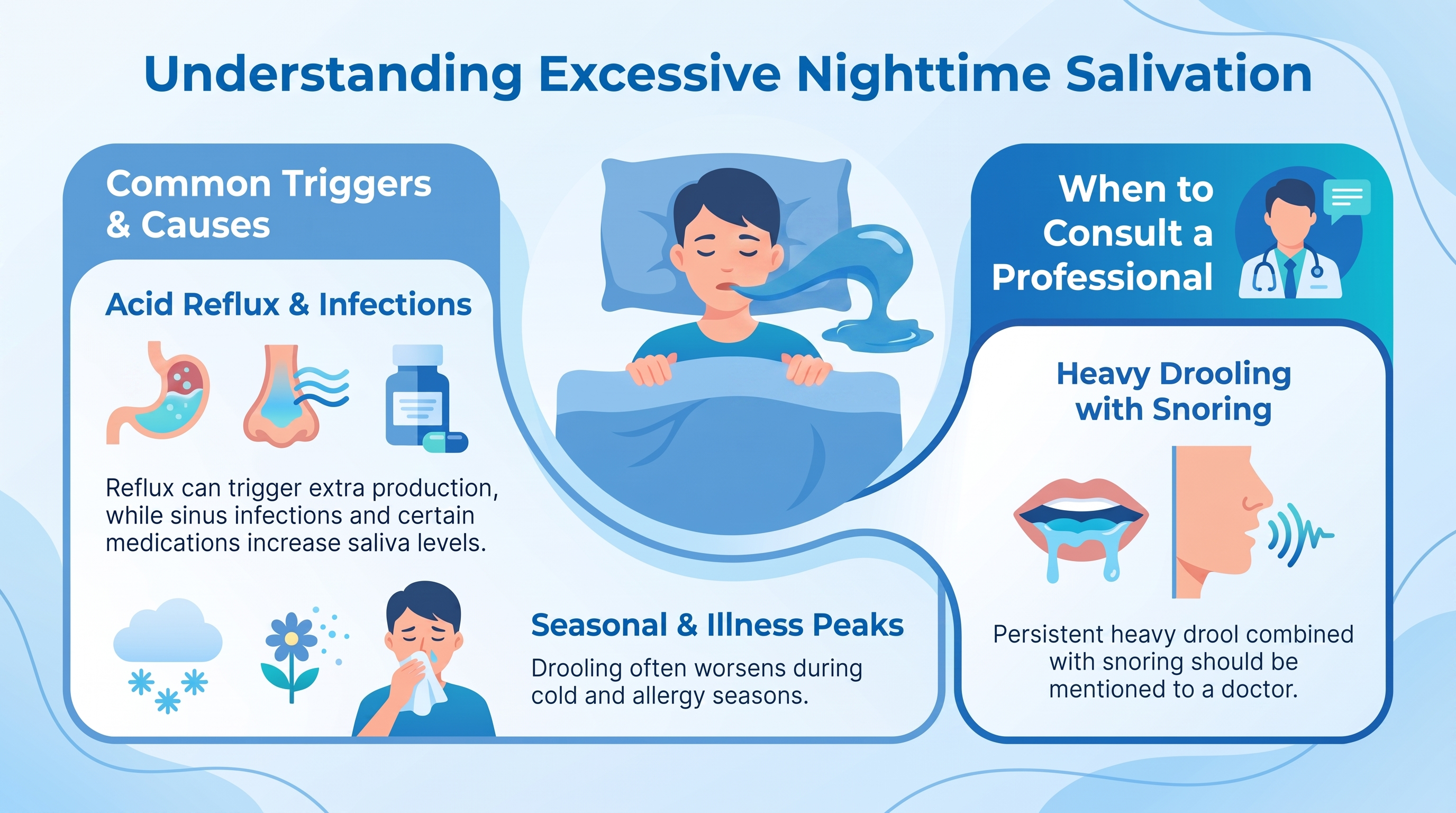
Most nighttime drooling is simply saliva finding an easier way out — position and airway problems rather than the body making too much saliva. But in some cases, saliva production itself increases, a pattern sometimes called hypersalivation or sialorrhea. Reflux is one example: when stomach acid irritates the esophagus, it can trigger extra saliva production as a natural response. Certain medications and sinus or nasal infections can also increase how much saliva is produced. This is a different mechanism from simple positional pooling, though the two often look identical on the pillow.
"Sleep drool" is simply the everyday term for saliva that escapes the mouth during sleep, ranging from a small damp spot to noticeably wet bedding. It's most common with side or stomach sleeping and tends to get worse during colds, allergy season, or any stretch when nasal breathing is blocked. For most people, sleep drool isn't a sign of anything medically wrong — it's just saliva management combined with sleep position. Persistent or heavy sleep drool, especially alongside snoring or witnessed breathing pauses, is the exception worth mentioning to a doctor.
Pulling the drivers together, the most common causes of drooling during sleep are: sleeping on your side or stomach, mouth breathing from nasal congestion or allergies, obstructive sleep apnea, the natural drop in muscle tone during REM and deep NREM sleep, bruxism (teeth grinding), acid reflux, and certain medications. Sleep bruxism affects an estimated 10–16% of adults, and the jaw movement and mouth positioning involved can make drooling more noticeable on top of a night guard's protective role for the teeth. In most cases these causes overlap — someone with a cold who also happens to sleep on their side, for instance, is likely to notice more drool than usual until the congestion clears.
"Sleep slobber" is an informal, slightly more casual way of describing exactly the same thing as sleep drool: saliva escaping the mouth during sleep. There's no medical distinction between the two terms — they describe the same common, usually harmless nighttime occurrence, driven by the same mix of sleep position, mouth breathing, and muscle relaxation covered above.