Animals That Don't Sleep & Sleep Facts
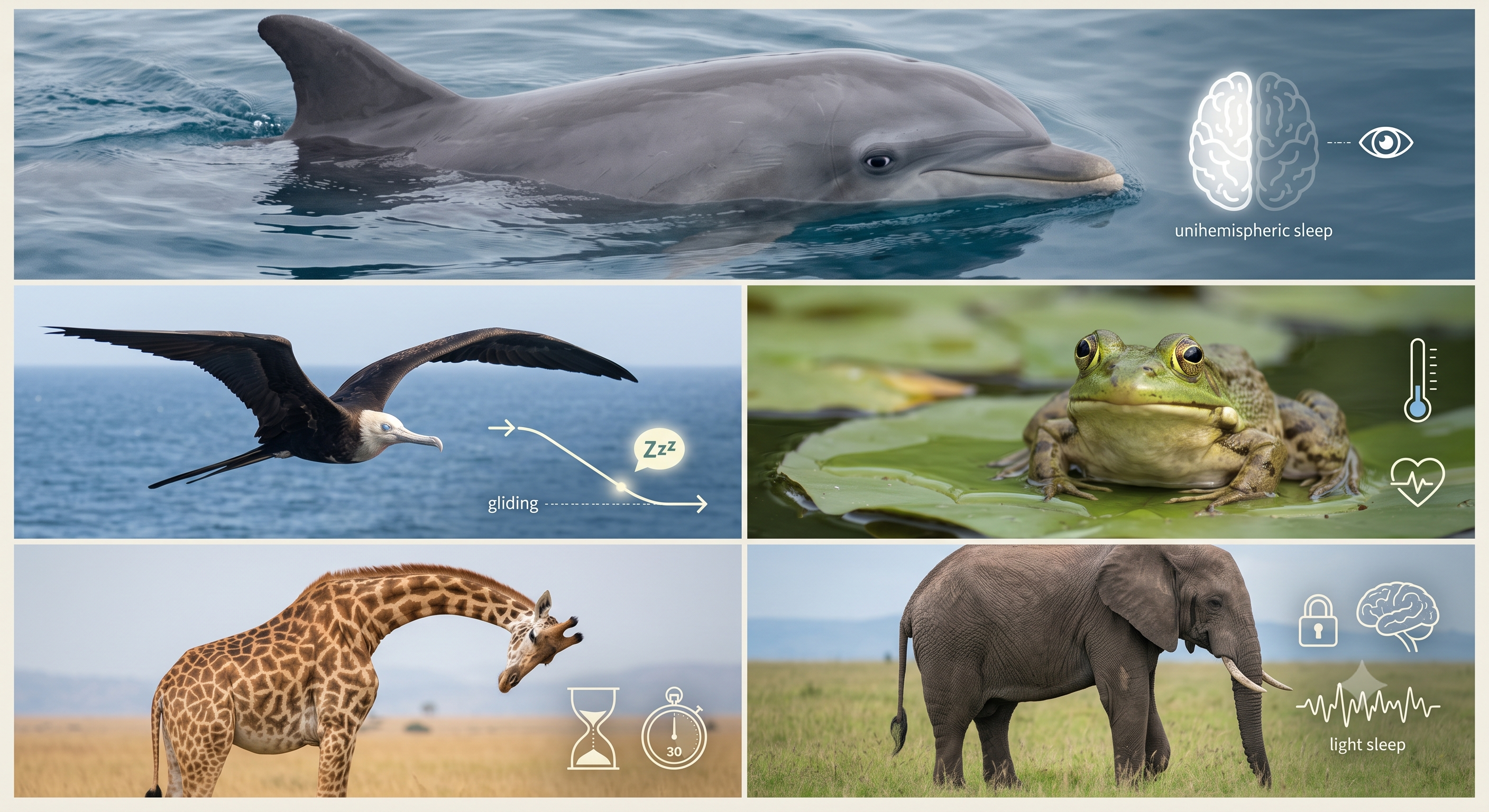
No animal studied truly sleeps zero. Cows can doze standing up thanks to locking leg joints, whales and dolphins rest half their brain at a time, fish show sleep-like rest without eyelids, and plants follow daily light-driven rhythms rather than true sleep.
Comparing animal sleep is easiest through what sleep scientists call the Two-Process Lens: every animal's rest is shaped by a homeostatic pressure that builds the longer it stays active, and a body clock that times rest to day or night. This two-process framework was first described for human sleep, but the same basic logic — a rising need for rest, timed by an internal clock — shows up across the animal kingdom in very different forms, from a dozing cow to a half-asleep dolphin.
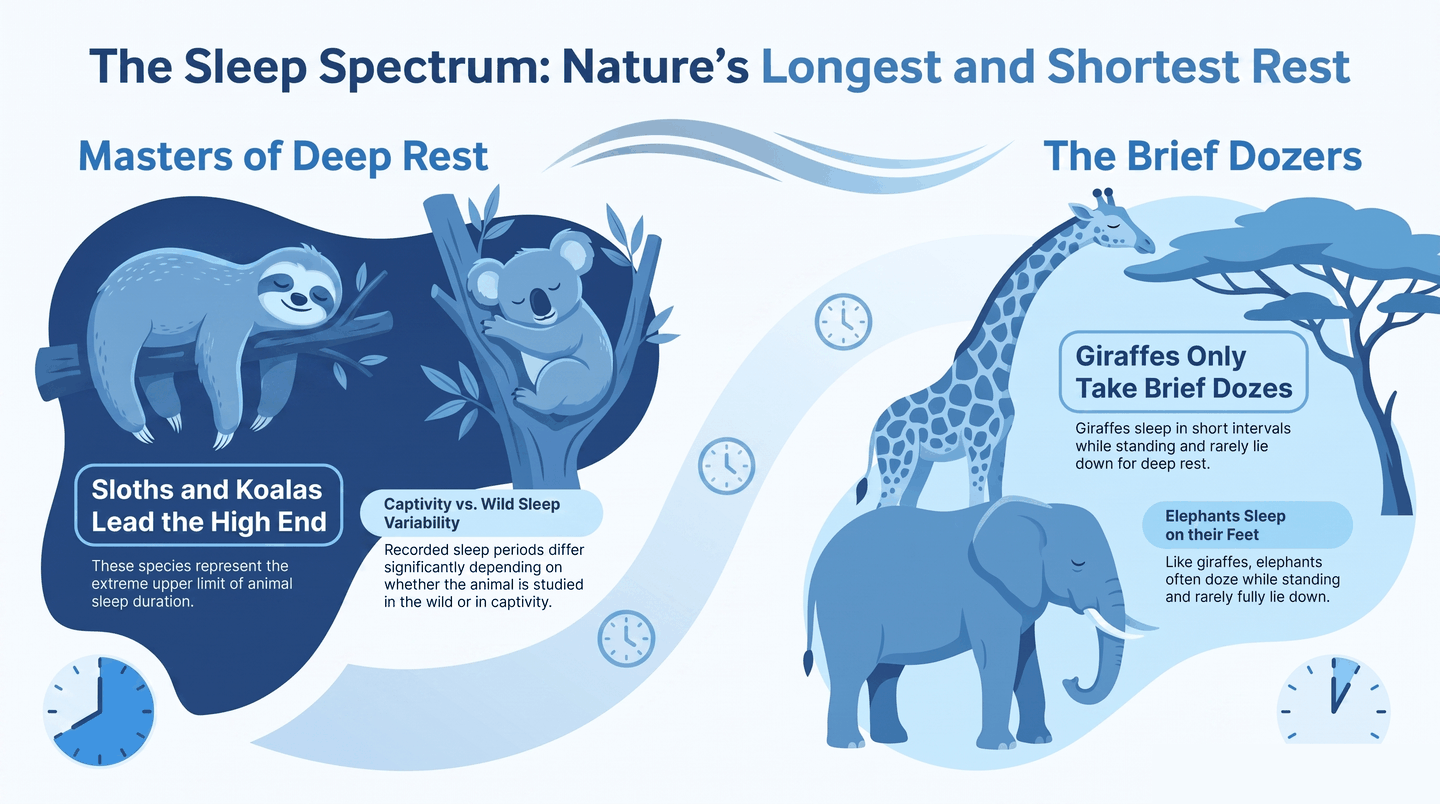
At the high end of the animal kingdom's rest spectrum are slow-moving mammals such as sloths and marsupials such as koalas, both of which spend the large majority of each day resting or dozing between brief, low-energy bursts of feeding. Reported hours vary a lot between wild and captive studies, so rather than repeating a single number, the safer takeaway is that these animals sit at the extreme high end of daily rest compared with most other mammals.
At the opposite end are animals that appear to need very little rest at all, largely because standing still for long periods leaves them exposed to predators.
Giraffes are famous for extremely short rest periods relative to their size, taking brief standing dozes and only rarely lying down with their long neck curled around for deeper rest. Their height and open habitat make prolonged, unguarded rest risky, so their sleep is spread across many short bouts rather than one long block.
Elephants are another large mammal known for unusually short daily rest, often dozing standing up and only occasionally lying down fully. Their size, herd structure, and need to keep moving and feeding appear to favor short, fragmented rest over one long consolidated sleep period.
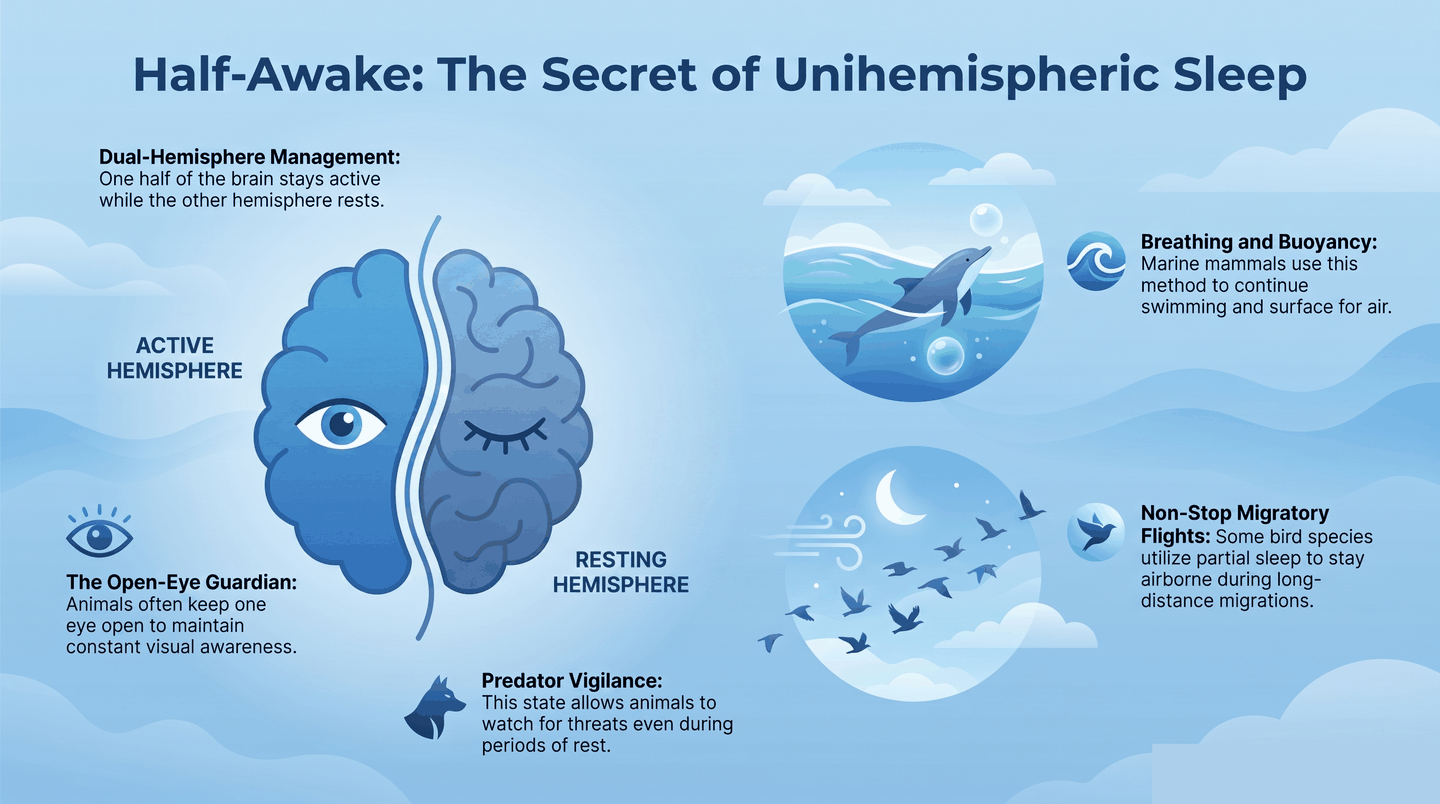
Strictly speaking, no animal that has been carefully studied appears to go without rest entirely. What looks like "not sleeping" is usually a workaround that lets an animal stay partly alert while still getting some restorative benefit. The best-documented version of this workaround is unihemispheric sleep.
Unihemispheric sleep is a state in which one half of the brain shows sleep-like activity while the other half stays awake and alert, often paired with one eye staying open. It lets an animal keep watching for predators, keep swimming, or keep breathing consciously while still getting some of the restorative benefit of sleep. This mechanism is the main reason marine mammals and some birds can appear to rest without ever looking fully "asleep."
Birds do sleep, and many species are able to use a form of unihemispheric sleep as well, most notably during long migratory flights, letting part of the brain rest while the other half keeps the bird oriented and airborne. On the ground or in a nest, many birds sleep more conventionally, with both halves of the brain resting together.
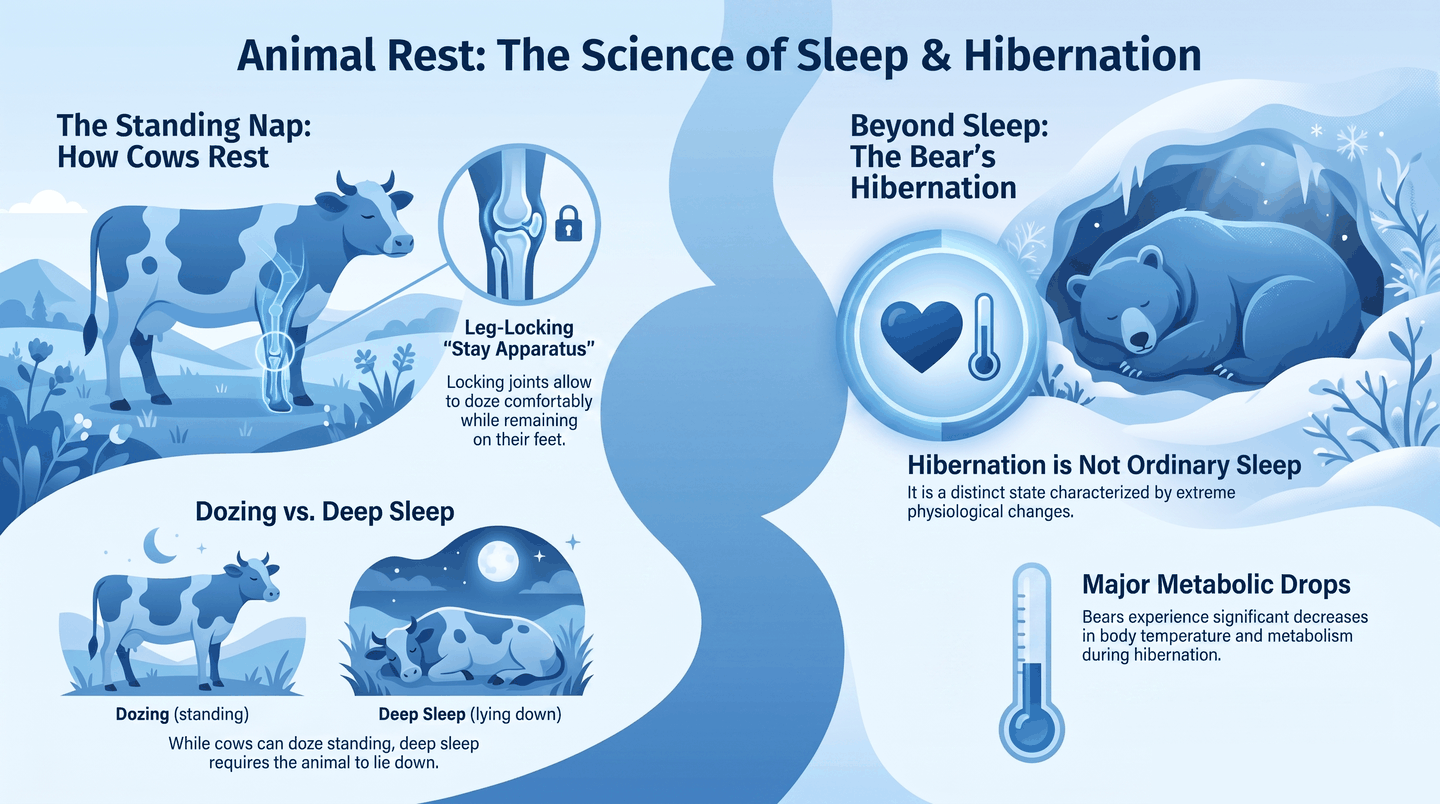
Yes — cows and many other large grazing mammals have what is known as a stay apparatus, a system of tendons and ligaments in the legs that can lock the joints in place with very little ongoing muscular effort. That lets a cow doze lightly while remaining upright, which is a useful trait for a prey animal that benefits from being able to react quickly. For deeper, more restorative stages of sleep, cows still need to lie down, since standing sleep on its own does not provide the same depth of rest.
Not in the way ordinary sleep works. Hibernation is a distinct physiological state, involving a much larger drop in metabolic rate, heart rate, and body temperature than normal sleep produces, and it is better described as prolonged dormancy than one continuous night of sleep stretched over months. Bears are also able to rouse relatively easily during hibernation compared with some smaller hibernating mammals, which is part of why the state is treated as biologically distinct from sleep itself.
Whales and dolphins are conscious breathers: breathing is never fully automatic for them, so they cannot afford to lose consciousness completely the way land mammals do when they sleep. Instead, they rely on the same unihemispheric sleep mechanism described above, resting one half of the brain while the other half stays alert enough to keep the animal swimming, oriented, and surfacing to breathe on a regular basis.
Fish do not sleep the way mammals do — they have no eyelids to close and no mammal-style brain structure — but many species show a clear rest-like state: reduced movement, lower responsiveness to stimulation, and a preferred resting spot or time of day. Researchers generally describe this as sleep-like rest rather than sleep in the strict human sense, since it lacks some of the defining markers used for mammal sleep.
Goldfish show the same pattern as many other fish: periods of stillness, reduced activity, and lower responsiveness, often timed to darker or quieter periods in their tank. It is a sleep-like resting state rather than sleep in the fuller mammalian sense.
Sharks are a special case because some species must keep swimming to move oxygen-rich water over their gills. Species that rely on that kind of continuous swimming show rest in the form of reduced activity and lowered responsiveness while still moving, rather than becoming fully still, while other shark species that can pump water over their gills while stationary are able to rest while motionless on the seafloor.
None, as far as any credible source can establish. The claim that a person swallows a set number of spiders every year while sleeping is a widely circulated myth with no real scientific study behind it. Spiders are generally repelled, not attracted, by the vibrations, warmth, and breathing of a sleeping person, and a spider has little reason to crawl toward a mouth. This is a good moment to separate real animal sleep facts from internet folklore before looking at how actual insects and arachnids rest.
Many insects show a genuine rest-like state, marked by reduced movement, a consistent resting posture, and reduced responsiveness to stimulation that researchers treat as sleep-like behavior, even without the brain structures mammals use for sleep.
Bees show clear rest periods, including stretches of stillness with lowered antennae and reduced responsiveness, often at night inside the hive. This rest appears to support their ability to function normally, including tasks like navigation and communication with other bees.
Mosquitoes also show quiet, low-activity resting periods, generally timed around their feeding activity and the day-night cycle. As with other insects, this looks more like a simplified rest state than sleep as it is defined in mammals.
Plants do not sleep in the way animals with a brain do, but many show a well-documented daily rhythm called nyctinasty, in which leaves or petals fold, close, or reposition at night and reopen with daylight. This rhythm is driven by the plant's own internal biological clock responding to light and darkness — a different biological system from an animal brain, but conceptually similar to the circadian rhythms that time rest in animals, including humans. If your own household sleep patterns are also on your mind, related topics like baby sleep schedules and common baby sleep problems follow the same basic day-night rhythm logic.
This article covers general animal biology, not a substitute for veterinary or medical care. For your own sleep, or a child's, talk to a doctor if any of the following apply:
For pets, a sudden and unexplained change in an animal's normal rest pattern is best discussed with a veterinarian rather than compared to the general facts above.
For related human sleep topics, see how alcohol affects sleep, what to look for in baby sleep gear, and how baby sleep music is used to support a calming bedtime rhythm.