Sleep Anxiety: How to Sleep With Anxiety
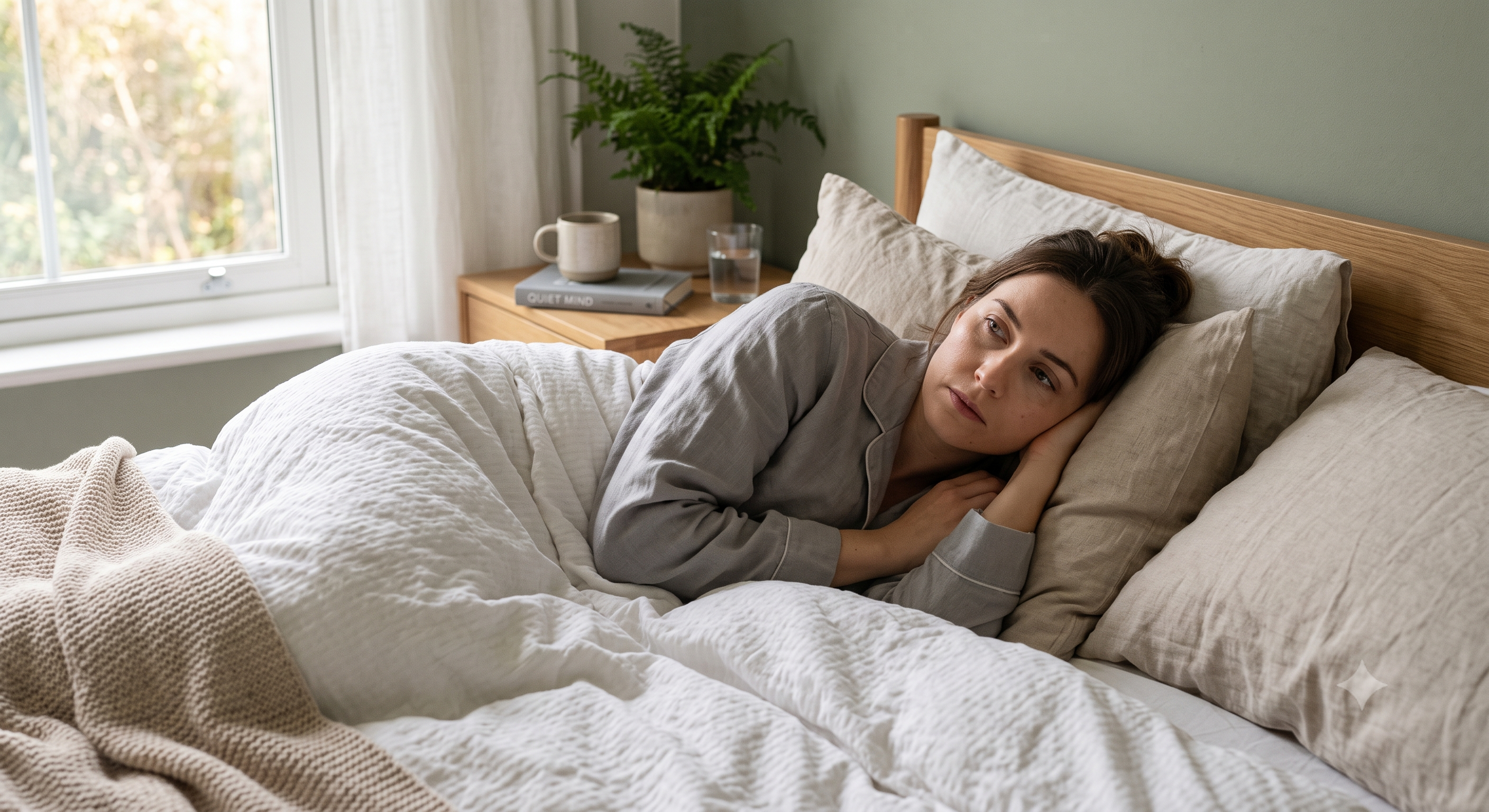
Sleep anxiety is a loop: worry keeps your body's arousal system too active to let sleep begin, and the resulting sleeplessness fuels more worry. Breaking it means calming physical arousal before bed, recognizing the symptoms early, and using stress management techniques such as a wind-down routine, a cool bedroom, and, for ongoing insomnia, CBT-I.
Sleep and anxiety feed each other through what can be called the Worry-Wake Loop. Falling asleep depends on the brain's arousal system stepping back so a separate sleep-promoting system can take over; anxiety keeps the arousal system switched on, which directly blocks that handoff. The result is a familiar pattern: you feel exhausted, you lie down, your mind races, sleep does not come, and the missed sleep becomes one more thing to worry about the next night. Understanding that loop is the first step in learning how to sleep with anxiety, recognizing sleep anxiety symptoms, and using real stress management techniques instead of just "trying harder" to relax.
Sleeping with anxiety usually means working on the arousal side of the Worry-Wake Loop rather than fighting the worry directly. A consistent wind-down routine signals to the body that it is time to shift out of an alert state. Keeping the bedroom cool, in the range of roughly 65-68°F, supports that shift, since a bedroom that is too warm works against the body's natural drop in core temperature at sleep onset.
Caffeine timing matters more than most people expect: caffeine has an average half-life of about 5 hours, and even a dose as far as 6 hours before bed can measurably disrupt sleep. Alcohol is a common but counterproductive fix — it is sedating at first, but it suppresses REM sleep and fragments the second half of the night, which can leave anxious sleepers more restless, not less. Melatonin is sometimes used as well, but it is a timing hormone (a chronobiotic) rather than a sedative, and it works best for shifting your body clock rather than calming anxious arousal itself; typical doses run from about 0.5-3 mg, with little added benefit above 5 mg.
For some people, the anxiety is not general background stress that happens to strike at bedtime — it is fear of sleep itself, sometimes called somniphobia. This can develop after a run of bad nights, a frightening nightmare, or an episode of sleep paralysis, and it often shows up as dread building as bedtime approaches. Left unaddressed, fear of sleep tends to produce avoidance: staying up later, filling the evening with distractions, or resisting the bedroom altogether, all of which delay sleep further and reinforce the fear. Treating the fear usually means rebuilding a predictable, low-pressure bedtime routine and, in the case of ongoing sleep paralysis, learning that it is a harmless (though frightening) REM-related phenomenon rather than a dangerous one.
Sleep anxiety symptoms show up both mentally and physically. Mentally, the most common signs are racing or looping thoughts once the lights go out, dread or clock-watching as bedtime nears, and replaying the day's stress instead of winding down. Physically, the same arousal circuits that keep you alert during the day — signals like noradrenaline, serotonin, dopamine, and histamine — stay active at night, which can show up as a faster heart rate, shallow breathing, muscle tension, or a wired, restless feeling even though you are tired.
When these symptoms happen occasionally, they are a normal stress response. When trouble falling or staying asleep occurs at least three times a week for three months or more despite having enough opportunity to sleep, that pattern meets the definition of chronic insomnia, which affects roughly 10-15% of adults and for which cognitive behavioral therapy for insomnia (CBT-I) is the first-line treatment.
The relationship between sleep and anxiety runs in both directions. Anxiety makes it harder to fall asleep, but insufficient sleep also feeds back into how well the brain regulates mood and stress the next day. Research on partial sleep restriction found that chronically getting around 6 hours of sleep a night for 14 nights in a row produced attention and reaction-time deficits comparable to two full nights of total sleep deprivation — even though the people in the study felt only ordinarily, "acceptably" tired rather than acutely sleep-deprived. That gap between how tired you feel and how impaired you actually are is part of why short sleep can quietly make anxiety symptoms feel worse without an obvious cause.
Stress and sleep are tightly linked at the level of basic brain chemistry. Wakefulness is maintained by the brain's ascending arousal system, which uses noradrenaline, serotonin, dopamine, and histamine to keep you alert; falling asleep requires a separate sleep-promoting region to quiet that system down using calming signals like GABA. Stress keeps the arousal system firing, which directly competes with the biological switch that is supposed to carry you into sleep — so a stressed-out body can stay "wired but tired" long after it is exhausted.
It also helps to let go of one common myth that quietly adds to sleep anxiety: the idea that everyone needs exactly 8 hours of sleep. Sleep needs vary from person to person, and treating 8 hours as a strict nightly requirement can itself become a source of bedtime pressure and worry.
Meditation and other relaxation practices — slow breathing, body scans, guided relaxation — are widely used to help quiet the arousal system described above before bed. They work by giving the mind something calm and repetitive to focus on instead of looping worry, which can make it easier for the sleep-promoting system to take over. Meditation is not a replacement for treating an ongoing sleep or anxiety disorder, but it is a reasonable, low-risk addition to a broader wind-down routine for people whose sleep anxiety is tied to a racing mind at night.
A few stress management techniques for sleep have real evidence behind them. Magnesium, in the range of about 200-400 mg of elemental magnesium taken 30-60 minutes before bed, has been studied specifically for sleep: one randomized trial using magnesium bisglycinate found it shortened sleep onset by about 17.8 minutes and increased deep sleep by about 19.3%. L-theanine, at doses up to about 450 mg per day, has been shown to improve subjective sleep quality, and ashwagandha (specifically the KSM-66 extract, at 600 mg per day or more) has shown moderate evidence for improving sleep onset time and sleep efficiency, though long-term data beyond about 12 weeks is still limited. Any supplement should be discussed with a healthcare provider first, especially alongside other medications.
Beyond supplements, the most consistently useful techniques are behavioral: a fixed wind-down routine, a cool dark bedroom, cutting caffeine several hours before bed, and, for sound-sensitive sleepers, a white or pink noise machine to mask disruptive sounds — pink noise in particular has shown early, preliminary promise for supporting deep sleep in small studies. For anxiety-driven insomnia that does not resolve with these habits, CBT-I remains the best-studied first-line treatment, with better long-term remission rates than sleep medication and none of the dependence risk.
Occasional sleep anxiety is common and usually manageable with routine and stress management changes. Talk to a doctor or a sleep or mental-health professional if:
This article is informational and not a diagnosis; a healthcare provider can evaluate your specific symptoms and history.