Safe Sleep for Babies: Positions and Guidelines
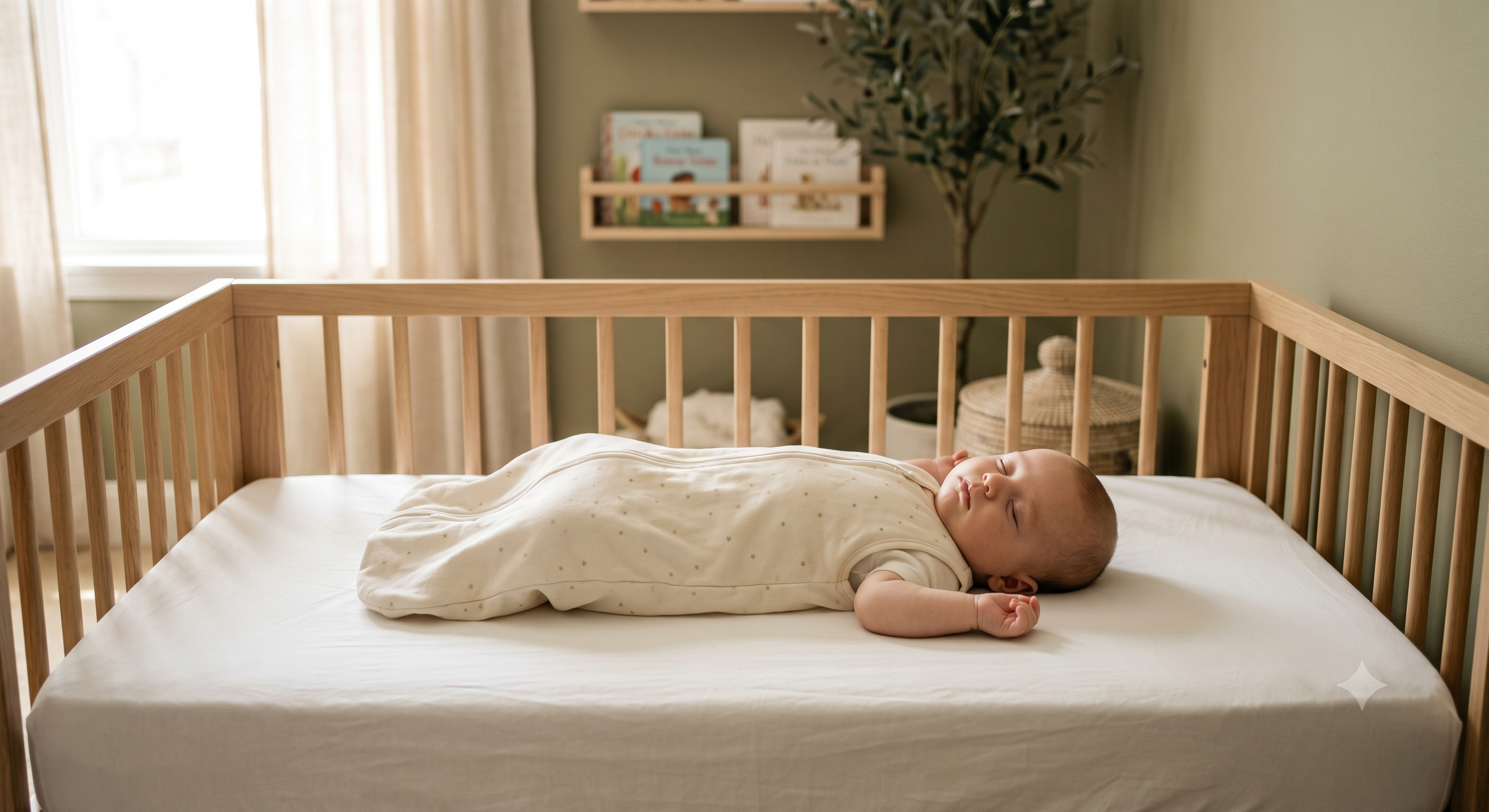
Babies should sleep alone, on their back, on a firm flat surface, in a crib free of blankets, pillows, and soft bedding, for the first year. Room-sharing without bed-sharing can lower SIDS risk by up to 50%. Since the Safe to Sleep campaign began in 1994, SIDS incidence has dropped by more than 50%.
Safe sleep for babies comes down to one consistent framework pediatric and public health sources use: the ABCs of safe sleep — Alone, on their Back, in a Crib. Every question below, from stomach sleeping to blankets, pacifiers, side sleeping, swings, and pillows, is really a variation on how closely a given setup follows those three letters. The CDC's guidance is built around lowering the risk of Sudden Infant Death Syndrome (SIDS) and other sleep-related infant deaths, and the framework gives parents a simple check to run before every nap and every night. For related setup questions, see co-sleeping and baby sleep schedule.
For the first year of life, the CDC recommends placing a baby on their back for every single sleep — every nap and every night, no exceptions. Stomach sleeping is not recommended as a starting position at any point during that first year because it is associated with a higher risk of SIDS than back sleeping.
Once a baby has developed enough to roll independently in both directions — from back to stomach and stomach to back — it is generally fine to let them settle into whatever position they land in during the night. The key word is independently: a baby should still always be placed down on their back to start every sleep, even after they can roll on their own. A pediatrician can help confirm when a baby has reached that rolling milestone reliably enough that repositioning them overnight is no longer necessary.
The ABCs are the easiest way to remember the full safe sleep picture in one line: Alone — no other person, pet, pillow, blanket, or toy sharing the sleep surface; Back — always placed on the back to begin sleep; Crib — a crib or bassinet that meets current safety standards, with a firm, flat mattress and only a fitted sheet. A couch, armchair, adult bed, or sitting device is not a substitute for a crib under this framework.
The "Back to Sleep" campaign, now known as Safe to Sleep, launched in 1994 to promote back sleeping as the standard infant sleep position. Since it began, SIDS incidence has dropped by more than 50%, and consistent back sleeping is considered one of the central factors behind that decline.
Loose blankets are not recommended anywhere in a baby's sleep space during the first year. The CDC's guidance calls for a bare crib: a firm, flat mattress with only a fitted sheet, and nothing else — no loose blankets, no pillows, no crib bumpers, no stuffed toys. Soft, loose bedding raises the risk of suffocation and overheating, both of which are linked to a higher risk of SIDS and other sleep-related infant deaths.
Instead of a loose blanket, many families use a wearable blanket or sleep sack, which keeps a baby warm without introducing loose fabric near the face. There is no single fixed age in the safe sleep guidance at which a loose blanket becomes appropriate; that transition depends on a baby's individual development, and it is a decision to make together with a pediatrician rather than on a calendar date.
A pacifier at naptime and bedtime is generally considered compatible with a safe sleep setup. Unlike blankets, pillows, and stuffed toys, a pacifier is not on the CDC's list of items to keep out of the crib, and many pediatric sources note it alongside back sleeping as part of routine safe sleep practice.
Whether to introduce a pacifier for a newborn specifically is more of a personal, feeding-related decision than a strict safety rule. Because a newborn's feeding routine is still being established, some pediatric sources suggest waiting until breastfeeding is going well before offering a pacifier, so that pacifier use does not interfere with those early feeding patterns. A pacifier is not required for a safe sleep setup, but it also is not something that needs to be removed once it is part of a family's routine. A pediatrician is the best resource for timing this decision for an individual newborn.
Side sleeping is not considered a safe sleep position for babies during the first year. The back position is the only one the CDC recommends for every sleep in that first year, because a baby placed on their side can more easily roll onto their stomach, which is the highest-risk position. Even babies who are swaddled or propped should still be placed flat on their back rather than on their side.
A swing is not recommended for routine sleep, and neither is a car seat, bouncer, or other sitting or reclined device. Safe sleep guidance calls for a firm, flat surface — a crib or bassinet — rather than an inclined or sitting surface, because these devices can let a baby's head tip forward or to the side, which can restrict breathing. If a baby falls asleep in a swing or car seat during travel or a short errand, the safer practice is to move them to a crib or bassinet on a firm, flat surface for any longer or routine sleep.
Pillows are not recommended in a baby's crib during the first year, for the same reason loose blankets are excluded: soft bedding in a crib is a recognized suffocation risk. A crib that follows the ABCs of safe sleep has a firm, flat mattress and a fitted sheet only, with no pillow of any kind.
The move to a pillow typically comes later, closer to the transition from a crib into a toddler bed, rather than at any specific point during the first year. As with blankets, there is no single fixed age given in safe sleep guidance for introducing a pillow — it is a call to make with a pediatrician based on a child's individual development and sleep setup.
Bring any safe sleep question to a pediatrician, and reach out promptly if you notice any of the following:
The American Academy of Pediatrics publishes detailed safe sleep guidance, and a pediatrician can tailor it to your baby's development and any individual health considerations.
For more on infant sleep, see baby sleep music and the best noise machines for sleep, or explore colored noise for sleep.