Newborn Sleep Behaviors: Grunting, Twitching, Breathing
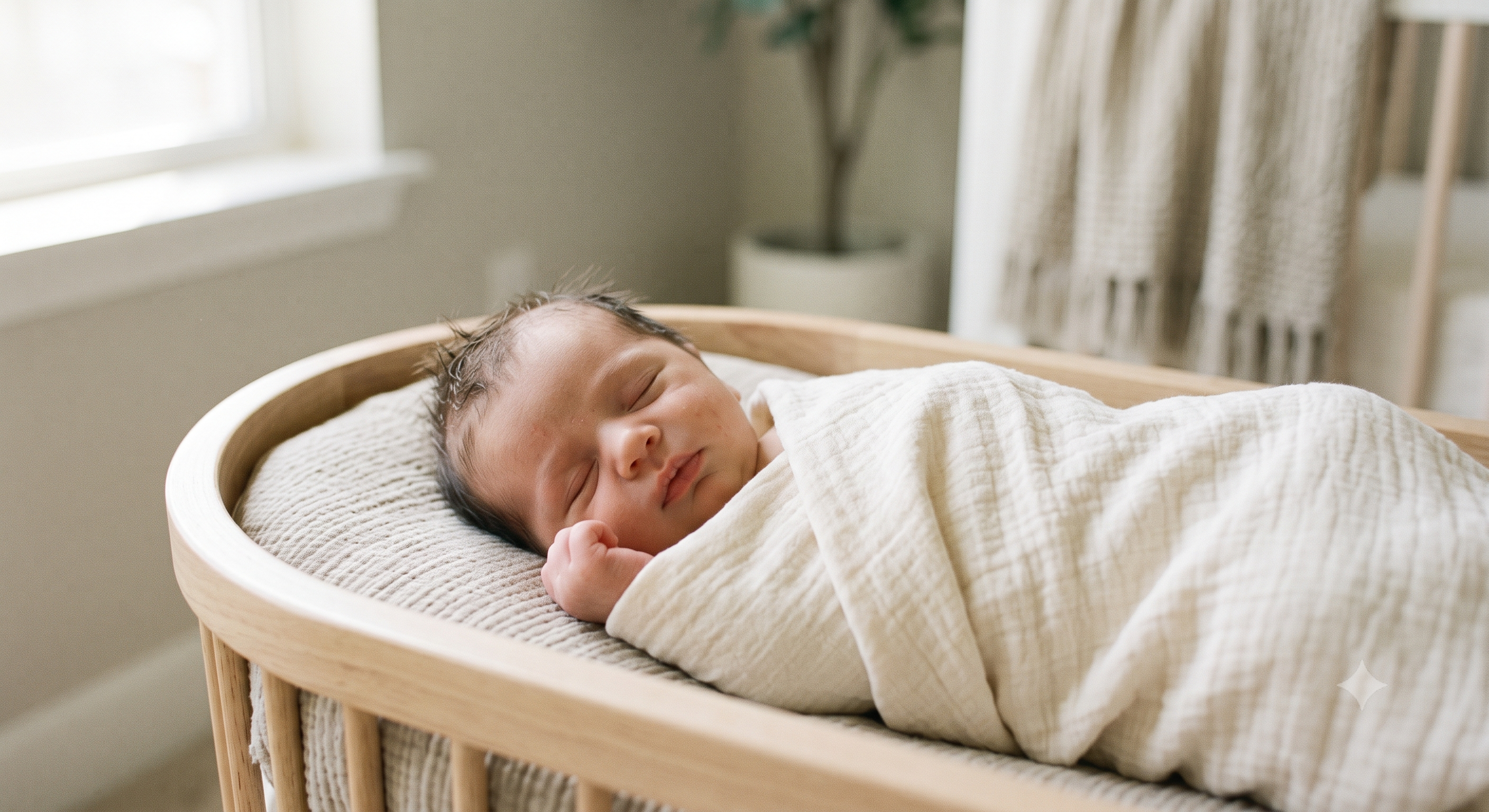
Fast breathing, twitching, smiling, grunting, coughing, and sleeping with eyes or mouth open are almost always signs of a newborn's active sleep phase, when the brain is busy but the body hasn't yet learned to stay still. Most of these behaviors settle as babies mature. True red flags are breathing pauses, bluish skin, or persistent distress.
Newborns don't sleep the way older children and adults do. Instead of long, unbroken stretches, a newborn's sleep alternates in short cycles between active sleep (the newborn version of REM sleep) and quiet sleep (deeper, more still sleep). Active sleep dominates a large share of newborn sleep time, and it is the phase behind most of the twitching, grunting, fast breathing, faces, and odd noises that catch new parents off guard.
The single framework worth keeping in mind is the Active-vs-Quiet lens: almost every behavior below is either (a) something that happens because the baby is in active sleep, when the brain is highly engaged but muscle stillness is still developing, or (b) something that happens because a newborn's breathing, temperature control, and eye and mouth muscles are simply still maturing. Understanding which bucket a behavior falls into is usually enough to tell "normal for a newborn" from "worth a call to the pediatrician." For the bigger picture on newborn rest, see baby sleep schedule and core sleep.
It's common for a newborn's breathing to speed up, slow down, or briefly pause during sleep, especially in active sleep. Because a newborn's breathing control center is still maturing, the rhythm can look irregular from one moment to the next — a run of quicker breaths, a short pause, then a return to a steadier pace. On its own, this pattern is typically part of normal newborn sleep and tends to even out as the baby gets older.
What separates a normal irregular pattern from a concerning one is usually duration, color, and effort. Occasional brief pauses that resolve on their own and don't affect the baby's color are generally not worrying. Breathing that stays fast and labored, is paired with grunting on every breath, or comes with a bluish tint around the lips or face is different and should prompt a call to the pediatrician right away.
Contact your pediatrician promptly if your newborn shows any of the following during sleep:
The American Academy of Pediatrics recommends discussing any ongoing breathing or sleep concerns in a newborn directly with your child's pediatrician rather than waiting it out.
Twitching, jerking limbs, small startles, and brief muscle spasms are one of the most common things parents notice while watching a sleeping newborn. This is a hallmark of active sleep: the brain is nearly as active as it is when awake, but the mechanism that keeps muscles fully still during dream-type sleep in older children and adults hasn't fully developed yet in a newborn. The result is visible twitches, jerks, and startles layered on top of otherwise restful sleep.
Grunting and squirming often show up alongside the twitching, particularly as a newborn works on digestion or shifts position without waking. A newborn's digestive system and the muscles involved in passing gas or stool are still maturing, so straining sounds and grunts during sleep are common and are usually not a sign of pain by themselves. These sounds tend to decrease over the first weeks and months as digestion matures.
Some sweating during sleep is also common in newborns, largely because temperature regulation is still developing. A newborn who is dressed too warmly, or sleeping in a room that runs warm, may sweat more noticeably than an older child would in the same conditions. Dressing lightly for sleep and keeping the room at a comfortable temperature usually resolves it. Sweating that is heavy, happens even in a cool room, or is paired with poor feeding or unusual sleepiness is worth mentioning to a pediatrician.
Smiling, soft giggling sounds, and small facial expressions during sleep are also tied to active sleep. Because brain activity in active sleep resembles wakeful activity in some ways, the face can show spontaneous, reflexive movements — smiles, grimaces, lip movements — that look emotionally expressive to a watching parent. These are generally considered automatic, physiological movements of a maturing nervous system rather than evidence of dreaming in the way older children or adults dream.
These moments are typically brief and pass without the baby waking. They tend to become less frequent as a baby's sleep cycles mature and shift toward more quiet, still sleep over the following months.
Short coughs, fussing sounds, or brief crying during sleep are common in the lighter, active phase of a newborn's sleep cycle, when the baby is more easily stirred by hunger, a wet diaper, noise, or simply the natural transition between sleep phases. Many of these sounds pass on their own without the baby fully waking, and by the time a parent checks, the baby may already be settled again.
Crying out briefly during sleep, sometimes called sleep crying, often reflects a newborn moving between sleep cycles or responding to a passing discomfort like hunger or a soiled diaper, rather than genuine distress. Because newborns cycle between active and quiet sleep frequently, these brief vocalizations are a normal part of the pattern. Crying that escalates, doesn't settle, or is paired with breathing difficulty, fever, or visible pain is different and should be evaluated rather than assumed to be normal sleep crying.
Persistent, forceful coughing during sleep — especially with wheezing, rapid breathing, or trouble feeding — should also be brought to a pediatrician's attention, since it falls outside the range of brief, self-resolving sleep sounds.
Some newborns sleep with their mouth open, their eyes partly open, or both. Eyelid muscle control is still developing in early infancy, so a thin sliver of the eye can remain visible even during deep sleep; this is usually harmless on its own. Mouth-open sleep in newborns is also common and is not typically a sign of a breathing problem by itself, though ongoing nasal congestion that forces mouth breathing is worth mentioning at a wellness visit.
The crusty discharge often called "sleep" in the corners of a newborn's eyes after waking is typically just dried mucus and skin cells that build up overnight, the same process that happens in older children and adults. It can usually be wiped away gently with a clean, damp cloth once the baby wakes. Thick, colored discharge, redness, swelling, or eyes that seem stuck shut can point to a blocked tear duct or an eye infection and should be checked by a pediatrician rather than managed at home alone.
Across all of these behaviors, the same safe-sleep basics apply every night: always place a newborn on their back to sleep, use a firm, flat sleep surface with no soft bedding, and avoid sofas or sitting devices as a sleep spot. Room-sharing — keeping the baby's crib or bassinet in the parents' room without bed-sharing — has been shown to lower the risk of sudden infant death syndrome (SIDS) by as much as half. Since the "Safe to Sleep" campaign launched in 1994, SIDS rates in the U.S. have dropped by more than 50%, underscoring how much these basics matter alongside the normal quirks covered above.