Best Sleeping Positions for Your Health
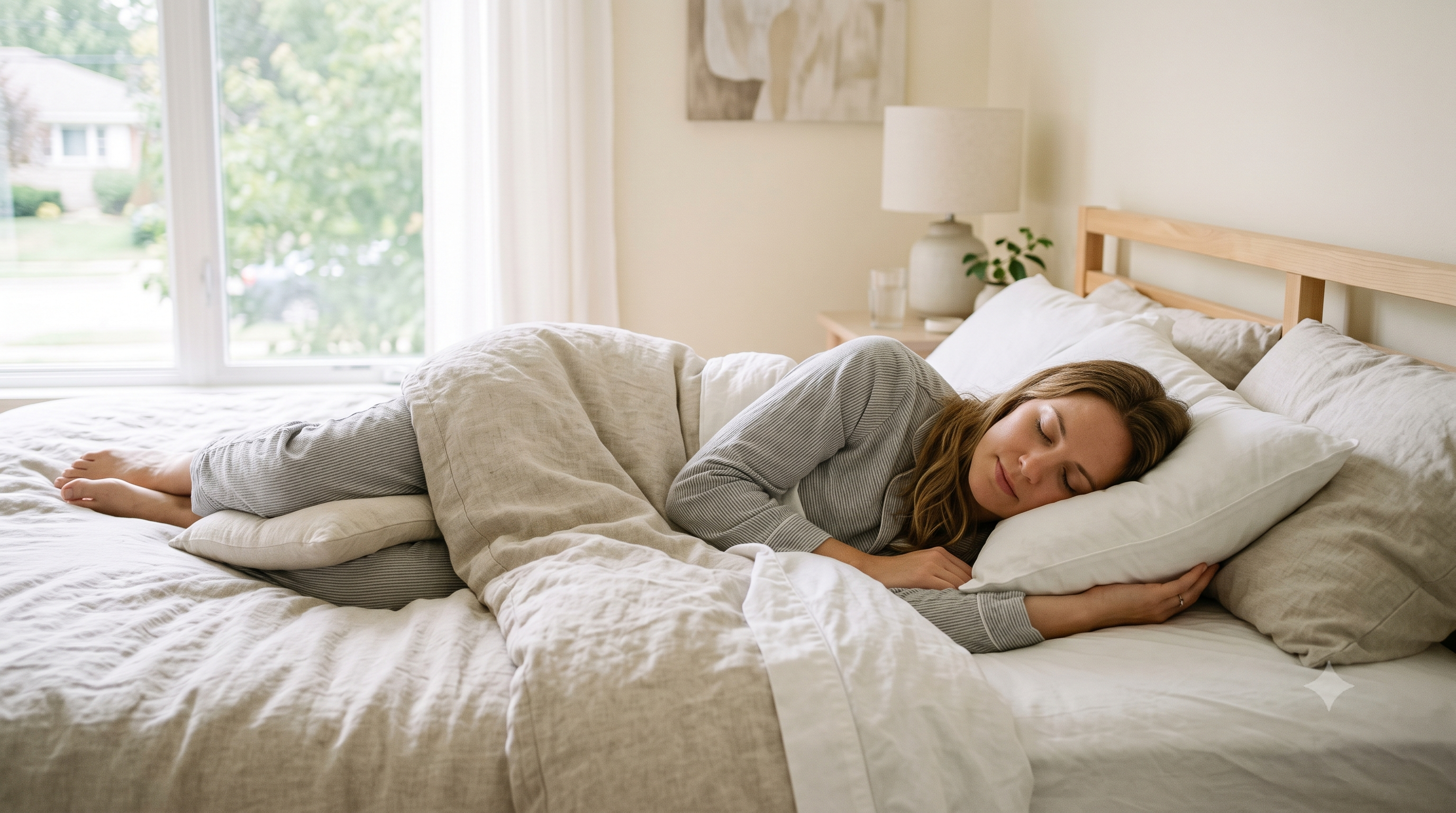
There is no single sleeping position that is best for everyone. Back and side sleeping generally support a neutral spine, while stomach sleeping tends to strain the neck. Side sleeping, especially on the left, is often preferred in pregnancy and for reflux. Choose based on comfort, breathing, and any doctor's guidance for conditions like snoring or sleep apnea.
Comparing sleeping positions is easiest with one simple framework: the Neutral Spine Test. Ask whether a position lets your spine keep its natural curve, keeps your airway open, and spreads your body weight without concentrating pressure on one shoulder, hip, or joint all night. Side and back sleeping generally pass this test more consistently than stomach sleeping, though the right choice for you still depends on comfort, any existing health conditions, and specific guidance you may have for snoring, sleep apnea, or pregnancy. For more on building a healthy sleep routine overall, see our sleep guide.
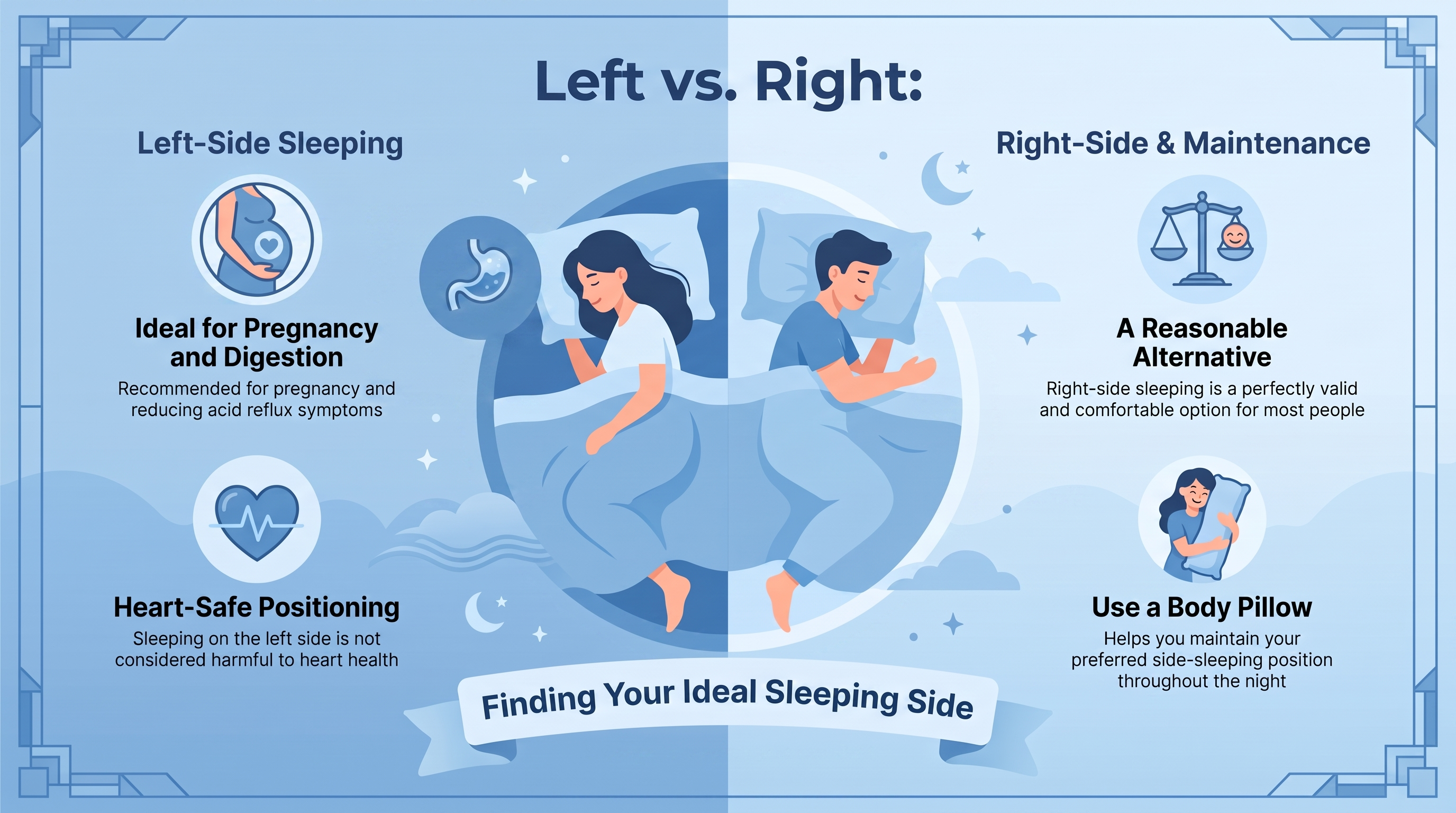
Deciding which side to sleep on comes down to comfort first, with a few situational reasons to lean one way or the other. Neither side is inherently "wrong" for a healthy adult — the goal is picking one side you can hold comfortably through the night with your spine in a neutral line, rather than switching sides restlessly.
Sleeping on the left side is the one most commonly recommended in specific situations, such as pregnancy or acid reflux, because it can ease pressure on certain organs and blood vessels compared with the right side. Outside of those situations, the right side is a perfectly reasonable alternative, and many people simply find one side more comfortable than the other because of shoulder, hip, or arm positioning. If you toss and turn between sides all night, a body pillow can help you settle into one side more consistently.
For most healthy people, sleeping on the left side is not considered harmful to the heart — it is, if anything, the side more often recommended, particularly in pregnancy. Some people who already have a heart condition report that one side feels less comfortable than the other, which is worth raising with a doctor rather than trying to interpret on your own. If you notice new chest discomfort, palpitations, or shortness of breath tied to a particular sleeping position, that is a reason to seek medical advice rather than simply switching sides.
When people ask about the single best side to sleep on, the honest answer is that it depends on the reason you are asking. For reducing acid reflux symptoms or during pregnancy, the left side is the one most often suggested. For general comfort with no specific medical reason to prefer one side, the best side is simply the one that lets you keep a straight, supported spine and wake up without new aches. A pillow that fills the gap between your ear and shoulder, plus one between the knees, does more for comfort than the choice of left versus right on its own.
Stomach sleeping is generally considered the least favorable of the common positions. It usually forces the neck to stay turned to one side for hours, which can strain the neck and upper back, and it can flatten the natural curve of the lower spine since the hips tend to sink into the mattress. That said, stomach sleeping is not medically dangerous the way an untreated health condition can be — it is more a matter of comfort and next-day stiffness for most people. If you are a committed stomach sleeper, a thin, flat pillow (or none at all) reduces some of the neck strain, and a slim pillow under the hips can help support the lower back.
Side sleeping is one of the more commonly recommended positions overall. It tends to support a neutral spine when paired with the right pillow height, and it is a standard recommendation during pregnancy and for people managing acid reflux. Side sleeping can also be more comfortable for people who snore, since it moves the tongue and soft tissue of the throat away from directly blocking the airway compared with lying flat on the back.
The trade-offs with side sleeping are mostly about pressure points and cosmetic comfort: extended pressure on one shoulder and hip, and some people notice facial skin creasing against the pillow overnight. A pillow between the knees keeps the hips level and takes pressure off the lower back, and a supportive pillow under the head keeps the neck aligned with the spine rather than tilted upward or downward.
Back sleeping is often considered the most spine-friendly default position because it lets the body's weight distribute evenly along the mattress without the spine curving to one side. For many people it also reduces the facial pressure and skin creasing that can come with side sleeping. Deep, uninterrupted sleep supports processes like the brain's glymphatic clearance system, which expands the space between brain cells by roughly 60% during deep sleep to help clear metabolic waste — a benefit tied to getting solid deep sleep generally, not to any single position, but comfortable positioning is part of what makes that uninterrupted sleep possible.
Back sleeping is not the right fit for everyone. People who snore heavily or have been told they stop breathing during sleep sometimes find that back sleeping makes snoring more noticeable, since gravity can let the tongue and soft palate rest further back in the throat. If that describes you, see the guidance below on when to talk to a doctor.
Proper sleeping posture, in any position, means keeping the spine's natural curves supported rather than forced flat or sharply bent. On the back, that usually means a pillow with enough loft to support the neck's curve without tilting the chin too far up or down, and sometimes a thin pillow under the knees to ease lower-back pressure. On the side, it means a pillow that fills the space between the ear and the mattress and a pillow between the knees. The common thread across positions is avoiding a posture that twists the spine or forces a joint into an unsupported angle for hours at a time.
Switching to back sleeping is usually a gradual habit change rather than something that happens in one night. A few approaches people find helpful: starting the night on your back with a supportive pillow under the knees, using a body pillow or wedge along one side to make rolling onto your side less automatic, and staying consistent over several weeks rather than giving up after one uncomfortable night. If you are trying to switch to back sleeping specifically because of loud snoring or witnessed pauses in breathing, that is worth discussing with a doctor, since it may point to sleep apnea rather than something position alone will fix.
The fetal position — sleeping on your side with the knees drawn up toward the chest — is essentially a curled variation of side sleeping, and it is one of the most common positions people naturally fall into. A relaxed curl keeps most of the benefits of side sleeping, including airway comfort and a supported spine. A very tightly curled posture held all night, on the other hand, can restrict deep breathing and add extra stiffness to the neck and lower back by morning. Keeping the curl gentle rather than tight, with a pillow between the knees, is generally the more comfortable version of this position.
Beyond left, right, back, or stomach, a few related questions come up often. What is a good sleeping position overall comes back to the Neutral Spine Test described above: a good position keeps your spine supported, your airway open, and pressure off any single joint, and it is comfortable enough that you are not fighting your own body all night.
The best direction to sleep in clinical sleep guidance almost always refers to which side of the body you sleep on, not compass direction. Some traditional and cultural systems, including Vastu Shastra, recommend orienting the head toward a specific compass direction while sleeping. This is a cultural and traditional practice rather than something studied in mainstream sleep medicine, so it is reasonable to follow if it matters to you personally, alongside the physical positioning guidance above rather than instead of it.
Sleep difficulties are also commonly reported in autistic children and adults, and comfort preferences for sleeping position can vary widely from person to person — often tied to sensory preferences around pressure, bedding texture, or a preferred curled posture. There is no single sleeping position that is medically required for autism specifically; a pediatrician can help tailor bedtime routines and positioning to an individual's sensory needs, and our guide to baby sleep problems covers broader troubleshooting for young children who resist settling into any position.
Sleeping position alone rarely explains a serious health problem, but a few signs are worth raising with a doctor:
For infants, sleeping position is a separate safety topic from this guide — babies should always be placed on their backs to sleep, on a firm, flat surface, through the first year. Our baby sleep schedule guide covers safe infant sleep routines in more depth.