What are dust mites, exactly? They are microscopic arachnids — tiny relatives of spiders and ticks — that live in the dust of nearly every home. You share your mattress, pillows, and sofa with them, yet you will never see one with the naked eye. This explainer walks through what they are, where they come from, how big they are, and how they live.
Dust mites are microscopic arachnids, about 0.2 to 0.3 mm, that live in house dust. They feed on the dead skin flakes people shed, thrive in warm, humid places, and cannot fly or bite. They are creamy white and invisible to the naked eye.
Because they are so small and never bite, dust mites are easy to misunderstand. The sections below use one simple framework — the Feed, Thrive, Spread lens — to explain their food, their ideal conditions, and how they get around your home.
Where Do Dust Mites Come From
Dust mites come from the ordinary dust that builds up in any lived-in home, not from dirt or poor housekeeping. Wherever people spend time, they shed dead skin flakes, and those flakes are exactly what dust mites eat. Once a food supply and warm, humid air are present, a population can establish itself.
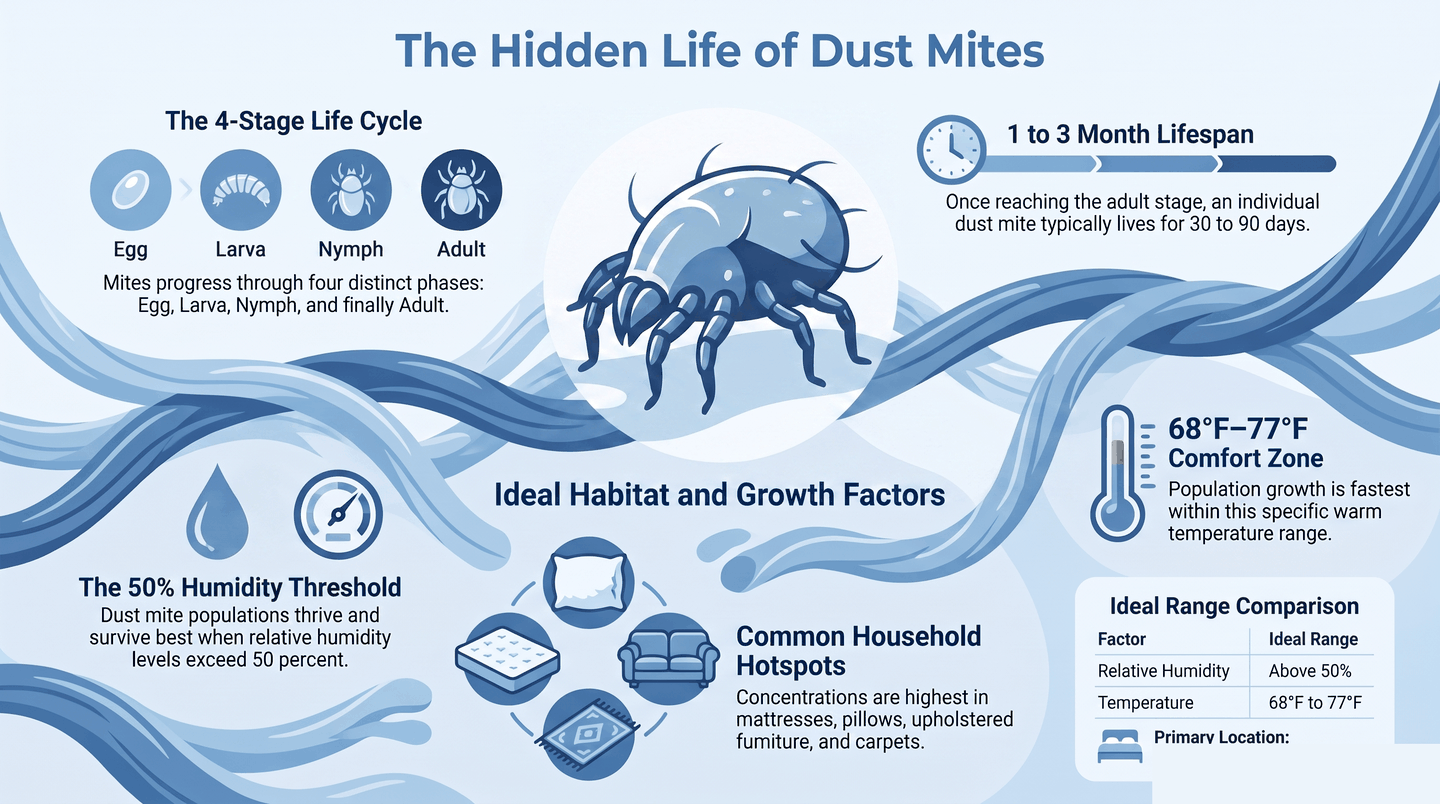
They travel into a home on clothing, bedding, upholstered furniture, and secondhand textiles, then settle in soft materials that trap dust. Even a spotless house has them, because skin flakes and humidity — not clutter — are what they need.
House Dust Mite (Dermatophagoides)
The house dust mite belongs to the genus Dermatophagoides, and two species dominate indoor dust worldwide. Dermatophagoides farinae is often called the American house dust mite, and Dermatophagoides pteronyssinus is often called the European house dust mite. Despite the names, both are found across the world.
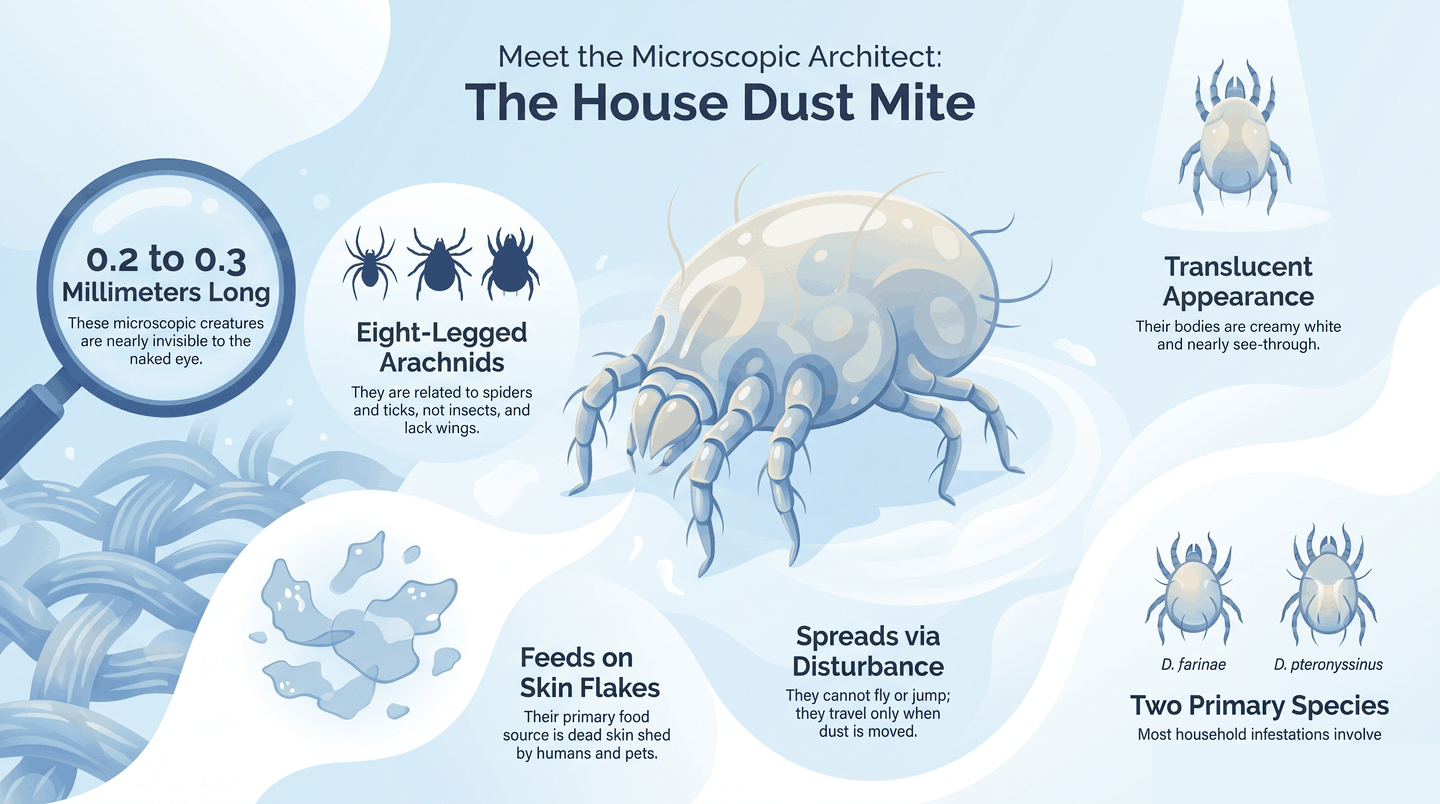
Both are arachnids, not insects — they have eight legs as adults and are closely related to spiders and ticks. Their scientific name roughly means "skin eater," which captures precisely how they live: quietly feeding on the flakes of dead skin humans and pets leave behind.
Dust Mites Size (How Big Are Dust Mites)
Dust mites size is tiny: an adult measures only about 0.2 to 0.3 mm long, far below what the naked eye can resolve. For scale, that is roughly the width of a fine grain of salt, which is why a mattress can hold a large population without a single visible sign.
Their small size and pale, translucent bodies are the main reasons people doubt they exist at all. You cannot see them individually; you can only see the dust they live in.
What Do Dust Mites Eat?
Dust mites eat the dead skin flakes that humans and pets shed every day. An adult person sheds enough skin cells to feed thousands of mites, and those flakes collect exactly where people rest — in mattresses, bedding, and upholstered furniture. This is the "Feed" part of how they live: they do not need blood, plants, or the food in your kitchen, only shed skin.
Do Dust Mites Fly?
Dust mites do not fly, because they have no wings, and they cannot jump either. They move slowly across surfaces on their own, so they spread mainly when the material they live in is disturbed — for example when you shake out bedding, vacuum, or move cushions and their fragments drift briefly through the air in the dust.
Are Dust Mites Everywhere?
Dust mites are nearly everywhere people live, found in almost every home regardless of how clean it is. They concentrate wherever dust and textiles collect: mattresses, pillows, bedding, upholstered furniture, and carpet. Rooms that stay warm and humid tend to hold the largest populations, which is the "Thrive" and "Spread" side of the framework.
Dust Mite Eggs & Life Cycle
Dust mite eggs are the first stage of a life cycle that runs egg → larva → nymph → adult. After hatching from the egg, a mite passes through larval and nymph stages before reaching adulthood, and an individual typically lives about one to three months. Under warm, humid conditions the population can grow steadily, since each stage develops faster in ideal temperature and moisture.
Understanding the life cycle matters for control: because mites depend on humidity at every stage, keeping indoor relative humidity below 50% makes conditions far less favorable for eggs to develop and populations to build.
Frequently Asked Questions
Want to go deeper on the symptoms and where they hide? These guides continue the topic:
- Dust mite allergy — symptoms, causes, and relief.
- Dust mite bites — what the skin reaction really is.
- Dust mites hub — the full overview of the topic.
Sources
- American College of Allergy, Asthma & Immunology — Dust Allergy
- American Lung Association — Dust Mites
- Ohio State University Extension — House Dust Mites