If you searched for dust mite bites, you probably woke up itchy with a few red bumps and want to know if these tiny household mites are biting you. Here is the honest answer up front: they are not. Dust mites cannot bite, and understanding why changes how you treat the marks on your skin.
Dust mites do not bite. They have no biting mouthparts and feed on dead skin flakes, never blood. What people call "dust mite bites" are actually an allergic skin reaction to dust mite droppings and body fragments — itchy red bumps or hives — or bites from a different insect.
That single fact is the foundation for everything below. Because there is no real bite, there is no venom or wound to heal — instead you are managing an allergy. Below we cover what the reaction looks like, how it differs on darker skin, why it itches, and how to calm it down.
Do Dust Mites Bite Humans?
Dust mites do not bite humans. These microscopic arachnids live in mattresses, bedding, carpets, and upholstered furniture, and they survive entirely on the dead skin cells that people and pets shed every day. They have no interest in blood and, crucially, no mouthparts capable of piercing human skin.
So where do the itchy marks come from? Dust mites produce waste and shed body fragments packed with proteins that act as powerful allergens. In sensitized people, contact with these allergens — or breathing them in — sets off an allergic response. The skin version of that response is what gets mistaken for a bite.
If you want the full picture of how these allergens affect the body, our guide to dust mites explained covers what they are and why they thrive in bedrooms.
What Do Dust Mite Bites Look Like
What people describe as dust mite bites look like small, red, itchy bumps or raised welts, usually appearing where skin has been in contact with bedding, pillows, or upholstered furniture. Because no actual bite is involved, the appearance is really the look of an allergic skin flare — closer to hives or eczema than to a puncture mark.
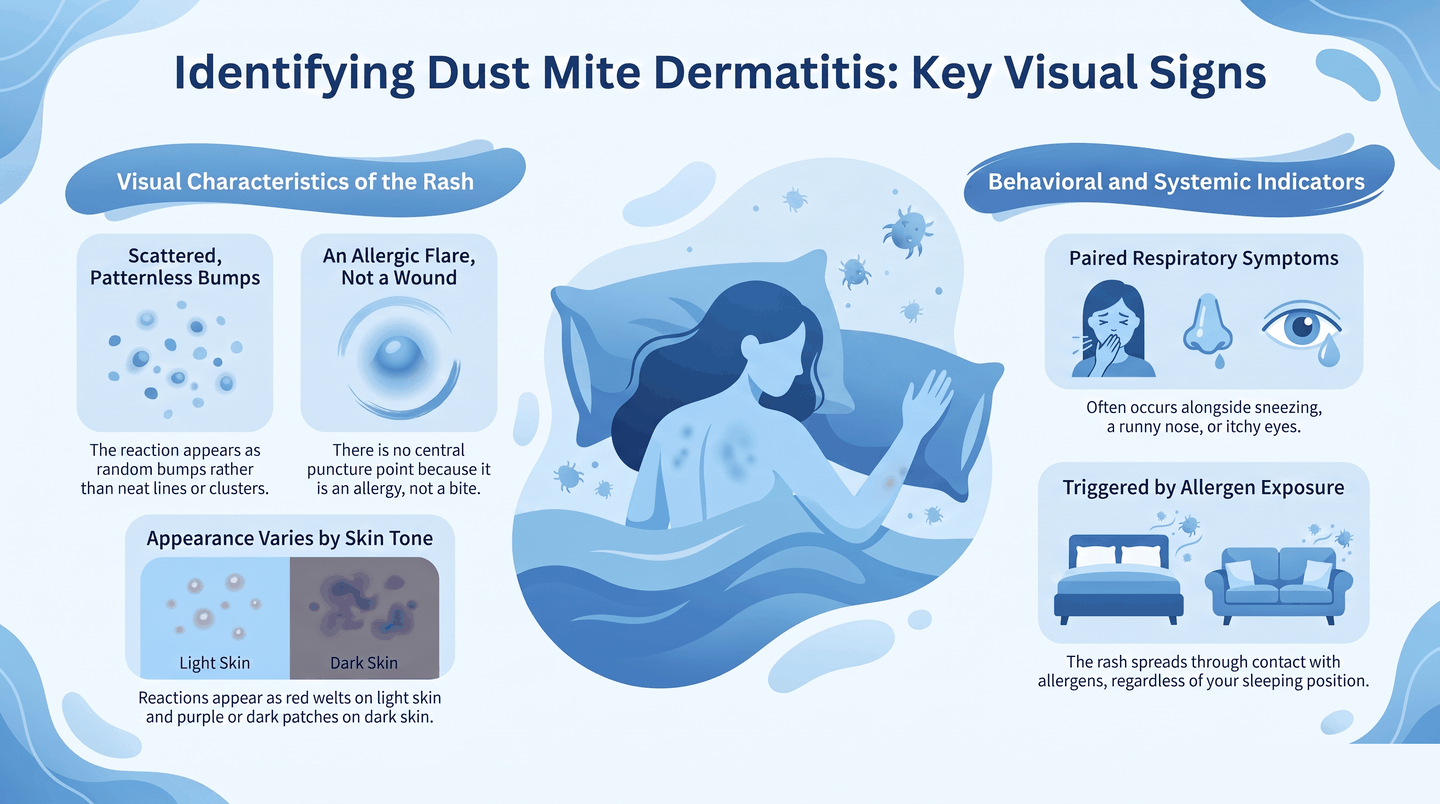
The most useful clue is the pattern. True biting insects tend to leave organized marks: bed bugs often bite in rough lines or clusters, and fleas favor the ankles. A dust mite reaction is the opposite — scattered and patternless, following wherever your skin reacts rather than where an insect fed. There is also no central puncture point and no room evidence such as specks on the sheets.
Dust Mite Bites on Humans
On human skin, dust mite bites show up as diffuse redness with small itchy bumps rather than distinct, evenly spaced spots. In people prone to allergies, the reaction can spread into patches of dry, inflamed, eczema-like skin, and repeated scratching can make the area rougher and more irritated over time.
The reaction also tends to travel with exposure, not with a sleeping position. If bumps flare after time on a dusty sofa or worsen in a stuffy, humid bedroom — and come alongside sneezing, a runny nose, or itchy eyes — that combination points firmly toward a dust mite allergy rather than an insect that bites.
Not sure whether an insect is actually involved? Our side-by-side comparison of dust mite bites vs bed bug bites walks through the marks, the pattern, and the room evidence that separate an allergy from a true bite.
Dust Mite Bites Treatment
Dust mite bites treatment works best on two fronts at once: calming the skin reaction you already have, and cutting the allergen exposure that keeps causing it. A simple way to remember it is the Reduce–Relieve–Review framework — reduce the trigger, relieve the symptoms, and review with a professional if things do not settle.
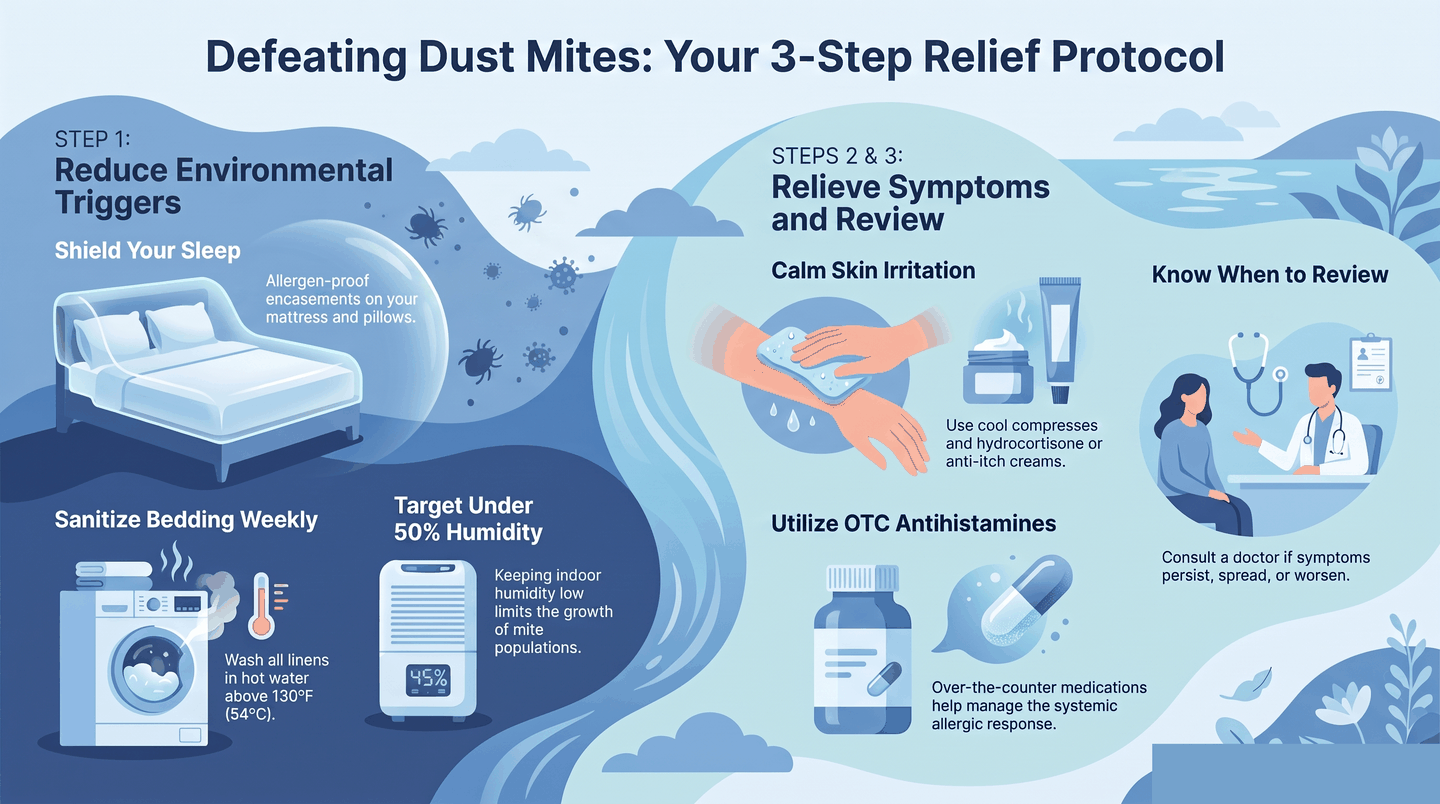
- Reduce the trigger. Use allergen-proof encasements on your mattress and pillows, wash bedding weekly in hot water, and lower indoor humidity so mite populations shrink. Our guide to dust mite removal covers this step by step.
- Relieve the symptoms. Cool compresses ease itching, while over-the-counter anti-itch or hydrocortisone creams and oral antihistamines can calm the allergic response. Avoid scratching, which prolongs irritation.
- Review with a professional. If the reaction is persistent, widespread, or paired with breathing symptoms, see a doctor or allergist. They can confirm a dust mite allergy and discuss longer-term options.
Dust Mite Bites on Black Skin
Dust mite bites on black skin often look different from the bright-red bumps shown in most stock photos. On black or brown skin tones, the allergic reaction tends to appear purple, dark brown, or simply darker than the surrounding skin rather than red, which can make the flare harder to spot at a glance even though the underlying reaction is the same.
The itch, the raised texture, and the scattered pattern are identical across skin tones. One extra thing to watch for on darker skin is post-inflammatory hyperpigmentation — the healed spots can leave darker marks that linger for weeks. Avoiding scratching and calming the reaction early helps limit that discoloration.
Allergic Reaction to Dust Mite Bites
An allergic reaction to dust mite bites is, in truth, the whole story — since there is no bite, the "reaction" is the condition itself. When a sensitized immune system meets dust mite allergens, it releases histamine, producing itchy bumps, hives, or eczema flare-ups on the skin, and often sneezing, congestion, or itchy, watery eyes at the same time.
Because it is an allergy rather than a wound, the skin usually settles within a few days once exposure drops. If bumps keep returning, the mites are still present in your environment. Treating the root cause — the allergen load in your bedding — matters more than any cream. To understand the wider symptom picture, see our overview of dust mite allergy.
Strip your bed and wash the sheets and pillowcases in the hottest water the fabric allows, then wipe down the mattress and vacuum around the bed. If the itchy bumps ease over the next few nights, dust mite allergens were the likely trigger — and adding an allergen-proof encasement keeps them from coming back.
Frequently Asked Questions
Sources
- Asthma and Allergy Foundation of America — Dust Mite Allergy. Confirms dust mites are not parasites and do not bite; symptoms come from an allergic reaction to mite droppings and body parts, treated by reducing exposure.
- Mayo Clinic — Dust mite allergy. Describes dust mite allergy symptoms (sneezing, itchy skin, congestion) and prevention such as encasements, hot washing, and lowering humidity.
- American College of Allergy, Asthma & Immunology — Dust Allergy. Explains that dust mite allergens trigger allergic reactions and outlines management through allergen reduction and medical treatment.