How to get rid of dust mites comes down to three levers you can control at home: heat, moisture, and barriers. Dust mites are microscopic and live deep in bedding, mattresses, carpet, and upholstery, feeding on the dead skin flakes we shed. You will not see them, but you can make your home a much harder place for them to thrive.
To get rid of dust mites, wash bedding weekly in hot water at or above 130°F (54.4°C), use allergen-proof encasements on the mattress and pillows, keep indoor humidity below 50%, and vacuum with a HEPA filter. Chemicals are rarely needed — heat and dryness do the work.
No approach removes every mite, so the honest goal is strong reduction, not a "100% elimination" promise. The good news: a simple, repeatable routine built around washing, drying, and dryness reliably cuts both mite numbers and the allergens they leave behind.
What Kills Dust Mites Instantly
What kills dust mites instantly is heat and washing. Washing bedding in hot water at or above 130°F (54.4°C) kills dust mites on contact, and a dryer set to high heat kills them as well. These two methods are the fastest, most reliable tools you have.
Heat matters because dust mites cannot survive high temperatures. That is why a hot wash-and-dry cycle is the backbone of control for anything washable — sheets, pillowcases, blankets, and mattress pad covers. For items you cannot wash hot, a high-heat dryer cycle does the killing instead.
The other side of the coin is moisture. Dust mites need humidity to survive because they absorb water from the air. Keeping indoor humidity below 50% with a dehumidifier or air conditioner slowly starves them out. It is not instant, but it steadily lowers the population between washes.
Dust Mite Control Products
Dust mite control products work best when they attack the two things mites depend on: humidity and access to your skin. You do not need a cabinet full of sprays — a short, focused kit covers most homes.
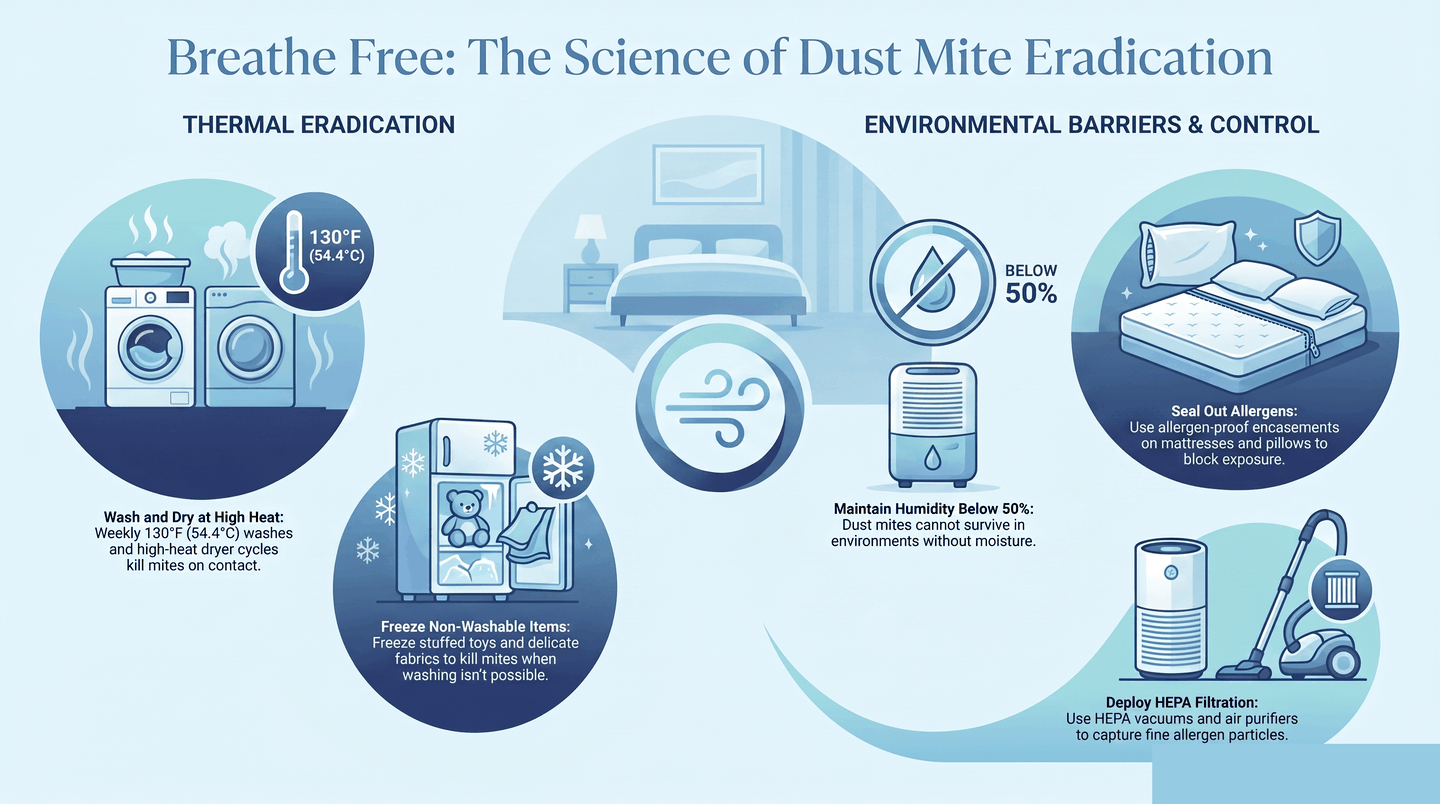
- Allergen-proof encasements — zippered, tight-weave covers for the mattress and pillows that trap mites and their allergens inside so they cannot reach you.
- A dehumidifier or air conditioner — to hold indoor humidity below 50%, the level that keeps mites from thriving.
- A HEPA vacuum — captures fine dust and allergen particles that ordinary vacuums can stir back into the air.
- A HEPA air purifier — reduces airborne allergens in the bedroom, where you spend the most time.
- Washable bedding — sheets and covers you can safely run through a 130°F (54.4°C) hot wash each week.
Chemical treatments are rarely necessary. The most effective plan leans on heat, moisture control, and physical barriers rather than pesticides, which is cheaper, simpler, and better for the air you breathe.
How to Get Rid of Dust Mites in Bed
How to get rid of dust mites in bed starts with the bedding you touch every night. Your mattress and pillows are the single biggest reservoir of mites in the home because they collect warmth, moisture, and shed skin. Attack the bed first and you deal with the largest source at once.
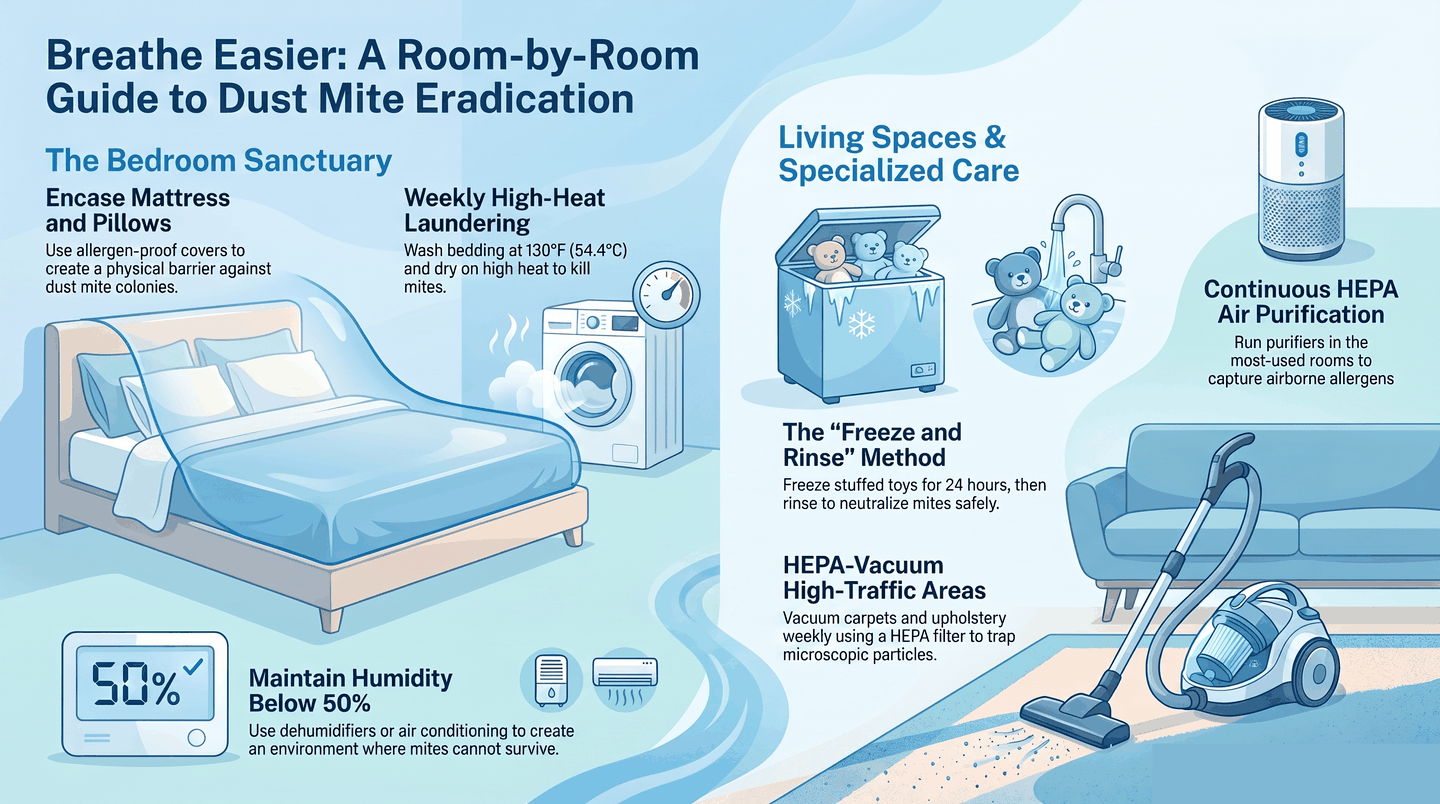
The core routine is simple: wash all bedding weekly in hot water at or above 130°F (54.4°C) and dry it on high heat, then seal the mattress and pillows inside allergen-proof encasements so trapped mites cannot reach you. Keep the bedroom below 50% humidity to slow any regrowth.
How to Get Rid of Dust Mites in Your House
How to get rid of dust mites in your house means widening the same principles beyond the bed. Reduce the soft surfaces that hold dust, and clean the ones you keep more thoroughly and often.
- Keep whole-home humidity below 50% with a dehumidifier or air conditioner.
- Vacuum carpets and upholstery with a HEPA vacuum, and run a HEPA air purifier in the rooms you use most.
- Where practical, reducing carpet and heavy upholstery removes places mites settle; hard floors and washable rugs are easier to keep mite-poor.
- Wash or hot-dry curtains, throw blankets, and cushion covers on a regular schedule.
How to Get Rid of Dust Mites in a Mattress
How to get rid of dust mites in a mattress is mostly about sealing and denial, since you cannot put a mattress through a hot wash. An allergen-proof encasement zips fully around the mattress and traps mites and allergens inside, cutting off your exposure.
- Fit a zippered, allergen-proof encasement over the whole mattress and leave it on.
- Vacuum the mattress surface with a HEPA vacuum before encasing it.
- Keep bedroom humidity below 50% so any mites inside cannot thrive.
- Wash the sheets and mattress pad over the encasement weekly at 130°F (54.4°C).
How to Get Rid of Dust Mites in a Room
How to get rid of dust mites in a room ties the bed, the air, and the soft furnishings together into one space you can keep under control — usually the bedroom, where exposure matters most.
- Encase the mattress and pillows, and hot-wash bedding weekly.
- Run a dehumidifier or air conditioner to hold the room below 50% humidity.
- HEPA-vacuum floors and upholstery, and run a HEPA air purifier.
- Hot-wash or freeze stuffed toys; freezing small items that cannot be washed helps kill mites before a rinse.
Strip the bed and run every washable item through a hot wash at 130°F (54.4°C) and a high-heat dry. While it runs, HEPA-vacuum the mattress and floor, then set a small hygrometer in the room and adjust your dehumidifier or AC until it reads below 50%. That single afternoon covers heat, moisture, and barriers at once.
Dust Mites Treatment
Dust mites treatment at home is less about killing every mite and more about keeping their numbers and allergens low for good. Because you cannot reach total elimination, the winning strategy is a steady routine that combines heat, dryness, and barriers week after week.
| Method | What it does | How to use it |
|---|---|---|
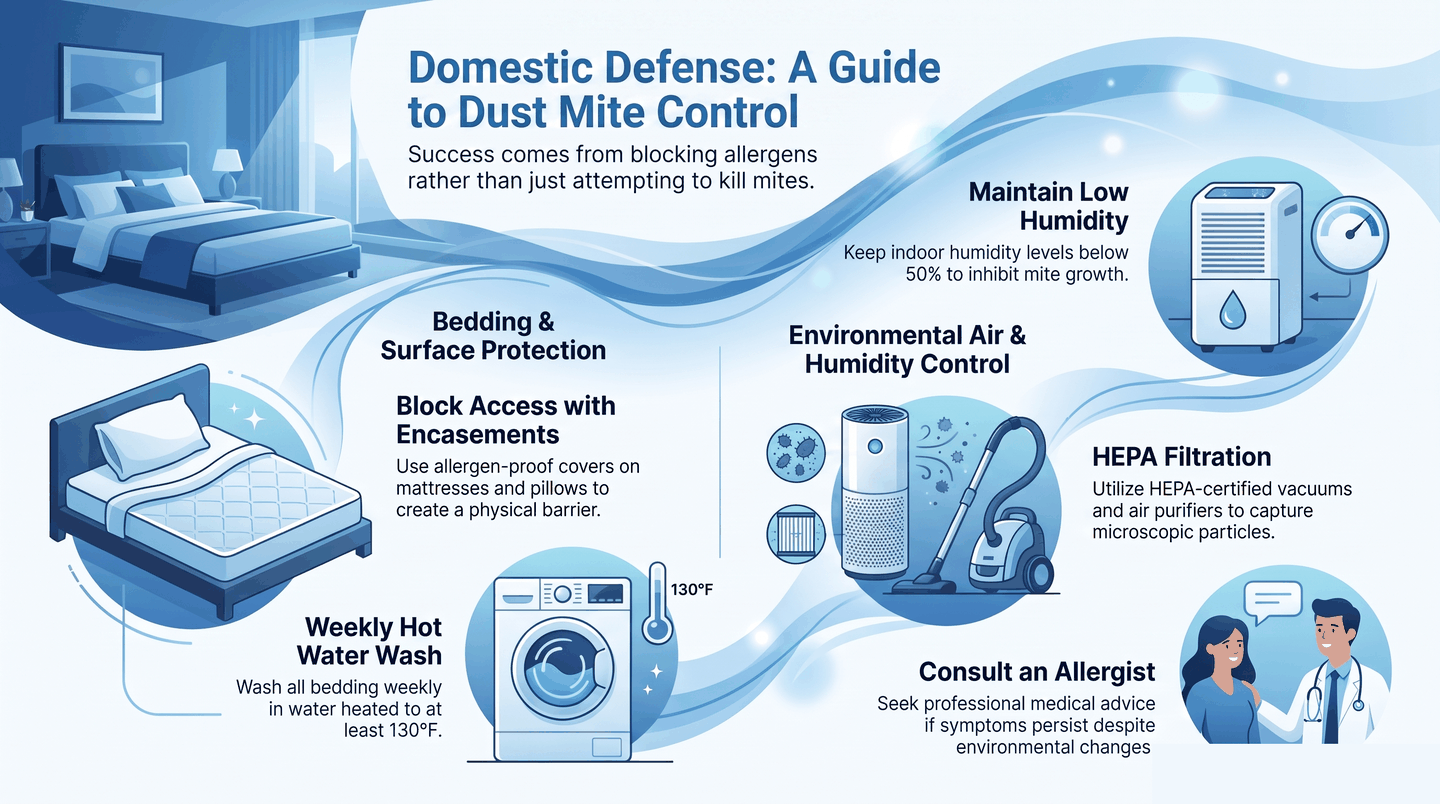
| Hot washing | Kills mites in washable items | Bedding weekly at ≥130°F (54.4°C) |
| High-heat drying | Kills mites, including on non-hot-wash items | Dryer on high heat after washing |
| Encasements | Traps mites and allergens, blocks exposure | Zip over mattress and pillows, keep on |
| Humidity control | Starves mites of the moisture they need | Keep indoor humidity below 50% |
| HEPA cleaning | Reduces settled and airborne allergens | HEPA vacuum plus HEPA air purifier |
| Freezing | Kills mites in items you cannot wash hot | Freeze stuffed toys, then wash |
Notice what is missing: pesticides. Chemical mite treatments are rarely necessary, and most households get strong, lasting results by leaning on heat, moisture control, and barriers instead. If dust mite allergy symptoms persist despite a solid routine, that is a cue to talk with a healthcare provider about medical options.
Want the background on the creatures themselves? See dust mites explained for what they are and where they live, and dust mite bites for why the skin reaction is really an allergy, not a bite. You can also browse the full dust mites hub for every guide in one place.
Frequently Asked Questions
Sources
- Mayo Clinic. "Dust mite allergy — Diagnosis & treatment." mayoclinic.org
- Asthma and Allergy Foundation of America. "Dust Mite Allergy." aafa.org
- American Lung Association. "Dust Mites." lung.org