Why Is Sleep Important? The Science of Sleep

Sleep is important because it is an active process the body uses to repair tissue, clear waste from the brain, regulate metabolism and immunity, and consolidate memory. Two brain systems govern it: a homeostatic sleep drive and a circadian clock. Getting too little — or too much — sleep is linked to measurably worse health outcomes.
The clearest way to understand why sleep matters is the Two-Process Model of Sleep Regulation, first described by researcher Alexander Borbély in 1982. It holds that sleep is governed by two interacting systems: Process S, a homeostatic sleep drive that builds the longer you stay awake as the chemical adenosine accumulates in the brain, and Process C, a circadian drive run by the suprachiasmatic nucleus (SCN) that times sleepiness and alertness to roughly a 24-hour cycle. Nearly every question people ask about sleep — why we sleep, what sleep does for the body, why humans cannot skip it — traces back to these two systems working together.
This guide covers the science of sleep from why the brain evolved to need it, through its measurable benefits, to what specifically alcohol disrupts. For sleep needs at different life stages, see baby sleep schedule; for building a better sleep environment, see best noise machines for sleep. The full sleep hub has guides on every stage of the sleep cycle.
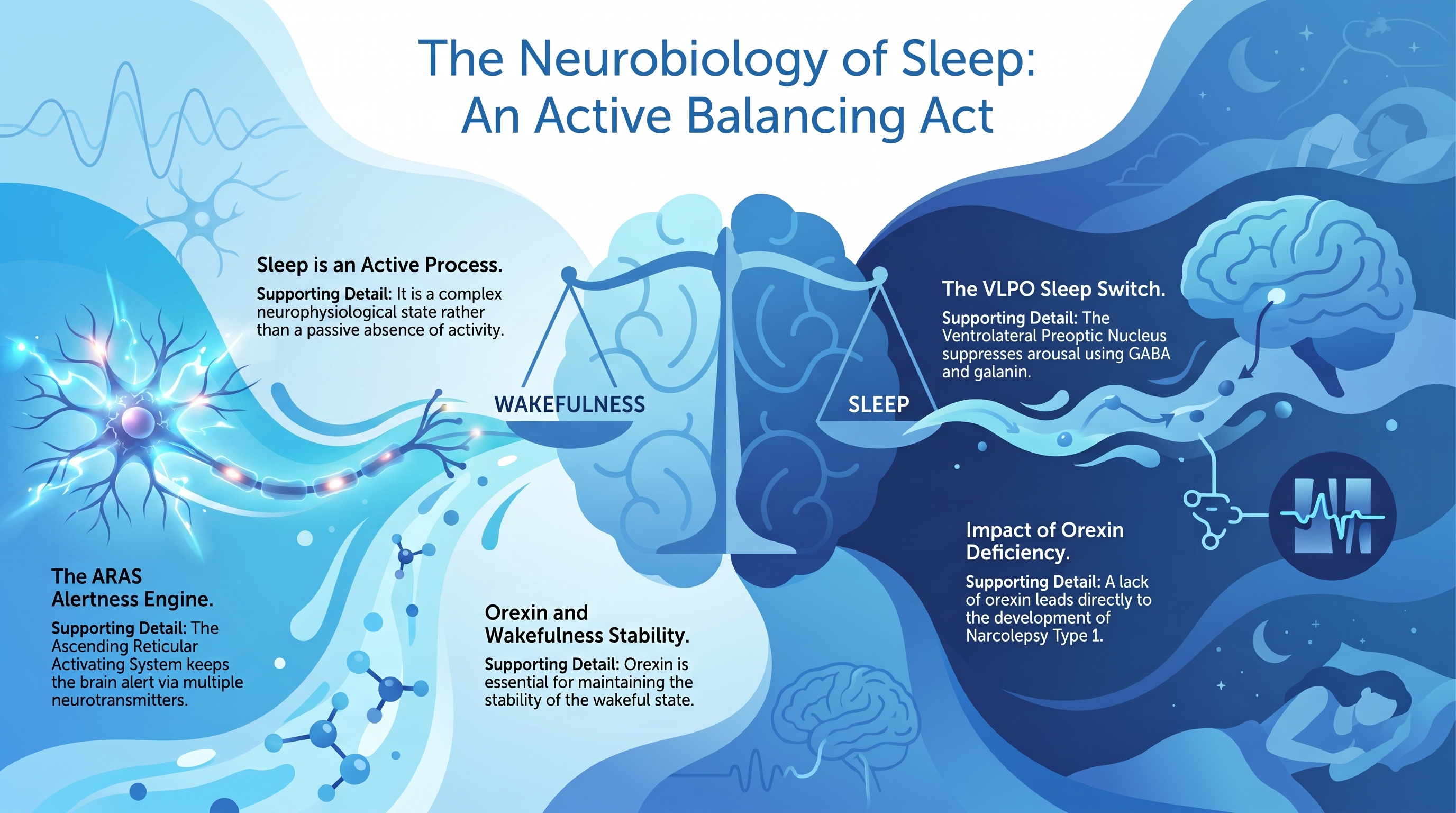
Sleep is not simply the absence of wakefulness. It is an active, highly conserved neurophysiological process that the body relies on for cellular housekeeping, physical recovery, metabolic regulation, and cognitive upkeep. Two brain systems control when it happens. Wakefulness itself is maintained by the ascending reticular activating system (ARAS), which uses norepinephrine from the locus coeruleus, serotonin from the raphe nuclei, dopamine from the ventral tegmental area, and histamine from the tuberomammillary nucleus to keep the brain alert. Sleep is switched on by the ventrolateral preoptic nucleus (VLPO), which uses the inhibitory neurotransmitters GABA and galanin to suppress those arousal signals. Orexin (also called hypocretin), released from the lateral hypothalamus, stabilizes the transitions between the two states — a deficiency in orexin is what causes narcolepsy type 1.
Caffeine's effect on sleep is a useful illustration of how this system works: caffeine is a competitive antagonist at adenosine receptors (A1 and A2A), meaning it blocks the buildup of Process S sleep pressure rather than adding energy, which is why it can delay sleep onset even hours after it is consumed.
Sleep itself is not one uniform state. It cycles through non-REM (NREM) stages N1, N2, and N3, followed by REM sleep, in cycles that last roughly 90 to 110 minutes each. N1 is a light transitional stage marked by theta brain waves. N2 is stable light sleep featuring sleep spindles and K-complexes, which support motor and procedural memory. N3, also called slow-wave or deep sleep, produces the largest slow delta brain waves, the greatest release of growth hormone, and the most tissue repair. REM sleep is when most vivid dreaming happens, accompanied by temporary muscle atonia and heavy emotional processing. Deep sleep dominates the earlier cycles of the night, while REM sleep becomes more concentrated in the second half — one reason cutting a night short disproportionately reduces REM sleep.
Much of the public interest in the science of sleep traces back to the book Why We Sleep by sleep scientist Matthew Walker, which introduced a broad readership to concepts like sleep stages, the two-process model, and the downstream effects of chronic sleep loss. It remains one of the most commonly referenced popular science books on the subject, and it is a reasonable starting point for readers who want a deeper narrative treatment of the neuroscience summarized on this page.
Sleep's benefits show up across nearly every system in the body. During deep, slow-wave sleep, the brain's interstitial space expands by roughly 60%, allowing the glymphatic system — a brain-wide waste-clearance network dependent on astrocyte water channels called AQP4 — to flush out neurotoxic proteins such as amyloid-beta and tau, both implicated in Alzheimer's disease. This clearance process is one of the clearest physical reasons deep sleep matters, not just for feeling rested but for long-term brain health.
Sleep also directly supports the immune system. People getting fewer than 7 hours of sleep a night have been shown to have almost three times (2.94x) the risk of catching a cold compared with those sleeping 8 or more hours, and poor sleep efficiency below 92% was linked to a 5.5 times higher risk in the same research. On the metabolic side, even one week of restricting sleep to 5 hours a night can lower peripheral insulin sensitivity by up to 16% and reduce testosterone in young men by 10 to 15%, while sleep loss more broadly drops the appetite-suppressing hormone leptin by about 18% and raises the hunger hormone ghrelin by about 28%, driving roughly 385 extra calories of daily intake.
Sleep extension also measurably improves physical performance. In a study of college basketball players who extended their sleep to 10 or more hours a night over 5 to 7 weeks, sprint times improved from 16.2 to 15.5 seconds, free-throw shooting improved by 9%, and three-point shooting accuracy improved by 9.2%. Deep sleep's role in memory is just as concrete: declarative memory is consolidated in N3 sleep through the coordinated timing of cortical slow oscillations, sleep spindles, and hippocampal sharp-wave ripples.
What is the importance of sleep in the simplest terms? It is one of the few daily behaviors with a measurable, U-shaped relationship to how long you live. Research shows the lowest risk of death from any cause occurs around 7 to 8 hours of nightly sleep. Sleeping less than 7 hours is associated with roughly a 14% higher mortality risk (hazard ratio ≈ 1.14), while sleeping 9 or more hours is associated with roughly a 34% higher risk (hazard ratio ≈ 1.34) — often a marker of an underlying health condition rather than the long sleep itself causing harm.
Sleep need is not fixed across a lifetime, which is part of why "getting enough sleep" means something different depending on age. The CDC recommends: newborns (0–3 months) get 14–17 hours; infants (4–12 months) get 12–16 hours; toddlers (1–2 years) get 11–14 hours; preschoolers (3–5 years) get 10–13 hours; school-age children (6–12 years) get 9–12 hours; teenagers (13–18 years) get 8–10 hours; and adults (18 and older) get 7 or more hours. Parents navigating the earliest, highest-need stages can find age-specific guidance in baby sleep schedule and safe setup guidance in baby sleep gear.
Older adults do not need less sleep than younger adults — the recommendation stays at 7 to 8 hours — but age-related changes in the brain and circadian system can make it harder to generate deep sleep, which is one reason sleep quality, not just duration, becomes more important to track later in life.
Humans need sleep because there is no substitute state that performs the same functions. The clearest demonstration of that comes from sleep deprivation itself: the longest documented period of voluntary wakefulness, by Randy Gardner in 1963–1964, lasted 264 hours (11 days) and produced cognitive impairment and hallucinations that resolved only once he was allowed to recover with sleep. Even far short of that extreme, chronically sleeping 6 hours a night for 14 straight nights produces attention and reaction-time deficits comparable to two full nights of total sleep deprivation — despite the person subjectively feeling only mildly tired.
Sleep is not controlled by a single brain region but by a switch between two competing networks. The ascending reticular activating system keeps the brain awake using norepinephrine, serotonin, dopamine, and histamine, while the ventrolateral preoptic nucleus (VLPO) actively promotes sleep using GABA and galanin. The suprachiasmatic nucleus (SCN), a cluster of roughly 20,000 neurons that functions as the body's master clock, sets the timing of that switch, and it responds most strongly to blue light around 480 nm detected by specialized retinal cells. Orexin from the lateral hypothalamus stabilizes the transitions between wake and sleep, and losing orexin-producing neurons causes narcolepsy type 1.
Historically, case studies of patients with damage to specific brain regions have been central to how scientists mapped which areas control sleep and wakefulness in the first place. Injury affecting sleep-promoting circuitry around the VLPO, or the arousal pathways running through the hypothalamus and brainstem, has been associated with excessive or persistent sleep in some patients, depending on exactly which pathway is disrupted. These lesion studies, alongside conditions like narcolepsy caused by orexin loss, are part of the evidence base that built the current picture of the brain's sleep-wake switch.
Alcohol is sedating, which leads many people to assume it helps sleep — but that assumption does not hold up. The specific aspect of sleep alcohol impacts most is REM sleep: alcohol suppresses REM, particularly during the first half of the night. As the alcohol is metabolized later in the night, sleep becomes more fragmented and disrupted, and alcohol also tends to worsen sleep-related breathing problems, including snoring and apnea-like disruptions. The net effect is sleep that may begin faster but is lower in quality and less restorative — the opposite of what people are usually looking for when they reach for a nightcap.
Occasional poor sleep is common, but certain patterns are worth discussing with a doctor rather than managing alone:
This article is educational and does not provide a diagnosis; a doctor can evaluate individual symptoms and recommend appropriate testing or treatment.