Sleep Divorce & Couple Sleeping Arrangements
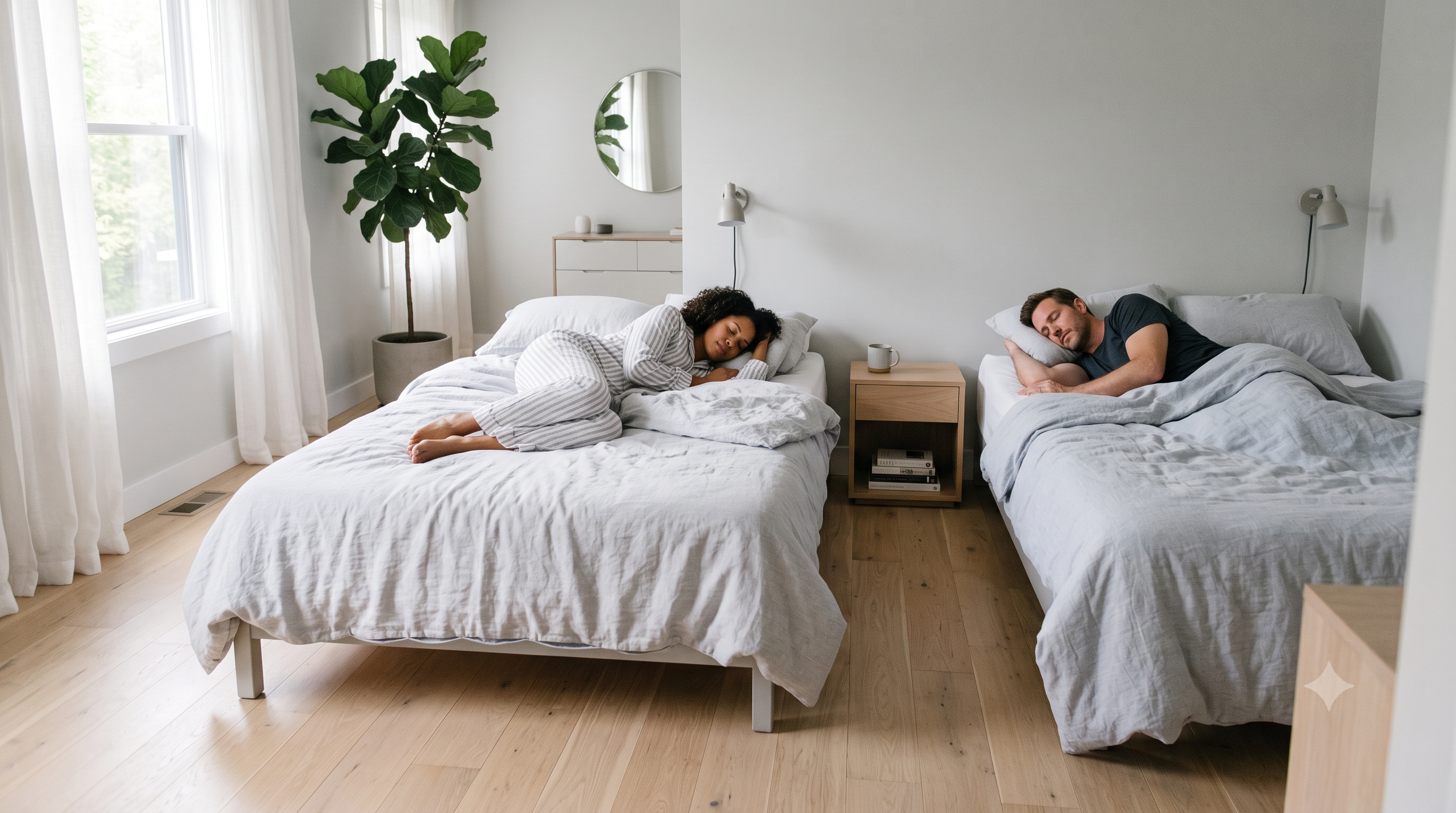
A sleep divorce means partners sleep in separate beds or rooms to protect sleep quality, not the relationship. Common triggers are snoring, mismatched schedules, restlessness, or a pet in bed. Because sleep loss measurably affects mood, metabolism, and long-term health, separate arrangements are a practical fix rather than a relationship failure.
Deciding how a couple should sleep — same bed, same bed with separate covers, or separate rooms entirely — is easiest with one clear framework: the 7-Hour Rule. Whichever sleep arrangement lets both partners consistently reach at least seven hours of sleep is the right one, because falling short of that threshold is tied to measurably worse outcomes: short sleep under 7 hours is associated with a higher mortality hazard ratio of about 1.14 compared with 7–8 hours, and adults generally need 7 or more hours a night regardless of age. If a shared bed keeps either partner under that line night after night, a change in arrangement is worth considering.
There is no single scientifically verified "best" couple sleeping position — the more relevant question is how much a partner's movement disturbs the other person's sleep cycle. A full night of sleep runs through repeated ultradian cycles of about 90 to 110 minutes each, alternating between lighter stages (N1, N2) and deeper stages (N3 slow-wave sleep and REM). During the lighter stages, a person is more easily woken by movement, light, or noise than during deep N3 sleep. A couple's chosen position — back-to-back, spooning, facing each other, or minimal contact on separate sides — matters less than whether the contact repeatedly interrupts these cycles.
For a couple sharing one bed, the most common disruptions are a partner shifting position, pulling covers, or getting in and out of bed while the other is in a lighter sleep stage. Because deep, slow-wave N3 sleep is when the body does most of its physical repair and the brain's glymphatic clearance system is most active, repeated awakenings during that window are more costly to recovery than a brief stir during N1 or N2. Couples who consistently wake each other during the same part of the night are more likely to consider a change in position, bedding, or arrangement — not because the relationship is at fault, but because the sleep cycle keeps getting interrupted at a vulnerable point.
How a couple sleeps has a real, measurable connection to well-being, mainly because sleep loss itself has documented psychological and physiological effects. In a controlled study, restricting sleep to about 5 hours a night for one week lowered peripheral insulin sensitivity by up to 16 percent and reduced testosterone in young men by 10 to 15 percent. Sleep loss also shifts appetite-regulating hormones — leptin drops roughly 18 percent and ghrelin rises roughly 28 percent — which is linked to eating around 385 extra calories a day. None of this is about relationship dynamics directly, but chronic sleep disruption from a shared bed can quietly erode mood, patience, and physical health, which in turn affects the relationship.
Even sleep that feels "good enough" can be misleading: getting 6 hours a night for 14 consecutive nights produces cognitive performance deficits comparable to two full nights of total sleep deprivation, even though the person subjectively feels only mildly tired. For couples debating whether disrupted shared sleep is "bad enough" to change, this is a useful data point — the damage can be real and cumulative even when it doesn't feel dramatic night to night. For ongoing, frequent insomnia (trouble falling or staying asleep three or more nights a week for three months or more), cognitive behavioral therapy for insomnia (CBT-I) is the recommended first-line approach, whether or not a couple also changes their sleep arrangement.
A pet sharing the bed adds another possible source of disruption, since movement, sound, or a change in position from an animal can trigger the same kind of micro-arousal a restless partner would. Because arousal thresholds are lowest during lighter N1 and N2 sleep stages, a pet that shifts around frequently is more likely to interrupt sleep than one that settles and stays still. There is no single rule here: some people report a calming effect from a pet's presence and sleep fine, while others sleep measurably better once the pet is moved to its own bed or another room. If sleep quality seems affected, tracking whether disrupted nights line up with the pet being in bed is a reasonable first step before assuming it's the human partner causing the problem.
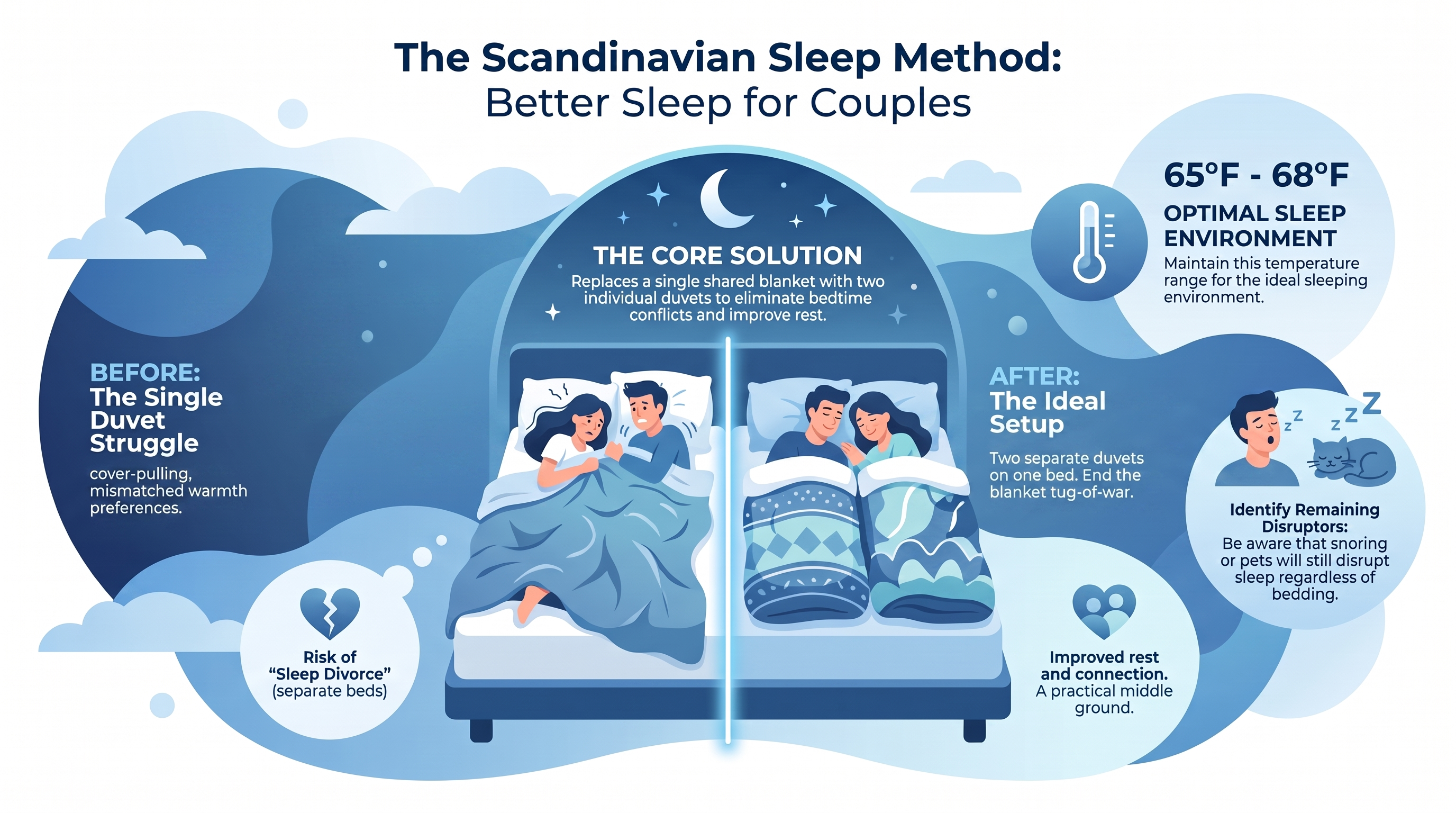
The Scandinavian sleep method keeps a couple in one shared bed but replaces a single shared top cover with two separate duvets or blankets, one per person. The appeal is practical: it removes cover-pulling and mismatched blanket preferences as a nightly source of waking each other, while keeping the closeness of sharing a bed. Temperature is a central piece of this — the recommended sleep environment is roughly 65 to 68°F (about 15.6–20°C), and partners often run warmer or cooler than each other. Separate duvets let each person manage their own warmth independently instead of negotiating a single shared setting all night.
The method does not address every source of disruption — a snoring partner or a pet in bed will still affect sleep regardless of how the covers are arranged. It is best thought of as one low-effort adjustment couples can try before moving to a full sleep divorce with separate beds or rooms. It's also worth noting that a nightcap is not a fix for a restless co-sleeper: alcohol can make a person fall asleep faster but it suppresses REM sleep, fragments the second half of the night, and can worsen snoring and sleep-related breathing issues — read more in alcohol and sleep.
Some reasons for a sleep divorce point to a medical issue rather than a simple mismatch in habits. Talk to a doctor if:
A snoring partner should not be assumed to simply be "a loud sleeper" without ruling out sleep apnea first.