Magnesium for Sleep: Types, Dosage and Benefits

Magnesium glycinate, taken as 200–400 mg of elemental magnesium about 30–60 minutes before bed, is the form and dose most studied for sleep. A trial using magnesium bisglycinate found people fell asleep 17.8 minutes faster and got 19.3% more deep sleep. Magnesium supports the nervous system's wind-down process rather than acting as a direct sedative.
Magnesium is a mineral cofactor involved in hundreds of processes in the body, and it has become one of the most searched supplements for sleep. The clearest way to think about it is the Calm-the-System framework: magnesium does not knock you out the way a sedative would, it supports the underlying nervous-system processes — nerve signaling, muscle relaxation, and the brain's own sleep-promoting chemistry — that make it easier for the body to settle into sleep. That distinction shapes everything below: which type to choose, how much to take, and when to take it.
Getting enough sleep matters for reasons far beyond feeling rested. If magnesium is one piece of a broader routine, it helps to look at the full picture in how to sleep better, and if falling or staying asleep is a recurring problem rather than an occasional one, see insomnia.
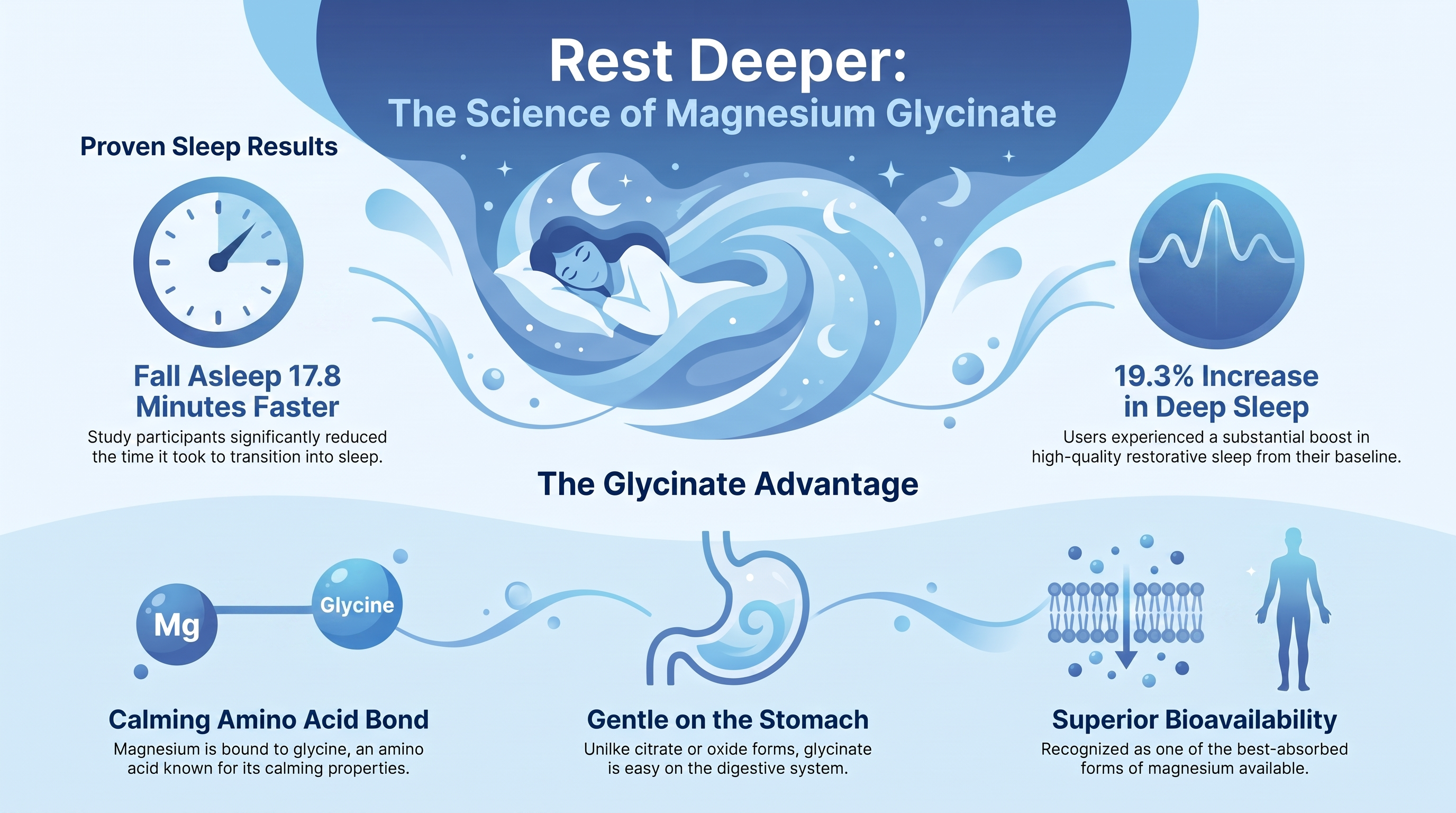
Magnesium glycinate — also called magnesium bisglycinate — is the form most closely tied to the sleep research behind magnesium's reputation. In a randomized controlled trial, participants who took magnesium bisglycinate fell asleep 17.8 minutes faster and saw their deep sleep increase by 19.3% compared with baseline. Magnesium is bound to the amino acid glycine, which is itself associated with calming, sleep-supportive effects, and this pairing is thought to be part of why the glycinate form is well tolerated and gentle on the stomach compared with other magnesium salts.
Because it is one of the better-absorbed forms and does not carry the laxative reputation of magnesium citrate or oxide, magnesium glycinate is the form most sleep-focused product formulations and recommendations default to.
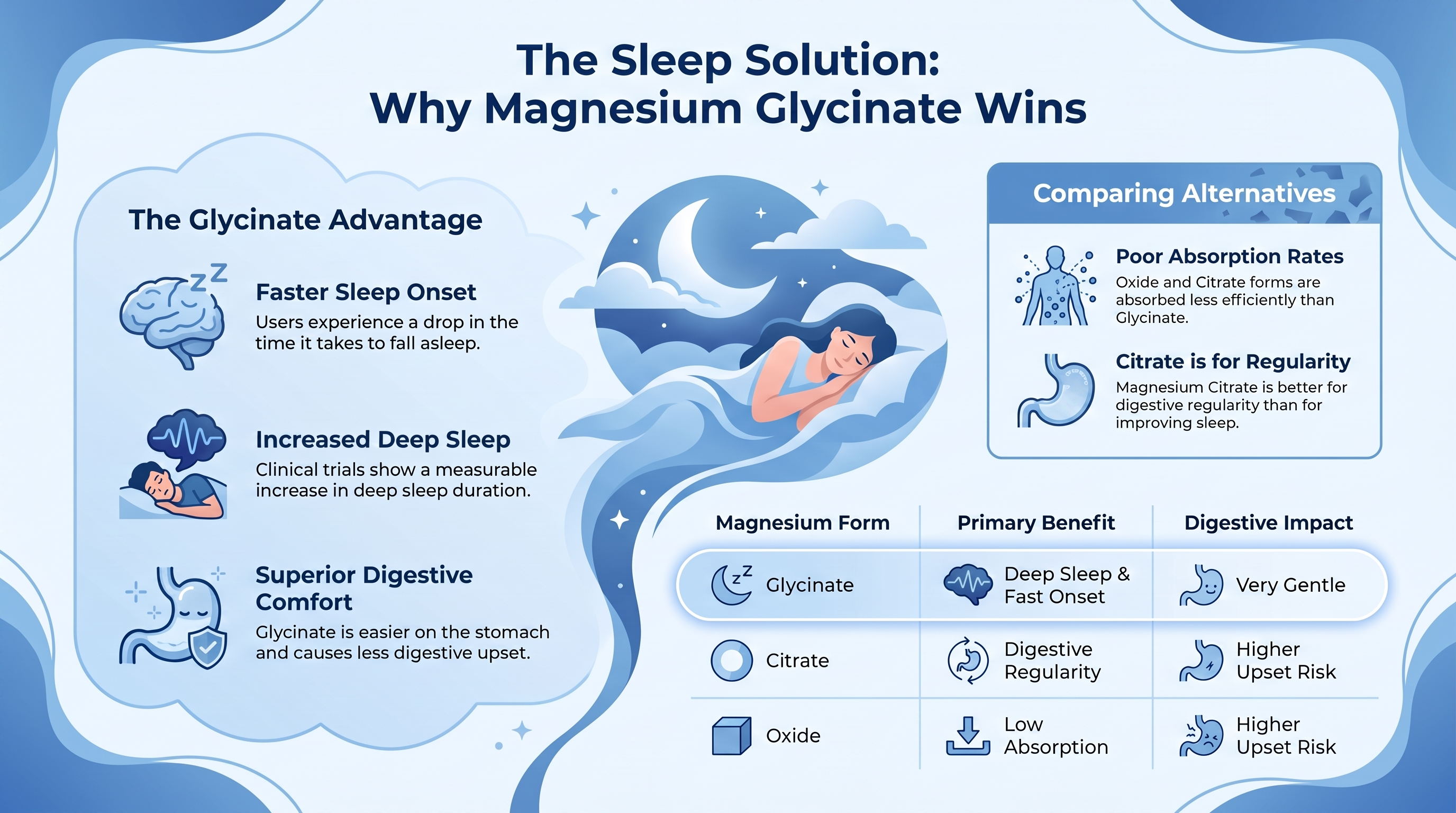
There is no single magnesium that outperforms every other for every person, but when the goal is sleep specifically, the evidence points most clearly to magnesium glycinate (bisglycinate). It is the form used in the trial showing measurable reductions in sleep-onset time and increases in deep sleep, and it tends to cause less digestive upset than forms like magnesium oxide or magnesium citrate, which are absorbed less efficiently and more likely to have a laxative effect.
When comparing types side by side, glycinate stands out for tolerability and the direct sleep-trial evidence behind it. Other forms are sometimes discussed for sleep but with a thinner evidence base specific to sleep outcomes — magnesium l-threonate is chosen more for proposed cognitive effects, and magnesium citrate is common generally but is better absorbed for regularity than for sleep specifically. For most people asking which type to start with for sleep, magnesium glycinate is the most evidence-aligned choice.
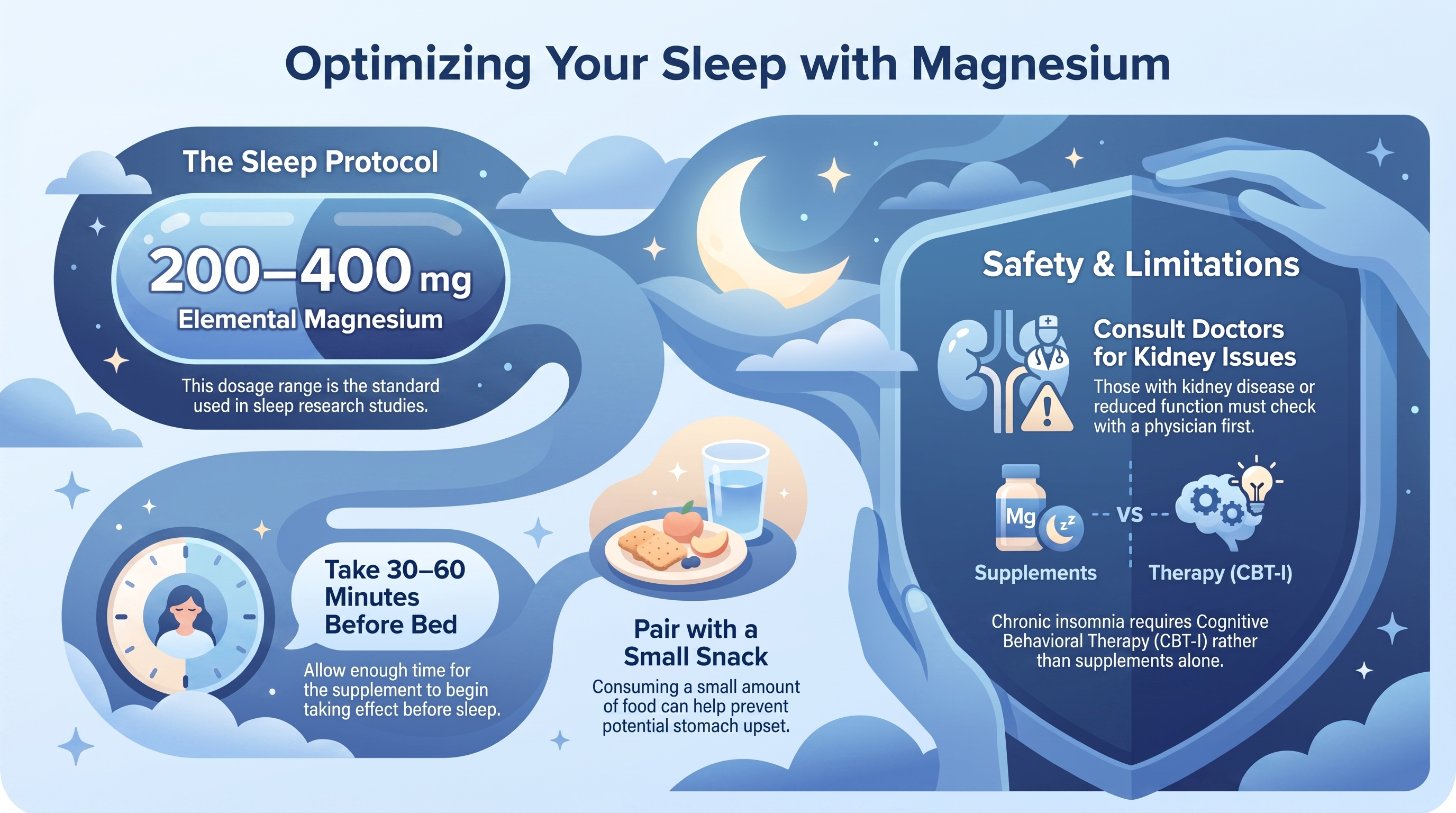
Sleep-focused research on magnesium has generally used 200–400 mg of elemental magnesium, taken roughly 30–60 minutes before bed. This is the range studied in trials, not a personalized medical recommendation — actual needs vary by diet, existing magnesium levels, kidney function, and other medications, so checking with a doctor before starting is the safer approach, especially for anyone with kidney disease.
Most of the research behind magnesium's sleep effects has participants take it about 30 to 60 minutes before their intended bedtime. That window gives the body time to begin absorbing it as the evening wind-down starts. Taking it with a small amount of food in the early evening may also reduce the mild stomach upset some people notice with certain magnesium forms.
Magnesium supplements are not right for everyone. Check with a doctor before starting, and seek medical advice if any of the following apply:
For people who are low in magnesium or generally struggling to wind down, the evidence suggests it can help. The clearest data point is the randomized controlled trial in which magnesium bisglycinate reduced time to fall asleep by 17.8 minutes and increased deep sleep by 19.3%. That said, magnesium works differently from a sleep aid like a sedative or even melatonin: melatonin is a chronobiotic that shifts the timing of the body's internal clock, while magnesium supports the underlying calming chemistry the nervous system uses to switch off, rather than forcing sleep directly.
Magnesium is a cofactor in nervous-system regulation, and it is thought to support the activity of GABA, the brain's primary calming neurotransmitter. Sleep is initiated in part by the ventrolateral preoptic nucleus (VLPO), which uses GABA to quiet down the brain's wake-promoting systems. Adequate magnesium supporting that same calming pathway is a proposed mechanism for why it is linked to falling asleep more easily and getting more deep sleep, even though it is not classified as a sedative itself.
Among the many forms of magnesium sold as supplements, magnesium glycinate (bisglycinate) has the most direct sleep-trial evidence, and it is generally the best-tolerated option for regular use before bed. Other types are marketed for sleep but have less sleep-specific research behind them — worth knowing before assuming any magnesium product will produce the same effect.
Magnesium l-threonate is a newer form developed for its ability to cross into brain tissue more readily, and it is discussed mostly in the context of cognitive support. It has not been studied for sleep to the same extent as magnesium glycinate, so anyone choosing between the two for sleep specifically should know the glycinate form has the stronger sleep-outcome data.
Magnesium powder is simply a delivery format — usually magnesium citrate or glycinate in powdered form, mixed into water — rather than a distinct type of magnesium. The sleep-relevant question is still which magnesium compound the powder contains and how much elemental magnesium it delivers per serving, not the powder format itself.
Magnesium spray and cream, often labeled "magnesium oil," are topical products meant to be applied to the skin rather than taken orally. They have far less research behind them than oral forms like magnesium glycinate, and how much magnesium actually gets absorbed through the skin is not well established in the way oral absorption is. People who want to try a topical product should treat it as an unproven add-on rather than a substitute for an oral form with sleep-trial evidence behind it.