How to Sleep Better: Proven Ways to Improve Sleep Quality
Sleep depends on two drivers: sleep pressure (which builds while you're awake) and your body clock (which runs on light and timing). To sleep better, cut caffeine several hours before bed, keep your room cool and dark around 65–68°F, and calm your body with a routine like the military method or slow breathing.
Most sleep advice ignores that falling asleep is driven by two separate systems working together. The first is sleep pressure (called Process S), which builds the longer you're awake as adenosine accumulates in the brain — it's the reason caffeine, a competitive blocker at adenosine receptors, keeps you feeling alert. The second is your body clock (Process C), run by the suprachiasmatic nucleus (SCN) in your brain and set mainly by light. Every method in this guide — the military sleep method, the Scandinavian sleep method, breathing exercises, or a simple bedtime routine — works by supporting one or both of these systems. Call it the Pressure-and-Clock method: build enough sleep pressure during the day, and keep your body clock consistent, and falling asleep gets much easier. For the daily habits that keep both systems on track long-term, see sleep hygiene.
Falling asleep fast means removing whatever is fighting your two sleep drivers. On the pressure side, caffeine is the biggest lever: it works as a competitive blocker at adenosine receptors, and its effects last roughly 5 hours on average, though this varies person to person. Even a dose taken about 6 hours before bedtime can measurably disturb sleep, so an early afternoon cutoff matters more than most people assume.
On the body-clock side, the single biggest fast-acting lever is bedroom temperature. A cooler room, generally recommended in the 65–68°F range, supports the natural overnight drop in core body temperature that helps trigger sleep onset. Combine a cool, dark room with a caffeine cutoff and a short relaxation routine — such as the military method or paced breathing below — and you're addressing both systems at once instead of just one.
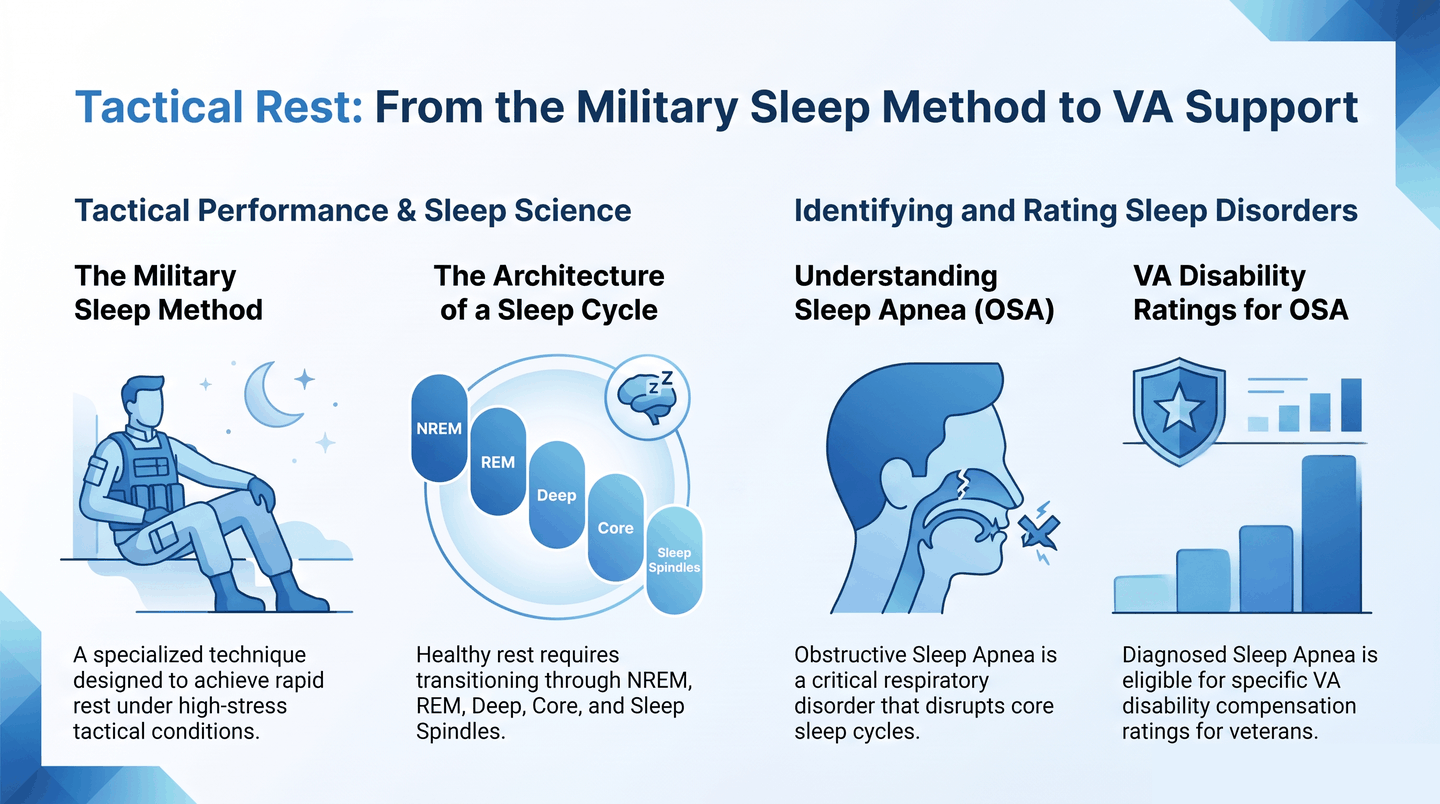
The military sleep method is a step-by-step body relaxation sequence, not a supplement or a light hack — it works by lowering physical tension and mental noise so your existing sleep pressure and body clock can take over. The general sequence is:
It's a relaxation technique, not a guarantee, and it tends to work best paired with the basics: a cool, dark room and no lingering caffeine in your system.
Beyond routine and environment, a few supplements have some evidence behind them as supporting tools, not replacements for consistent habits. Magnesium, in the range of 200–400 mg of elemental magnesium taken about 30–60 minutes before bed, has shown benefit in research: one randomized trial using magnesium bisglycinate found sleep onset shortened by about 17.8 minutes and deep sleep increased by about 19.3%. L-theanine, well tolerated up to about 450 mg per day, has shown improvements in subjective sleep quality, though its measurable effects are modest. Ashwagandha (specifically the KSM-66 extract) at 600 mg per day or more has moderate evidence for improving sleep onset and efficiency, though long-term data beyond about 12 weeks is limited.
Sound can help too, though the evidence is mixed. White noise mainly works by masking disruptive sounds rather than improving sleep itself. Pink noise — sound calibrated to match brain-wave patterns — has shown promise in small, preliminary studies for boosting deep, slow-wave sleep and memory consolidation.
Sleeping better long-term comes down to consistently supporting both the pressure and clock systems rather than chasing one trick. A steady wake time (even on weekends) anchors your body clock more reliably than a fixed bedtime, since the SCN resets itself based on your first major light exposure of the day. For the full daily checklist — light, temperature, screens, and timing — see sleep hygiene.
Sleeping well is less about a single fix and more about not undermining your own systems. A common mistake is relying on alcohol to fall asleep faster — it is sedating, but it suppresses REM sleep and tends to fragment the second half of the night with more awakenings, and it can worsen sleep-related breathing problems. A cool, dark, quiet room and a wind-down period free of screens does more for sleep quality than any single supplement.
Shifting your schedule earlier works best gradually, by nudging your body clock rather than forcing it. Since the SCN is set primarily by light, getting bright light (ideally daylight) soon after waking and dimming lights in the evening helps shift sleep timing earlier over several days. A fixed, earlier wake time — even before your body has fully adjusted — is what actually drives the shift, more than simply trying to go to bed earlier.
Slow, paced breathing lowers physical arousal, which supports whichever sleep driver is already building — it doesn't create sleep pressure on its own, but it removes the tension that keeps you from acting on it. Two common patterns:
Both work the same way as the military method: they lower the physical signs of stress and racing thoughts so your existing sleep pressure and body clock can do their job.
If you've been lying awake for a while, the most effective move is often to get up. Staying in bed while frustrated teaches your brain to associate the bed with wakefulness instead of sleep. Get up, go to a dim room, and do something quiet and non-stimulating — reading on paper, not a screen — until you feel sleepy again, then return to bed.
Frequent awakenings are often driven by the same disruptors that affect falling asleep in the first place: a bedroom that's too warm, alcohol fragmenting the second half of the night, or an underlying issue like sleep apnea. Keeping the room cool (65–68°F) and skipping alcohol before bed are the two most direct levers within your control.
You can't force sleep directly — trying too hard tends to increase the mental arousal that's keeping you awake. Instead of forcing it, remove what's fighting your sleep pressure and body clock (light, caffeine, a warm room) and use a relaxation routine, like the military method or paced breathing, to lower tension so sleep can take over on its own.
Occasional trouble sleeping is normal, but see a doctor if any of the following apply:
A doctor can identify whether an underlying condition, rather than habits alone, is driving the problem.
To sleep quickly, stack the fastest-acting levers together rather than relying on just one: a cool, dark room (65–68°F), no caffeine in your system (allow at least 6 hours, since effects last roughly 5 hours on average), and a short relaxation sequence such as the military method or 4-7-8 breathing to lower physical tension. None of these create instant sleep on command, but combined they remove most of what's actively working against your body's own sleep pressure and clock.
There's no method that reliably produces sleep the instant you want it — sleep is a gradual handoff between wakefulness and sleep pressure, not a switch. What comes closest is minimizing everything that delays that handoff at once: a genuinely dark and cool room, zero recent caffeine, and a relaxation routine to quiet physical tension, so that whatever sleep pressure you've already built can take over as fast as possible.
The Scandinavian sleep method is simple: instead of one shared blanket or duvet, each person in the bed uses their own. This means one partner running warm and one running cool can each regulate their own temperature, and neither is woken by the other pulling the covers or shifting position during the night. It pairs naturally with keeping the room itself cool — around 65–68°F — since each sleeper can then add or remove their own layer as needed rather than fighting over a shared one.