Yes, sleeping burns calories, because the body keeps up basal processes like tissue repair and brain waste clearance overnight. But the burn rate is not fixed, varies by person and by sleep stage, and is far too small to drive meaningful weight loss on its own — consistent, adequate sleep supports weight management mainly by keeping hunger hormones in balance.
Does Sleeping Burn Calories
Sleep is not a metabolic shutdown. It is an active, tightly regulated neurophysiological process that the body uses for cellular homeostasis, physical recovery, metabolic regulation, and cognitive maintenance — all of which require ongoing energy. So the short answer to "does sleeping burn calories" is yes: the body's baseline energy use continues through the night, just at a reduced level compared with most waking activity.
A large share of that overnight energy use goes toward processes you would not notice from the outside. During deep, slow-wave sleep (N3), the brain's interstitial space expands by roughly 60%, allowing the glymphatic system to clear neurotoxic proteins such as amyloid-beta and tau — a cleanup process that depends on active transport, not passive rest. N3 is also when growth hormone release and tissue repair are at their highest. Later in the night, REM sleep brings a different kind of activity: the brain becomes highly active, closer to a waking state, while the body's major muscles are held in atonia. Both of these very different states still cost energy to maintain, which is part of why "does sleeping burn calories" has a clear yes, even though you are motionless.
How Many Calories Do You Burn While Sleeping
There is no single number that applies to everyone, because overnight calorie burn depends on body size, muscle mass, and individual metabolic rate — factors that vary from person to person. What the underlying sleep research does support is that the rate is not flat across the night. Sleep moves through a repeating cycle of roughly 90 to 110 minutes, alternating through NREM stages (N1, N2, N3) and REM, and each stage places different demands on the brain and body.
Because deep sleep dominates the earlier part of the night and REM becomes more prominent later, the mix of "high-repair" and "high-brain-activity" states — and the energy each one requires — changes as the night goes on. That is a more accurate way to think about how many calories you burn while sleeping than any single flat rate, and it is also why sleep quality, not just sleep duration, matters for how the body functions overnight.
Sleep and Weight Loss
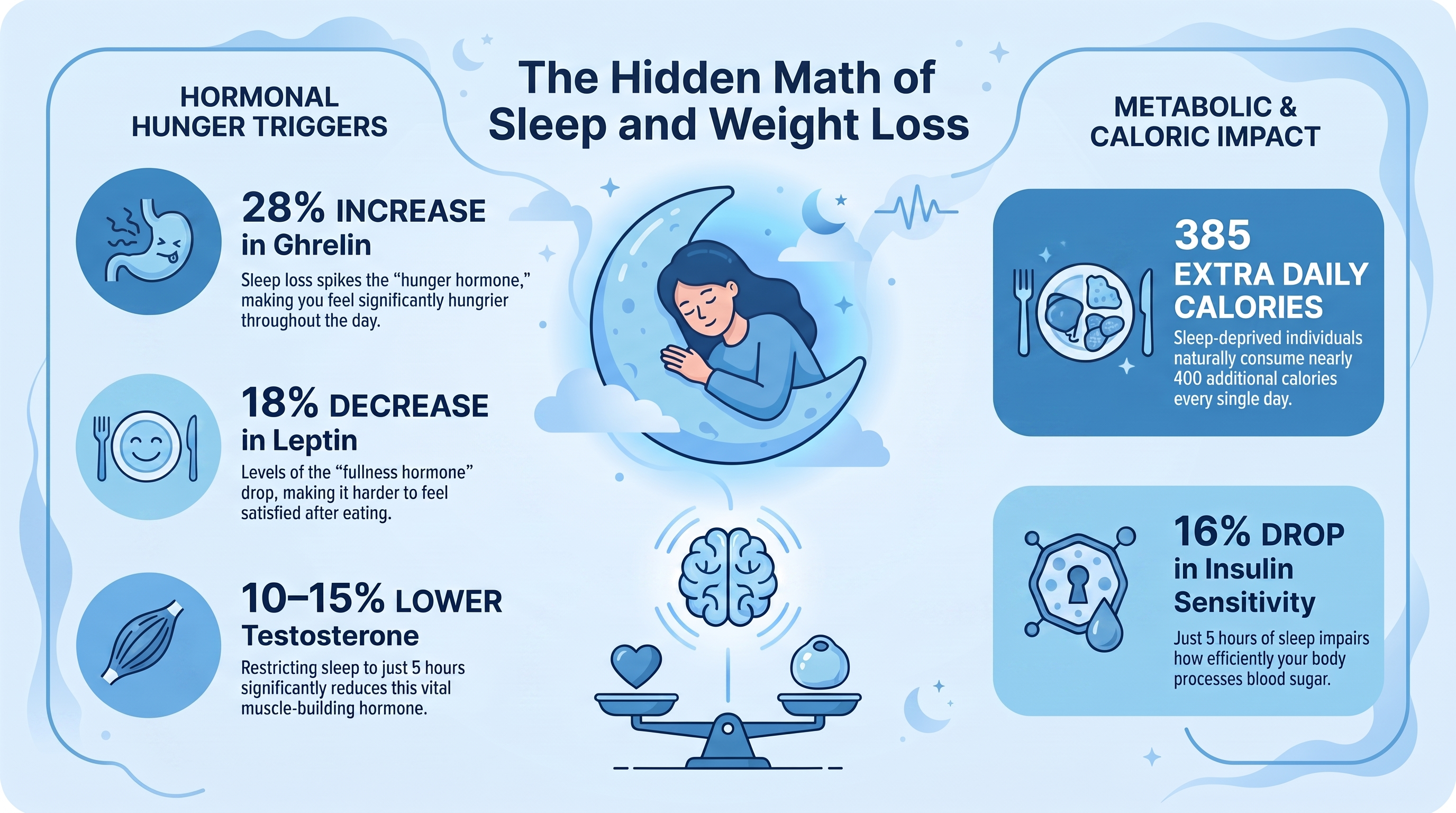
Sleep and weight loss are connected, but not because sleeping itself burns a meaningful number of calories. The connection runs mainly through hormones and metabolism. When sleep is restricted, the hunger hormone ghrelin rises by about 28% and the fullness hormone leptin drops by about 18%, a shift linked to eating roughly 385 more calories per day. One week of sleep restricted to 5 hours a night has also been shown to lower peripheral insulin sensitivity by up to 16%, and to reduce testosterone in young men by 10–15%. None of that is about calories burned during sleep — it is about how poor sleep changes appetite and metabolism the following day.
Do You Lose Weight When You Sleep
Stepping on a scale after a night's sleep often shows a lower number, but that is overwhelmingly water weight, lost through breathing and perspiration overnight, not fat loss. Meaningful fat loss requires a sustained calorie deficit maintained over time. A single night of sleep does not create that deficit on its own, even though the body is continuously using energy for repair and regulation while you rest.
Will Sleeping Help You Lose Weight
Consistent, adequate sleep can support weight management, but indirectly. Getting enough sleep helps keep leptin and ghrelin in balance, which reduces the kind of hormone-driven overeating linked to sleep loss. It also helps protect insulin sensitivity, which is relevant to how the body processes food. In that sense, sleeping well removes an obstacle to weight management rather than actively burning fat. Sleep alone does not replace a calorie deficit — it works alongside diet and activity, not instead of them. Note that alcohol before bed does not help: it disrupts sleep and suppresses REM, which works against the hormonal balance that supports weight management.
Talk to a doctor rather than trying to manage this through sleep or diet changes alone if:
- You have trouble falling or staying asleep at least 3 times a week for 3 months or more — a pattern consistent with chronic insomnia, for which CBT-I is the recommended first-line treatment
- You notice loud snoring, observed pauses in breathing, or gasping for air during sleep, along with unexplained weight changes — these can point to sleep apnea, which is undiagnosed in an estimated 80% of cases
- Sudden or unexplained weight loss or gain accompanies persistent sleep problems
This article is informational and does not diagnose conditions or recommend dosages; see a qualified clinician for personal guidance.
Frequently Asked Questions
Sources
- Internal research — Human Sleep Physiology Research (sleep stages, glymphatic clearance during N3, growth hormone release, 90–110 minute sleep cycle, leptin/ghrelin and calorie-intake effects of sleep restriction, insulin sensitivity and testosterone effects of sleep restriction).
- CDC — About Sleep (recommended sleep duration by age).
- NHLBI — How Much Sleep Is Enough? (sleep needs across the lifespan).
- Doctor Wayne Suway — The Hidden Health Crisis (sleep apnea prevalence and underdiagnosis).