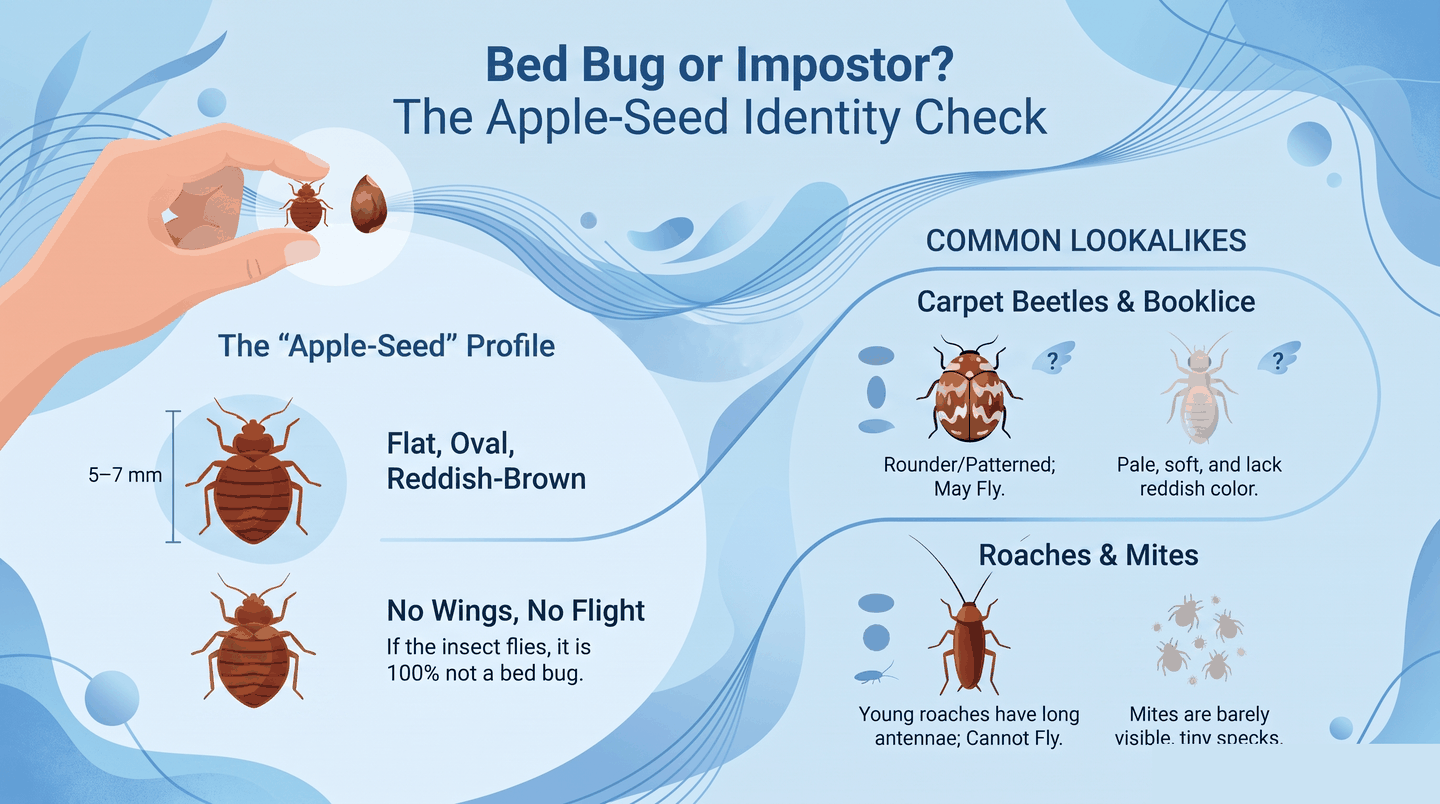
Yes — you can see adult bed bugs on the bed with the naked eye. They are about 5 to 7 millimeters long, roughly the size of an apple seed, and are flat, oval, and reddish-brown. Good lighting helps. The white eggs and freshly hatched nymphs are much harder to spot.
Can you see bed bugs on the bed? In most cases, yes. Adult bed bugs are visible to the naked eye, and once you know what you are looking for, they are surprisingly easy to recognize. The hard part is spotting the smaller stages and telling real bed bugs apart from the many tiny insects that look similar. To make this simple, we use one idea throughout: The Apple-Seed Check — judge any bug you find by its size, shape, and color, the way you would size up an apple seed.
An adult bed bug is about as big as an apple seed: 5 to 7 millimeters long, flat, oval, and reddish-brown. Its eggs are tiny — about a millimeter and pale white — and freshly hatched nymphs are only 1 to 1.5 millimeters and nearly translucent. So whether you can see them depends a lot on which stage you are looking at. If you want a fuller picture first, see what bed bugs look like.
Bed Bugs on Mattress
To find bed bugs on a mattress, you have to look where they actually hide rather than across the open surface. Bed bugs gather in tight, protected edges — so the seams and piping, the corners, the label, and the quilted folds are the first places to inspect with good light.
They do not usually sit out in the middle of the sheet during the day. Instead, they tuck themselves into the cracks the mattress provides. When you run a flashlight along those edges, you are looking for more than just the bugs themselves.
The four clues to look for on a mattress:
- Live bugs — apple-seed-sized, flat, oval, reddish-brown adults
- Dark fecal spots — tiny ink-like marks, like dots from a felt-tip pen
- Pale shed skins — the empty casings nymphs leave behind as they grow
- White eggs — about a millimeter, pale, tucked into seams
Finding several of these together is far more telling than one ambiguous speck. The dark spots in particular are a strong sign — learn to recognize them in our guide to bed bug poop, and see what the empty casings and other clues mean in the early signs of bed bugs.
Larvae Bugs in Bed
If you have searched for "larvae bugs in bed," here is the key correction: bed bugs do not have a true larval stage at all. There are no bed bug larvae. What people usually mean are the young bed bugs — the nymphs — and "larvae" is simply a common misnomer for them.
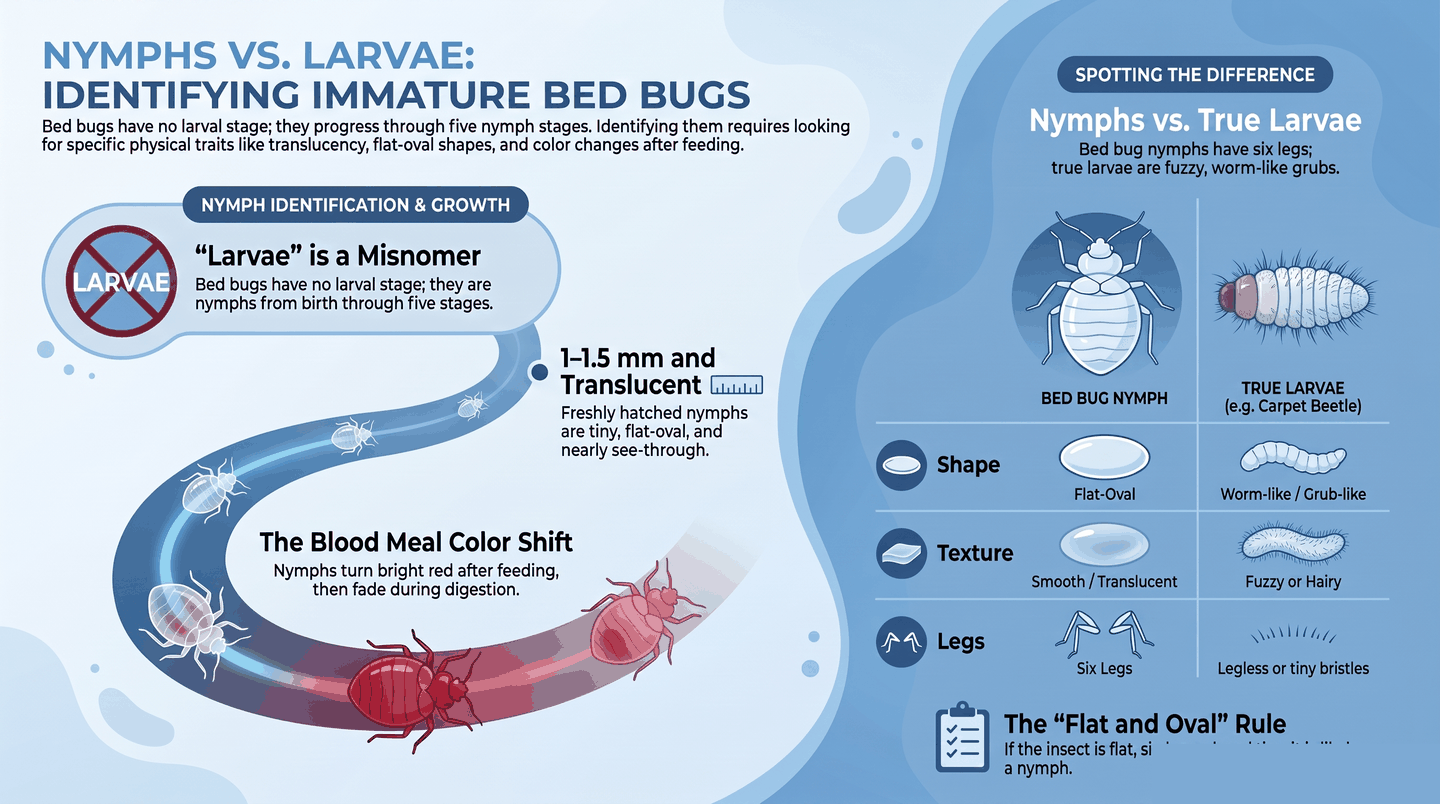
Bed bugs grow through five nymph stages before becoming adults. A newly hatched nymph is only about 1 to 1.5 millimeters and nearly translucent, which is why it is so easy to miss. After it feeds, it turns visibly red from the blood meal, then fades again as it digests. You can read more about these stages in our guide to baby bed bugs.
Because the word "larvae" sends people down the wrong path, it matters here. True larvae — soft, worm-like or bristly grubs — belong to other insects entirely, such as carpet beetles. If what you are seeing looks like a fuzzy little grub rather than a flat, six-legged insect, you are probably not looking at a bed bug.
Little Bugs in Bed
"Little bugs in bed" is one of the most common ways people describe what they have found, and it covers a lot of ground. The smallest true bed bug stages — the white eggs (about 1 mm) and the translucent newly hatched nymphs — are genuinely hard to see without good light and a close look.
So if you are noticing very tiny specks, slow down and use the Apple-Seed Check. Ask three questions: What size is it? What shape is it? What color is it? A bed bug nymph is small but still flat and oval, and it darkens or reddens after feeding. A round, pale, or fuzzy speck that does not match that profile may be something else entirely — which is exactly what the next sections cover.
Bed Bugs on Bed
Seeing bed bugs on the bed in the open is actually less common than you might expect, because during the day they stay hidden in seams, cracks, and crevices close to where you sleep. They are built to tuck away in tight spaces, not to lounge on top of the sheets.
Bed bugs are most active at night, typically coming out to feed in the hours between roughly midnight and 5 a.m. That is when they crawl from their hiding spots to a sleeping person, then return to cover. So if you spot a single bug sitting out on the bed, it is usually one that is "in transit" — on its way to or from a hiding place — rather than a bug that lives on the open surface.
This is also why a daytime inspection works best at the edges and crevices rather than the middle of the bed. One bug on the sheet is worth taking seriously, but the real evidence tends to sit along the seams and the frame. Whatever you find, remember that bed bugs are not known to transmit any diseases — they are a nuisance and their bites can itch, but they do not spread illness. If you do confirm them, our overview of how to get rid of bed bugs covers what comes next.
Plenty of small insects get mistaken for bed bugs. Run each one through the Apple-Seed Check — size, shape, color — before you decide. Commonly confused look-alikes include:
- Carpet beetles (and their fuzzy larvae) — rounder and often patterned, not flat and reddish-brown
- Booklice — pale, soft, and very small
- Young cockroaches — longer-bodied with long antennae
- Mites — far smaller, often barely visible specks
The clearest tell of all: if it flies, it is not a bed bug. Bed bugs cannot fly. When in doubt, compare what you found against the flat-oval, reddish-brown, apple-seed profile of a real bed bug.
Frequently Asked Questions
Sources
- U.S. EPA — Bed bugs appearance and life cycle (adult size, color, eggs, and nymph stages).
- U.S. EPA — How to find bed bugs (where to inspect a mattress and what signs to look for).
- Virginia Cooperative Extension / Virginia Tech — Bed bug biology and behavior (PDF).
- CDC — Bed bugs biology.