Bed bug heat treatment uses high temperatures to kill bed bugs and their eggs. Both die at roughly 118 to 122 degrees Fahrenheit once the heat is held long enough to reach them. Heat moves into cracks where sprays cannot, and bed bugs cannot become resistant to it.
Bed bug heat treatment works because these insects simply cannot survive high temperatures. Instead of relying on chemicals, it raises the heat in a room or an item until the bugs and their eggs die. This guide explains the temperatures that matter, how heaters and rentals work, what treatment tends to cost, and whether cold works too. Throughout, we use one simple idea: The Lethal Temperature Window — the range that kills bed bugs when held long enough to reach them.
What Temperature Kills Bed Bugs
The temperature that kills bed bugs is roughly 118 to 122 degrees Fahrenheit (about 48 to 50 degrees Celsius), but the key detail is time. Heat only works when it is held long enough to actually reach the insect where it hides. A quick spike in air temperature is not the same as a bug's body reaching that level.
This is why professionals do not aim for the bare minimum. They heat an entire room to a higher range, around 120 to 135 degrees Fahrenheit, so the lethal temperature has time to soak into mattresses, wall voids, and tight cracks. The eggs matter just as much as the adults, and the same heat range kills both when it reaches them.
- Bed bugs and eggs die at about 118–122°F (48–50°C) with enough exposure time
- Whole-room treatments run hotter, around 120–135°F, to be sure
- The heat must penetrate hiding spots, not just warm the air
Does Heat Kill Bed Bugs
Yes, heat kills bed bugs reliably when it is applied correctly. It damages the insect physically, which is why bed bugs cannot adapt to it the way they have adapted to some chemical pesticides over the years. There is no such thing as a heat-resistant bed bug.
That said, heat is not magic. If the temperature does not climb high enough, or if it does not stay there long enough to reach bugs deep in a couch or behind a baseboard, some can survive. Done properly, though, heat is one of the more thorough options because it spreads into places liquids and dusts struggle to reach. For a broader look at fast-acting methods, see what kills bed bugs instantly.
Bed Bug Heater
A bed bug heater is the equipment that produces and circulates the high temperatures a treatment needs. Professional units are powerful systems that warm a whole room evenly and use fans to push hot air into cracks and crevices. The goal is not just a hot room but consistent heat everywhere a bug could be hiding.
For smaller jobs, there are also portable heating devices and heat chambers sized for items like luggage, shoes, and bedding. One example sometimes mentioned for individual belongings is the ThermalStrike Ranger (sold under the EPRO line), a zippered heating bag designed to treat a single suitcase or load of items rather than an entire room. Tools like this handle objects, not the structure itself, so they work alongside a wider plan rather than replacing it.
- Whole-room heaters: large units that treat an entire space
- Portable chambers and bags: for luggage, clothing, and small items
- Fans: circulate heat so it reaches cracks and seams
Bed Bug Heater Rental
A bed bug heater rental lets you use professional-style equipment without buying it outright. Some equipment suppliers and hardware outlets rent heating units, which can appeal to people who want to run a treatment themselves. It can lower the upfront cost compared with hiring a company.
There is a real trade-off, though. Heating a room safely and effectively takes the right equipment, careful temperature monitoring, and an understanding of how heat moves through a space. Done incorrectly, a do-it-yourself heat job can miss bugs or create safety hazards. Many people weigh a rental against the certainty of a professional, which you can read more about under bed bug treatment options options.
Bed Bug Heat Treatment Cost
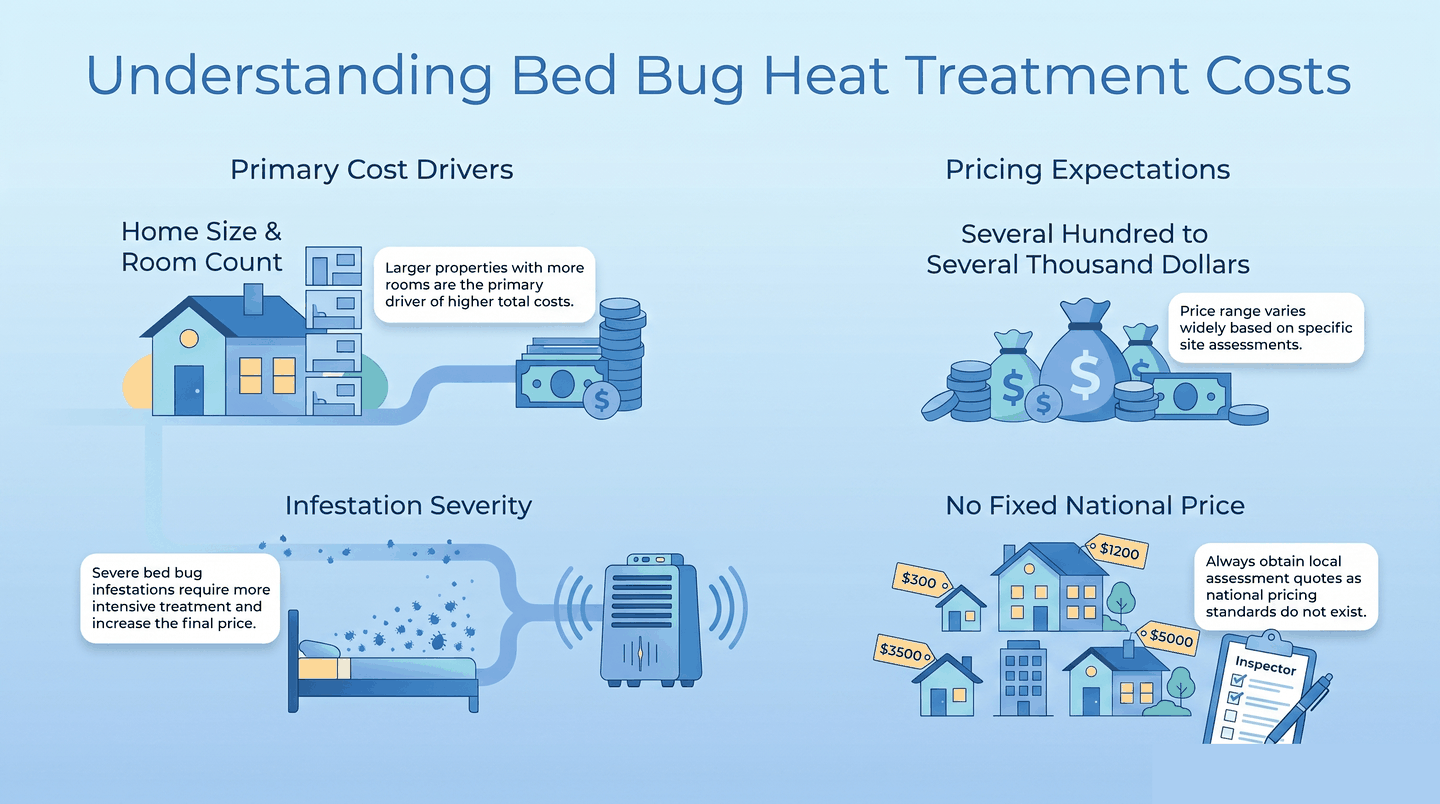
Bed bug heat treatment cost varies widely, and any honest answer has to acknowledge that. The price depends on the size of the home, how many rooms are involved, how severe the infestation is, and local rates. There is no single national figure, so treat any number as a rough range rather than a quote.
As a very general sense of scale, professional heat treatments can run anywhere from several hundred dollars for a small, contained job to several thousand dollars for a larger home or a whole-property treatment. The only reliable way to know is to get assessments for your specific situation. Heat is often chosen because a professional treatment can be completed in roughly a day, with a follow-up check afterward.
- Cost varies by home size, number of rooms, and severity
- A rough range spans from several hundred to several thousand dollars
- Get local assessments — there is no fixed national price
If you are comparing heat against other methods and their costs, the overview in bed bug treatment covers the wider picture, and how to get rid of bed bugs walks through the full process.
Does Cold Kill Bed Bugs
Cold kills bed bugs too, but it works slowly and needs sustained low temperatures. Placing infested items in a freezer set to about 0 degrees Fahrenheit (around minus 18 degrees Celsius) for roughly four days will kill bed bugs and their eggs. The freezer must stay that cold the entire time, and the items need enough time for the cold to reach all the way through.
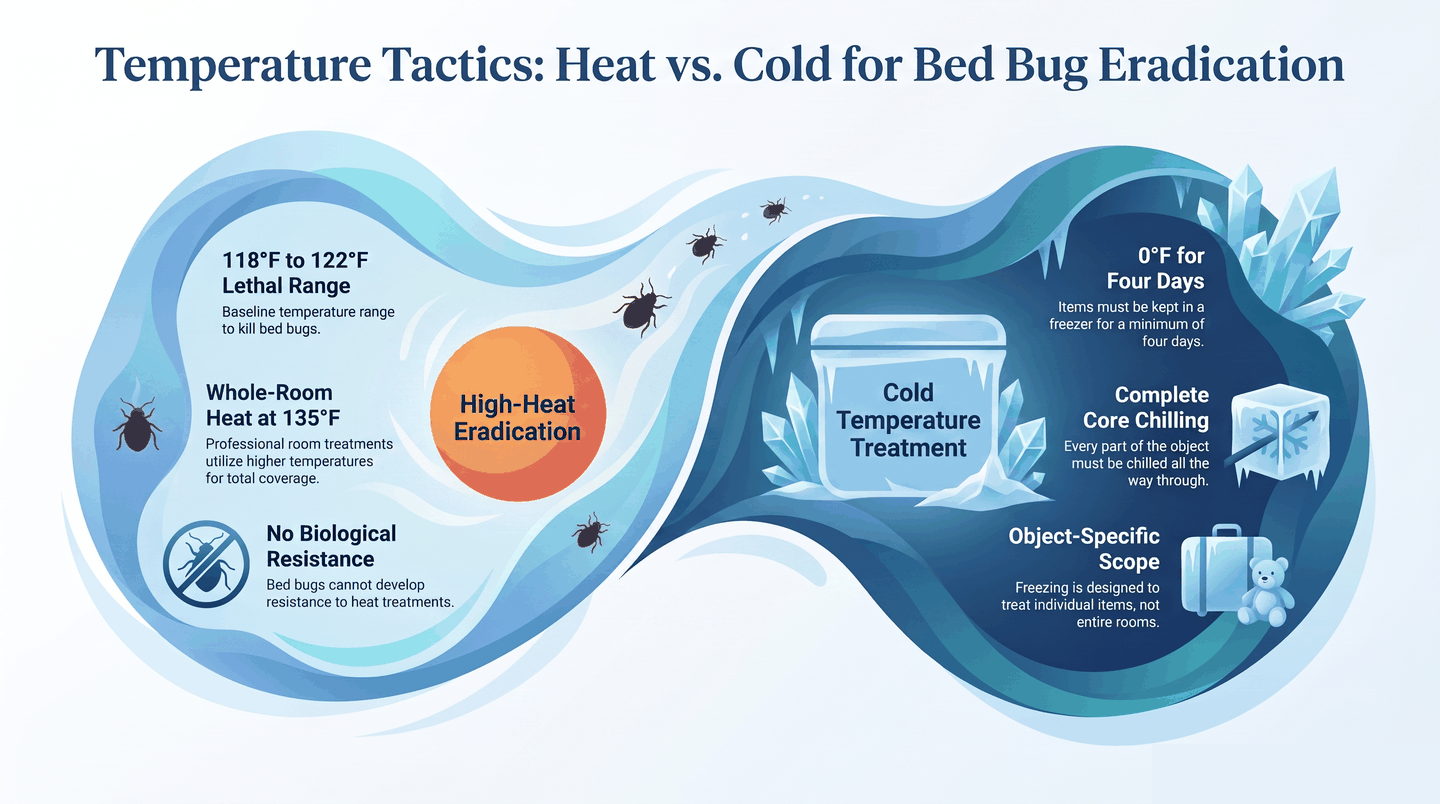
Like heat, cold damages the insect in a way it cannot adapt to, so there is no cold-resistant bed bug either. Freezing is most practical for items that fit in a freezer — books, shoes, small bags, and similar objects. It is not a way to treat a whole room. A hot dryer remains the quicker option for washable textiles, killing bugs in about 30 minutes.
Bed bugs have shown the ability to resist some chemical pesticides over time. Temperature is different. Both lethal heat and sustained freezing harm the insect physically, so the bugs cannot evolve their way around them. Keep these points in mind:
- Heat: about 118–122°F (48–50°C), held long enough to reach the bugs
- Cold: about 0°F (−18°C) for roughly four days
- Neither method allows resistance to build up
- Both must fully reach the bugs and eggs in their hiding spots
Because bed bugs can survive a long time between meals — up to around six months without feeding — half-measures often fail. The temperature has to reach every hiding spot to work.
Frequently Asked Questions
Sources
- U.S. EPA — Do-it-yourself bed bug control (heat and cold methods, hot dryer ~30 min, freezer 0°F for ~4 days).
- Virginia Cooperative Extension / Virginia Tech — Bed bug biology and behavior (lethal temperatures ~118–122°F, whole-room heat range, survival up to ~6 months without feeding).
- U.S. EPA — Bed bugs appearance and life cycle (life stages and eggs).