Blue Light, Red Light and Sleep
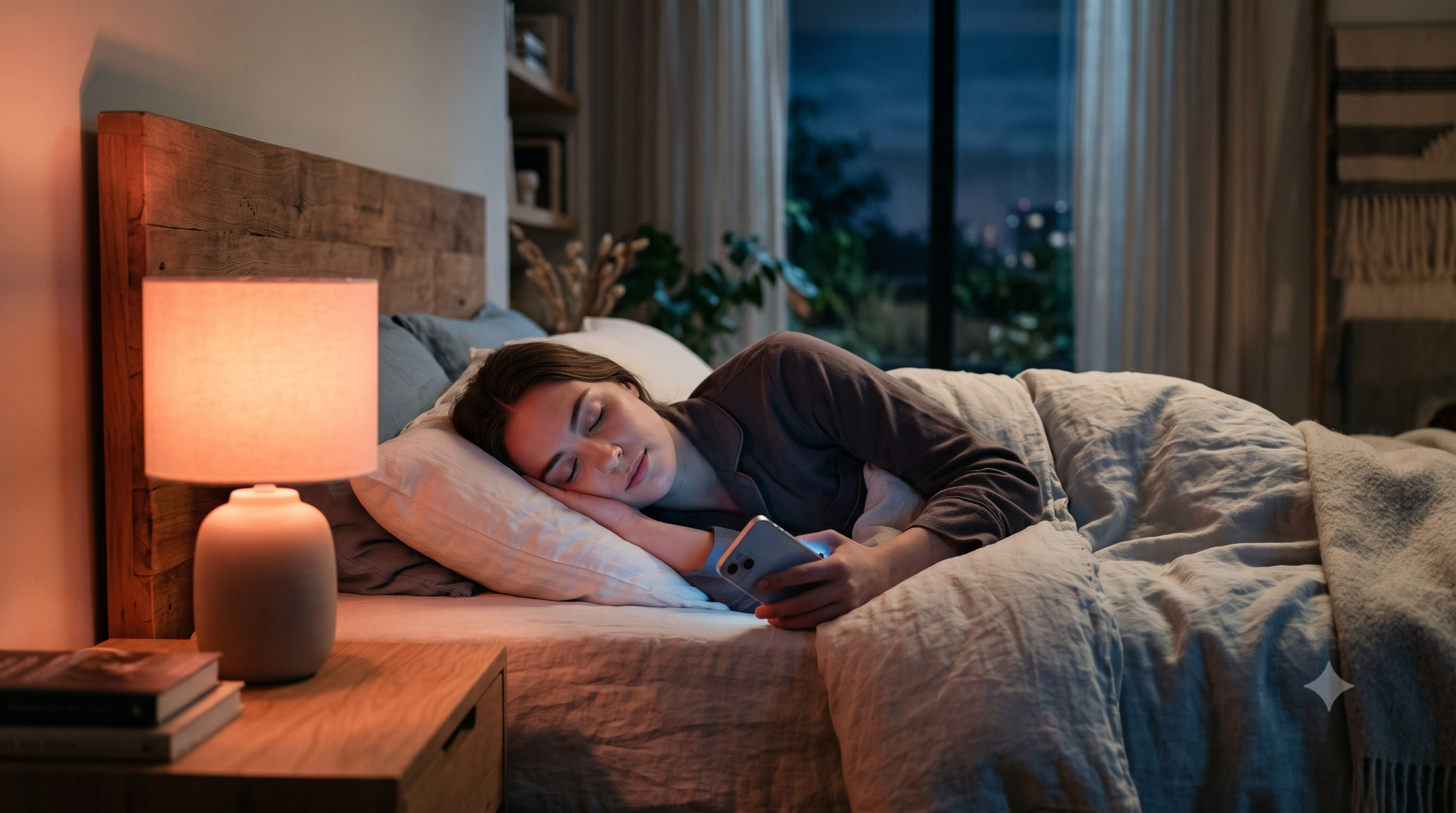
Blue light, especially around 480 nm, is the wavelength that most strongly activates the eye cells linked to your brain's circadian clock, so it suppresses melatonin more than other colors. Red light sits at the opposite end of the visible spectrum and is thought to interact with that pathway less, which is why it's often favored for nighttime light instead of blue or white.
Comparing blue light and red light for sleep is easier with one framework: the Spectrum-Timing Framework. It asks two questions about any light source in your bedroom — where does it sit on the color spectrum, and when during the day does the exposure happen? Color alone doesn't tell the whole story: total brightness, how long the light lasts, and how close to bedtime it occurs all shape whether a given light helps or hurts your sleep. For a full look at building out a calming sleep environment, see our sleep hub.
Your circadian clock, the suprachiasmatic nucleus (SCN), doesn't respond equally to every color of light. It relies on melanopsin-containing retinal ganglion cells (ipRGCs) that are most sensitive to blue wavelengths around 480 nm. Artificial light at night (ALAN) that falls in this blue range is what most strongly suppresses melatonin and shifts your internal clock. Red light, with its much longer wavelength, is thought to engage this pathway far less, which is the underlying reason red light is commonly recommended for situations where some light is unavoidable at night — a bathroom trip, checking on a sleeping child, or a hallway nightlight.
It's worth being precise about what this means in practice: the case for red light rests on the circadian mechanism itself, not on a claim that red light actively improves sleep. Blue light also isn't the only thing that can disrupt sleep — overall light intensity, how long you're exposed, and whether you're engaging with a stimulating device all play a role too. Swapping to red light without also dimming brightness or cutting down on screen time before bed may only address part of the problem. If sound is also part of your nighttime routine, our guide to noise machines for sleep covers the other half of a calming sleep environment.
"Red light therapy" typically refers to dedicated light panels or lamps marketed for a set period of red light exposure before bed, as distinct from simply using a red bulb as ambient light. The rationale is the same circadian mechanism described above: because red light interacts less with the blue-sensitive ipRGC pathway that signals the SCN, proponents suggest a red light session can serve as part of a wind-down routine without the alerting effect associated with bright blue or white light.
It's important to be clear-eyed here — the reasoning is mechanistic, built from what's known about how the eye and circadian clock respond to wavelength, rather than large-scale trial results specific to red light therapy devices and sleep outcomes. That makes it reasonable to treat red light therapy as a low-risk addition to a bedtime routine rather than a proven treatment. For anyone dealing with ongoing difficulty falling or staying asleep — trouble at least three nights a week for three months or more is the general threshold for chronic insomnia — cognitive behavioral therapy for insomnia (CBT-I) is the first-line, evidence-based approach, and it's worth discussing with a clinician rather than relying on light therapy alone.
The simplest way to apply this mechanism at home is swapping the bulb in a bedside lamp, hallway fixture, or nursery nightlight to a red or deep amber LED. Because these bulbs sit farther from the blue wavelength range that most strongly drives melatonin suppression, they're generally considered a gentler option than a standard white or blue-white bulb for the middle of the night. This is especially relevant for shift workers needing light during their sleep window, or parents who need to check on a baby without fully waking themselves or the child — our baby sleep gear guide covers nightlight options in more detail.
Thinking in terms of the Spectrum-Timing Framework, color sits on a rough spectrum from most to least likely to interfere with your circadian clock: cool blue-white light on one end, warm amber and red light on the other. The farther a light source sits from the ~480 nm blue peak that ipRGCs respond to, the less it's expected to suppress melatonin — which is the basis for recommending warmer-toned lighting in the evening.
As a general rule of thumb rather than a strict ranking, red and deep amber tones are considered the safer choices for light used close to bedtime, followed by warm white, with cool white and blue-tinted light being the least favorable for winding down. Brightness still matters on top of color — a dim warm light will generally interfere less than a bright one of the same color, so both variables in the framework need to be managed together.
Blue light blocking glasses use an amber or orange-tinted lens designed to filter out blue wavelengths before they reach the eye, based on the same ipRGC mechanism discussed above. They're most often used in the evening when screens are hard to avoid entirely. Because blue light isn't the only factor at play — screen brightness and how mentally engaging the device is also matter — glasses alone may not fully offset late-night screen use, and dimming devices or setting a screen cutoff time before bed can be a useful complement.
Any light exposure during sleep counts as artificial light at night (ALAN), and the same circadian mechanism applies whether the light comes from a lamp, a hallway fixture, or a television left on overnight. ALAN is detected primarily through the blue-sensitive ipRGC pathway, and it can suppress melatonin and shift the timing of your internal clock, which is why sleeping with the lights on is generally not ideal for sleep quality.
That doesn't mean every light is equally disruptive. Following the Spectrum-Timing Framework, a dim, warm-colored light — such as red or amber — used only when necessary is a meaningfully different exposure than a bright white or blue-white light left on for hours. For households working through a child's sleep routine, keeping evening light dim and warm-toned can be part of a consistent wind-down — see our guides to baby sleep schedules and common baby sleep problems for more on building that routine. True darkness remains the option least likely to disrupt melatonin and circadian timing.
Adjusting light color and timing is a reasonable first step, but talk to a doctor if:
For infants and young children, discuss any persistent sleep or nighttime light concerns with a pediatrician, in line with general safe sleep guidance.