Bed bug spray can kill bugs it directly touches, but many bed bugs resist common pyrethroid sprays, and the mist rarely reaches eggs hidden in seams and cracks. Use only EPA-registered products exactly as the label says, and treat spray as one part of a plan built around heat.
If you are searching for a bed bug spray, you want one thing: something that ends the problem fast. This roundup gives an honest overview of the sprays, brands, and powders people reach for — and explains why a spray alone usually is not enough. To keep things clear, we use one simple idea throughout: The Three-Layer Defense — sprays are just one layer, and they only work alongside heat and physical removal.
Before we name products, one fact shapes everything below: bed bugs are not like other household pests. Many populations have become resistant to the insecticides in most sprays, and the bugs hide in places mist cannot reach. That is why the strongest approach is rarely "buy the best spray" — it is combining several methods. For the full plan, see how to get rid of bed bugs.
Best Bed Bug Spray
There is no single best bed bug spray that works in every home, and any product claiming a guaranteed kill should be treated with caution. Because resistance varies from one infestation to the next, a spray that works in one apartment can fail in another. The most useful spray is simply one that is EPA-registered for bed bugs and used exactly as its label directs.
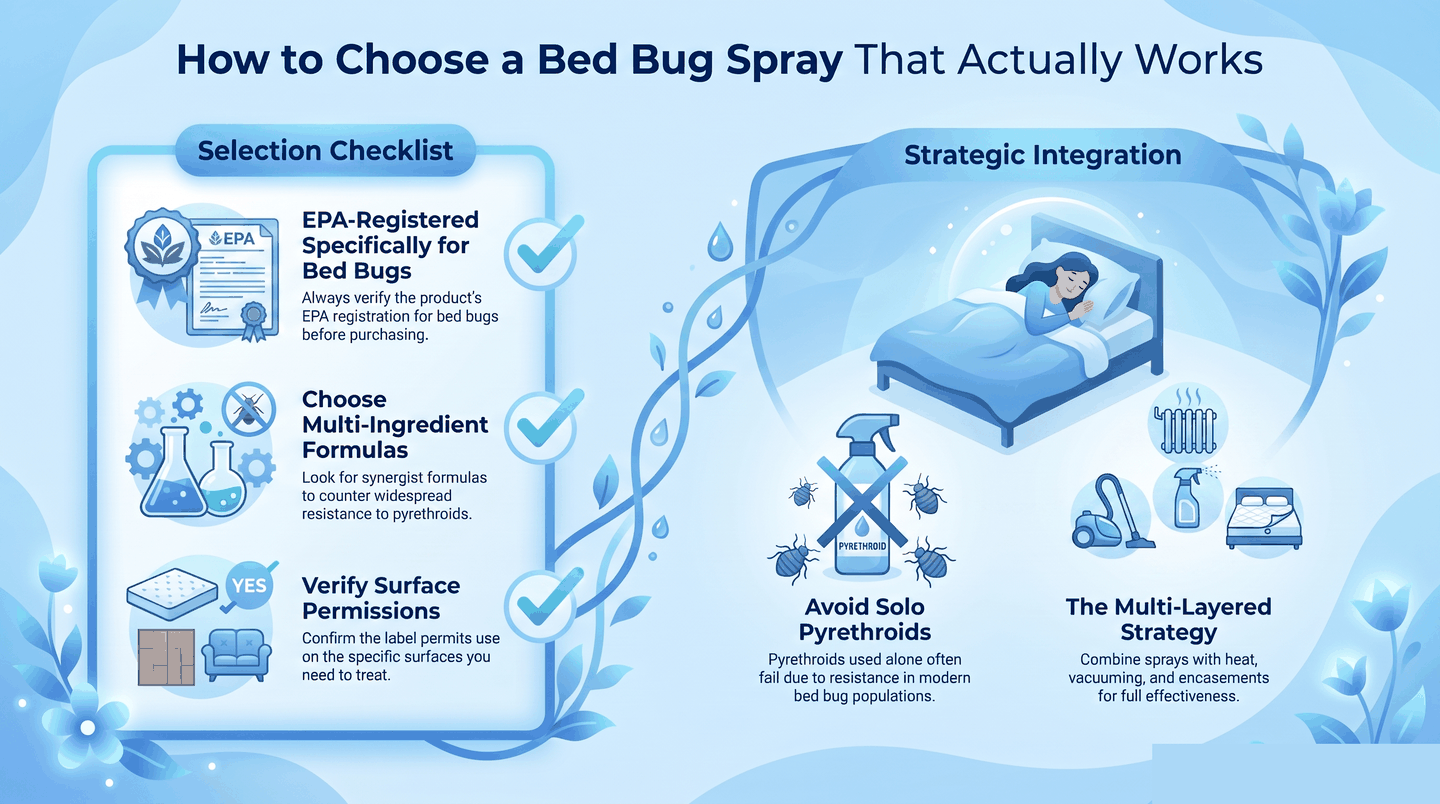
When comparing options, the practical questions are not "which brand is strongest" but: Is it EPA-registered for bed bugs? Does the label allow the surfaces you need to treat? And does it list more than a single pyrethroid, since resistance to that class is widespread? You can confirm any product against the EPA's searchable list, linked in the sources below.
Bed Bug Killer
A "bed bug killer" is any product — spray, dust, or aerosol — sold to kill bed bugs on contact. The honest truth is that no chemical killer reliably reaches every bug and egg, because they hide in cracks, seams, and wall voids the product never touches. That is the central limitation of all sprays.
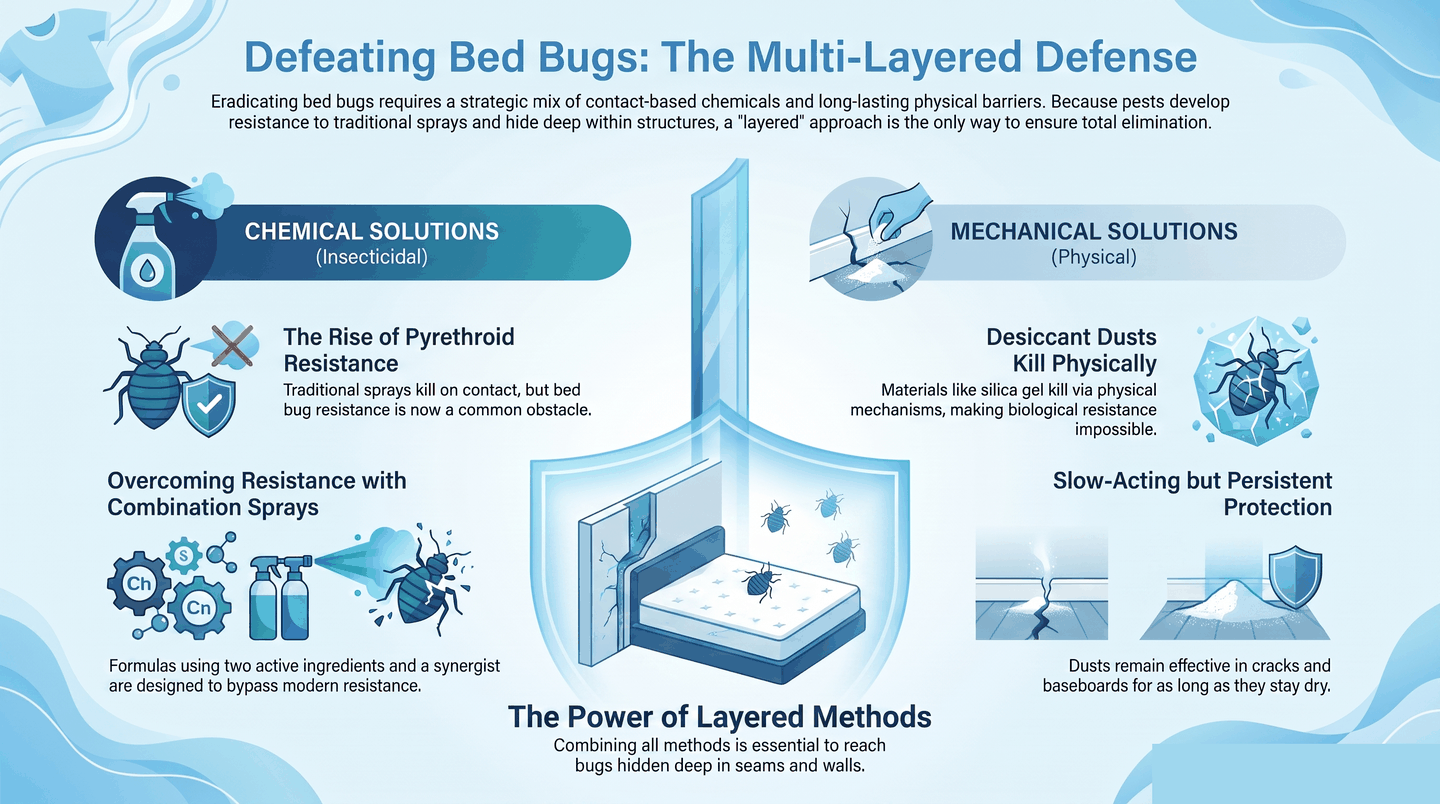
Effective bed bug killers fall into two broad types. Insecticidal killers use chemicals like pyrethroids; many bed bugs now survive these due to resistance. Mechanical killers, such as diatomaceous earth, work physically rather than chemically, so bugs cannot develop resistance to them. For the fastest-acting methods overall, see what kills bed bugs instantly.
Crossfire Bed Bug Spray
Crossfire bed bug spray is a concentrate built specifically around the resistance problem. It is a professional-grade product that combines more than one active ingredient (typically two insecticides plus a synergist) so that bugs resistant to one chemical may still be affected by another. That combination approach is why it is often mentioned for tough, resistant infestations.
Even so, Crossfire is still a contact-and-residual spray, which means it shares the same blind spot as every spray: it cannot reach bugs or eggs it never touches. It must be mixed and applied exactly as the label states. Many people use it as the chemical layer alongside heat and physical removal, not as a standalone cure.
Harris Bed Bug Killer
Harris bed bug killer is one of the most widely sold consumer lines, available as ready-to-use sprays and as powders. The liquid sprays are commonly built on a pyrethroid such as deltamethrin — the same chemical class that many bed bug populations have grown resistant to. That makes results unpredictable depending on the local bugs.
Harris also sells a diatomaceous-earth powder, which works mechanically and sidesteps the resistance issue entirely. If you use the spray, read the label for approved surfaces, expect to reapply, and pair it with vacuuming, laundering, and heat rather than relying on it alone.
Hot Shot Bed Bug Killer
Hot Shot bed bug killer is a familiar grocery- and hardware-store brand offering aerosol sprays and other home products. These are typically household pyrethroid formulations aimed at contact kill on surfaces you can reach. They can knock down bugs that are directly sprayed.
The brand also markets foggers — and this is important: the EPA states that total-release foggers (bug bombs) are largely ineffective against bed bugs and can even scatter them. Stick to the directed-spray products if you use this line, follow the label, and do not expect a fogger to solve an infestation.
Ortho Bed Bug Spray
Ortho bed bug spray is another mainstream consumer option, usually sold as a ready-to-use household insecticide based on pyrethroid-type ingredients. Like other store-shelf sprays, it can kill bugs on direct contact and may leave a short-lived residue on treated surfaces.
The same cautions apply: resistance can blunt its effect, and it will not reach the hidden eggs and bugs that drive an infestation. Use it only on labeled surfaces, exactly as directed, and treat it as a supporting tool within a broader plan that includes heat and encasements.
Bed Bug Spray at Walmart
Looking for bed bug spray at Walmart, or at any big-box or hardware store, mostly means choosing among the consumer brands above — Harris, Hot Shot, Ortho, and similar lines, plus diatomaceous-earth powders. Availability changes by store and season, and a product being on the shelf does not mean it will beat a resistant infestation.
Whatever the retailer, the buying checklist is the same: confirm it is EPA-registered for bed bugs, check that the label permits the surfaces you plan to treat, and remember that store-bought sprays are a starting layer — not a guaranteed fix. Severe or spreading infestations are often better handled by a bed bug exterminator.
Bed Bug Repellent
A bed bug repellent sounds appealing — something to keep them from biting or moving in — but repellents are unreliable against bed bugs. Unlike mosquito repellents, there is no proven spray that dependably keeps bed bugs away from you or your home, and leaning on one creates a false sense of safety.
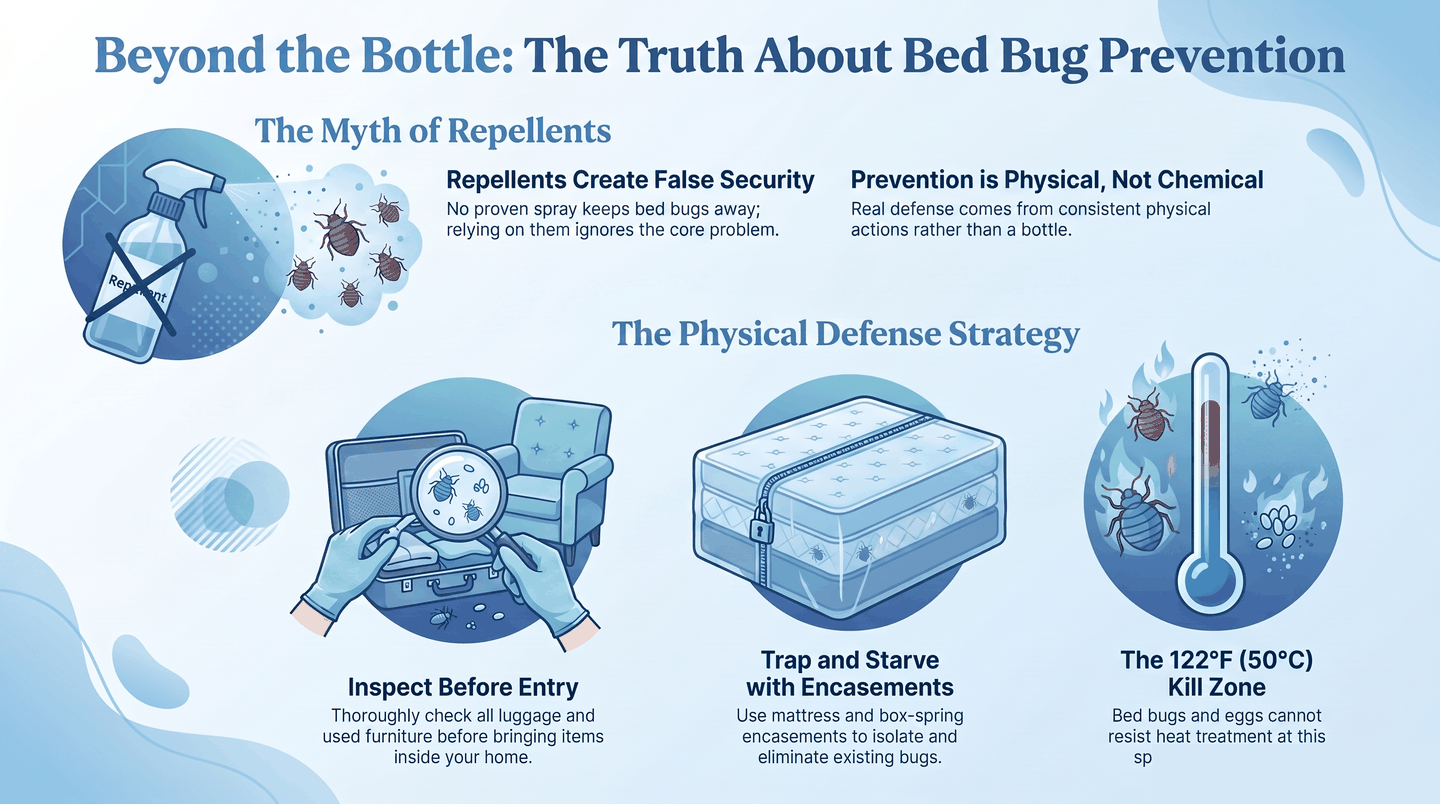
Real prevention is physical, not chemical: inspect luggage and used furniture before bringing them inside, use mattress and box-spring encasements to trap and starve any bugs, and treat suspect items with heat. Those steps prevent far more infestations than any repellent claim.
Bed Bug Powder
Bed bug powder usually means a desiccant dust — most often diatomaceous earth or a silica-based product. Instead of poisoning bugs, these powders kill mechanically: the fine particles damage the bug's protective outer layer so it dries out and dies. Because the action is physical, bed bugs cannot become resistant to it.
Powders are slow but persistent. Used in a thin layer in cracks, along baseboards, and in voids where bugs travel, they keep working as long as they stay dry. Choose a product labeled for bed bugs and indoor use, apply lightly (heavy piles repel bugs and are messy), and combine it with the other layers below. For more on this method, the EPA's do-it-yourself guidance in the sources covers safe dust use.
The biggest mistake is treating a spray as a one-step cure. These approaches routinely disappoint:
- Foggers and bug bombs — the EPA says they are largely ineffective for bed bugs and can scatter them
- Relying on a single pyrethroid spray when local bugs are resistant
- Spraying only the mattress surface while bugs and eggs survive in seams, frames, and walls
- Repellents — there is no proven spray that keeps bed bugs away
- Using a product not registered with the EPA, or ignoring its label directions
What does work is layering: an EPA-registered product used by the label, plus vacuuming, encasements, laundering on high heat, and — most reliably — sustained heat of 122°F (50°C), which kills bugs and eggs and cannot be resisted.
The Three-Layer Defense
No single spray ends an infestation, so think in layers. The chemical layer is an EPA-registered spray or dust, used strictly by the label. The physical layer is vacuuming, mattress and box-spring encasements, and decluttering to remove hiding spots. The heat layer is the dependable finisher: laundering on high heat and, for whole rooms, professional bed bug heat treatment at temperatures that kill every life stage.
- Chemical: spray or powder, EPA-registered, label-only
- Physical: vacuum, encasements, declutter
- Heat: high-heat laundry and 122°F (50°C) treatment for bugs and eggs
Frequently Asked Questions
Sources
- U.S. EPA — Should I use a fogger? (total-release foggers are largely ineffective against bed bugs and can scatter them).
- U.S. EPA — Find a bed bug pesticide product (use only EPA-registered products, applied exactly as labeled).
- U.S. EPA — Do-it-yourself bed bug control (combine methods; resistance is common; heat and desiccant dusts as non-chemical options).